

TL;DR:
- A business plan serves as a written roadmap that demonstrates your idea’s profitability and how to use investor capital effectively.
- Building a credible plan involves selecting the appropriate format, validating assumptions through research, and creating honest financial projections.
A business plan is a written roadmap that proves your idea can make money, shows who you’re selling to, and tells lenders or investors exactly how you’ll use their capital. The fastest credible path to a fundable version? Pick the right format, validate your core assumptions with real customers, and build honest financial projections before you write a single polished sentence.
TL;DR — every fundable plan needs these sections:
- Executive summary (the hook)
- Company overview and legal structure
- Products or services and value proposition
- Market analysis (TAM/SAM/SOM, competitors)
- Marketing and sales strategy
- Operations plan and milestones
- Management and team
- Financial projections (P&L, cash flow, balance sheet)
- Funding request
- Appendix
Companies that plan are measurably more likely to secure funding and grow faster than those that skip the process. A lean one-page plan takes a few hours. A traditional plan ready for a bank or VC usually runs 15–20 pages and takes days to weeks, depending on how much research you’ve already done.
Table of Contents
- What format should your business plan be?
- Why does writing a business plan actually matter?
- How to build a business plan, step by step
- How do you build credible financial projections?
- How do you size the market and validate demand?
- What does a realistic operations plan look like?
- How do you finish the plan and avoid the most common mistakes?
- Where can you find trusted US business plan templates?
- Key Takeaways
- The part most founders get backwards
- siift turns your plan from a static document into a validated strategy
- Useful sources
- FAQ
What format should your business plan be?
The SBA recognizes two primary formats: a traditional plan and a lean startup plan. Choosing the wrong one wastes time. Here’s how they compare:
| Dimension | Traditional Plan | Lean Startup Plan |
|---|---|---|
| Length | 15–20 pages | 1–2 pages |
| Primary audience | Banks, SBA lenders, VCs | Internal team, early co-founders, accelerators |
| Time to complete | Days to weeks | A few hours |
| Financial detail | Full 3–5 year projections | Key metrics and assumptions only |
| Best use case | Loan applications, Series A+ | Rapid validation, pivots, early ideation |
When to use each:
- Bank loan or SBA financing: — Go traditional. Lenders want detailed financials, collateral notes, and a clear repayment path.
The decision rule is simple: if someone is writing you a check, use the traditional format. If you’re still figuring out whether the idea holds water, start lean.
Why does writing a business plan actually matter?
Most founders treat the plan as a bureaucratic hurdle. That’s the wrong frame entirely.
Investors use a business plan as a proxy for management quality. A well-structured plan signals that you think clearly about market size, customer acquisition, and unit economics. A sloppy one signals the opposite, regardless of how good your product is.
From the founder’s side, the process of writing the plan forces you to surface assumptions you’d otherwise leave untested. What’s your customer acquisition cost? What’s your gross margin at scale? When do you break even? These aren’t questions you can hand-wave past when a banker or angel is sitting across from you.
“The act of writing the plan — researching market, costs, and channels — often delivers more value than the finished document because it forces founders to surface assumptions and risks.” — U.S. Small Business Administration
Concrete signals of a plan that’s working:
- A realistic break-even timeline tied to actual cost and revenue data
- Validated customer willingness to pay (from interviews or pre-sales, not surveys)
- A market size estimate built from real data sources, not a top-down guess
- Financial projections that match your operational assumptions
Think of the plan less as paperwork and more as a validation engine. The document is the output. The thinking is the product.
How to build a business plan, step by step
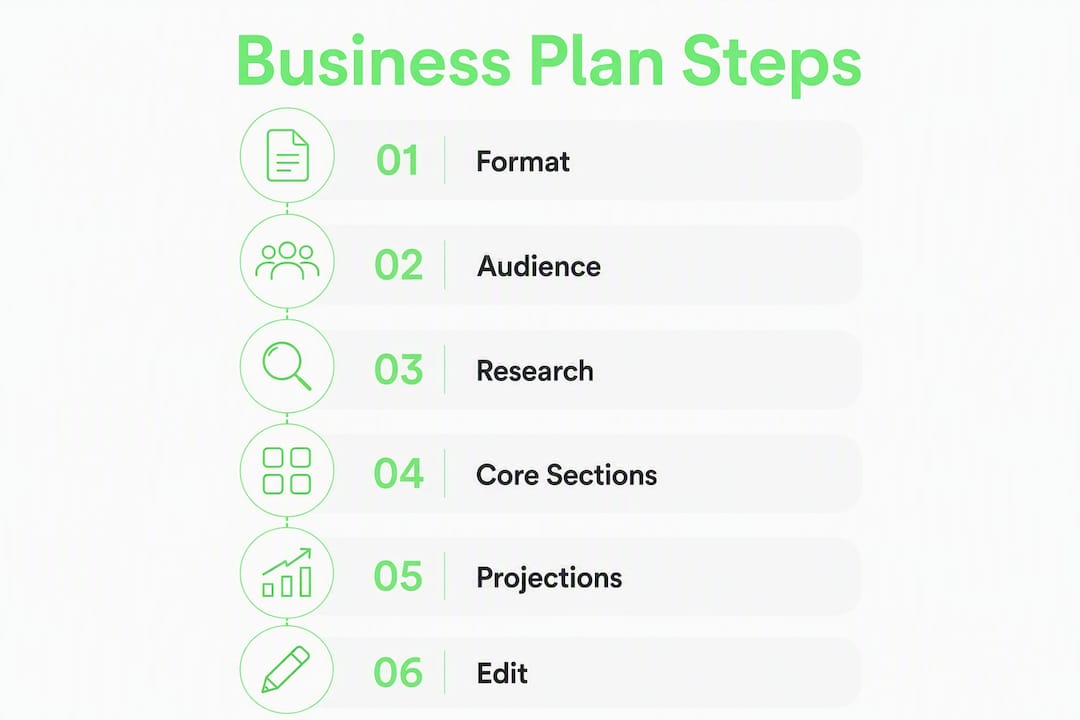
The workflow has five stages: pick your format, define your audience, research and validate, write the core sections, then edit and tailor. Here’s how to execute each one.
Step 1: Pick your format and define your audience
Decide upfront whether you’re writing for a lender, an investor, or internal use. That decision shapes every section’s depth. A bank wants collateral and repayment logic. An angel wants market size and team. Your co-founder wants clarity on priorities.
Step 2: Research and validate before you write
Don’t open a blank document yet. Run at least 10 customer interviews, pull market size data from the U.S. Census Bureau, and test your pricing assumptions with a simple landing page or pre-order. The research feeds every section; skipping it produces a plan full of guesses.

Step 3: Write the core sections
Follow this outline, in order:
- Executive summary — One page. Problem, solution, traction, market size, team, and ask. Write this last, even though it appears first.
- Company overview — Legal structure (LLC, C-Corp, sole proprietor), founding date, location, and mission in two to three sentences.
- Products or services — What you sell, your value proposition, and your pricing model. Include IP or proprietary advantages if you have them.
- Market analysis — TAM, SAM, SOM with sourced data. Competitive positioning using generic category comparisons.
- Marketing and sales strategy — Channels, CAC assumptions, conversion funnel, and retention approach.
- Operations plan — Key activities, suppliers, facilities, and a 12-month milestone timeline.
- Management and organization — Team bios, roles, and any gaps you plan to fill with hires or advisors.
- Financial projections — P&L, cash flow statement, and balance sheet. Monthly detail for year 1; annual for years 2–5.
- Funding request — Amount, use of funds, preferred instrument, and repayment or exit assumptions.
- Appendix — Resumes, permits, legal documents, detailed datasets. Keep the main plan clean.
Pro Tip: Write the executive summary last. Once every other section is drafted, you’ll know exactly what to highlight — and you’ll avoid the trap of writing a summary that doesn’t match the plan.
Step 4: Build your projections
Monthly cash flow for year 1 is non-negotiable. Annual projections for years 2–5 can be broader, but they must connect logically to year 1 actuals or assumptions. Every number needs a source or a stated assumption.

Step 5: Edit and tailor
Cut anything that doesn’t directly support your ask. A practical business plan runs 15–20 pages; if yours is much longer, move the excess to the appendix. Then tailor the language: banks want conservative projections and clear collateral; angels want a big market and a credible team; VCs want a scalable model and a defensible moat.
Checklist before you send:
- Executive summary fits on one page
- All financial figures tie back to stated assumptions
- Market size is sourced, not estimated from thin air
- Team section addresses obvious gaps honestly
- Appendix holds supporting documents, not core content
How do you build credible financial projections?
Projections are where most plans lose credibility. The fix isn’t more complexity — it’s more honesty.
Minimum financial statements to include:
- Projected profit and loss (P&L)
- Cash flow statement
- Balance sheet
Financial projections should be specific for year 1 (monthly or quarterly) and broader for years 2–5, always tied to stated assumptions and market research.
Sample projection assumptions table
| Driver | Example assumption | Data source |
|---|---|---|
| Average selling price | — | Pricing test / competitor benchmarks |
| Monthly unit volume (Y1) | — | Customer interviews + pilot data |
| Gross margin | — | COGS breakdown |
| Customer acquisition cost | — | Paid channel tests |
| Monthly churn (SaaS) | — | Industry benchmarks |
| Fixed monthly overhead | — | Lease + payroll estimates |
How to structure the funding request
A funding request should detail capital needs across several years, explain how funds will be used, and include projections that show a path to profitability. Specifically, cover:
- Total amount requested and the time period it covers
- Use of funds broken into categories (product development, marketing, hiring, working capital)
- Preferred instrument — debt, equity, convertible note, or SAFE
- Repayment or exit assumptions — when and how the investor gets their money back
Run at least two scenarios: a base case and a conservative case. Showing downside planning tells lenders you’ve thought past the optimistic version.
Pro Tip: Sanity-check your projections against industry benchmarks. If your gross margin is 80% in a sector where 40% is typical, investors will ask why. Have the answer ready, or revise the number.
Red flags investors watch for:
- Burn rate that outpaces revenue growth with no clear inflection point
- Runway under 12 months with no follow-on funding plan
- Growth multiples that require capturing an unrealistic market share in year 2
- CAC that exceeds lifetime customer value
How do you size the market and validate demand?
SCORE mentors consistently flag insufficient market validation as a leading cause of failed launches. Skipping this step doesn’t just weaken your plan — it means you might be building something nobody wants.
Sizing the market: TAM, SAM, SOM
- TAM (Total Addressable Market): — The full global or national demand for your category. Use Census Bureau data and industry reports.
Worked example: A meal-prep delivery service in Austin, Texas. TAM = U.S. meal kit market. SAM = Austin metro households with income above $75K who cook at home. SOM = 0.5% of SAM in year 1, based on planned marketing spend and channel capacity.
Customer validation checklist
- Run at least 10 structured interviews with your target customer before writing the market section.
- Ask about current behavior, not hypothetical intent (“What do you do today?” beats “Would you buy this?”).
- Test willingness to pay with a real ask — a pre-order page, a deposit, or a paid pilot.
- Document objections; they belong in your risk section, not hidden in a drawer.
- Use secondary research (industry reports, Census data, Federal Reserve consumer data) to corroborate primary findings.
Competitor positioning matrix
| Category | Strengths | Weaknesses | Your differentiation |
|---|---|---|---|
| Established incumbents | Brand, distribution | Slow to adapt, high price | Speed, niche focus |
| Low-cost alternatives | Price | Limited features, no support | Quality, service |
| DIY solutions | Free | Time-intensive, inconsistent | Convenience, reliability |
Use generic categories like these rather than naming specific companies. It keeps the plan focused on your positioning, not on theirs.
What does a realistic operations plan look like?
Strategy without execution is fiction. The operations section turns your plan into a schedule with owners and costs attached.
12-month milestone table (sample)
| Month | Milestone | Owner | Estimated cost |
|---|---|---|---|
| 1–2 | Complete customer discovery (10+ interviews) | Founder | $0–$500 |
| 2–3 | Build and test MVP or prototype | Product lead | $2,000–$3,000 |
| 3–4 | Run paid channel test (Google/Meta) | Marketing | $1,000–$3,000 |
| 4–6 | Close first 10 paying customers | Sales/Founder | $500–$2,000 |
| 6–9 | Hire first operational role | Founder | $40,000 annualized |
| 9–12 | Prepare seed round materials | Founder + advisors | $1,000–$3,000 |
Prioritization rule: If time and capital are limited, prove demand and unit economics first. Everything else — branding, hiring, office space — can wait. A plan that shows 10 paying customers and a positive contribution margin is worth more to an investor than 50 polished slides.
Pro Tip: Align your operational milestones to your funding milestones. If you’re targeting a seed round at month 9, work backward: what proof points do you need by month 6? Build the milestone table around those gates, not around a generic launch checklist.
Budget ranges for common plan-creation costs:
- Market research tools (SurveyMonkey, Statista): $0–$500/month
- Professional financial modeling help: $500–$3,000 one-time
- Legal review of plan and structure: $500–$2,000
- Design and formatting: $200–$1,000
How do you finish the plan and avoid the most common mistakes?
The executive summary is the most-read section and the most commonly botched one. Write it last, keep it to one page, and cover these five elements in order:
- The problem — one sentence on the pain your customer has today
- Your solution — what you offer and why it’s better
- Traction — any early customers, revenue, or pilots
- Market opportunity — your SOM figure with a source
- The ask — how much you need and what you’ll do with it
Formatting checklist
- Main plan: 15–20 pages, plain language, no jargon
- Appendix: resumes, permits, detailed financial models, legal docs
- Font: 11–12pt, readable serif or sans-serif
- No color-coded charts that don’t print cleanly in black and white
Common mistakes and quick fixes
Inflated projections: If your model shows 300% growth in year 2 with no explanation, investors will discount everything else. Fix: tie every growth assumption to a specific driver (new channel, new hire, new market).
Vague market analysis: “The market is worth $50 billion” with no source or segmentation is a red flag. Fix: show TAM, SAM, and SOM with named data sources.
Weak team section: Listing titles without explaining why this team can execute this specific plan. Fix: connect each person’s background directly to a key risk in the business.
Missing risk section: Plans that ignore risk look naive. Fix: name your top three risks and your mitigation approach for each.
Pro Tip: For investor meetings, prepare a one-page executive summary as a leave-behind and a separate 10–12 slide deck. The full plan answers due diligence questions — it rarely gets read cover-to-cover in a first meeting.
Where can you find trusted US business plan templates?
Templates save time, but only if you customize them. A generic template with your company name swapped in fools nobody.
Authoritative US templates:
- SBA business plan guide: The gold standard for traditional plans. Covers all standard sections with guidance notes. Best for bank loans and SBA-backed financing.
- SCORE startup template: Step-by-step worksheets with fillable exercises for market research and financials. Backed by SCORE mentors who can review your draft for free. Best for first-time founders who want structured guidance.
- Bank of America small business plan guide: Practical, lender-focused guidance with page-length targets and projection examples. Best for founders preparing a loan application.
| Template | Best for | Key strength |
|---|---|---|
| SBA guide | Bank loans, SBA financing | Comprehensive, lender-trusted |
| SCORE template | First-time founders | Mentor-backed, fillable worksheets |
| Bank of America guide | Loan applications | Lender perspective, projection format |
How to adapt a template quickly: Fill in the financial section first — it forces you to validate your assumptions before you write narrative. Keep the appendix for anything over two pages (resumes, legal docs, full datasets). For an early investor conversation, a lean one-pager built from the executive summary section of any of these templates is enough to open the door.
Key Takeaways
A fundable business plan proves demand, shows realistic financials, and signals that the founding team can execute — everything else is supporting detail.
| Point | Details |
|---|---|
| Choose the right format | Use a traditional 15–20 page plan for lenders and investors; a lean plan for early validation. |
| Validate before you write | Run at least 10 customer interviews and test willingness to pay before drafting projections. |
| Build honest financials | Monthly projections for year 1, annual for years 2–5, with every assumption stated and sourced. |
| Treat it as a living document | Update the plan quarterly or annually and compare actuals against original projections. |
| siift accelerates the process | siift’s Agentic AI platform guides founders through validation, go-to-market planning, and investor-ready outputs faster than static templates. |
The part most founders get backwards
There’s a tendency among first-time founders to spend weeks polishing the narrative and almost no time stress-testing the numbers. The plan reads beautifully. The projections are a fantasy.
Investors read a plan to evaluate founder judgment, and nothing reveals judgment faster than financial assumptions. A founder who presents a conservative base case with clearly stated drivers — and a downside scenario that still shows a path to break-even — signals discipline. A founder who projects 10x revenue in year 2 “based on market trends” signals wishful thinking.
My prioritization rule for founders with limited time: prove demand first, then unit economics, then growth. In that order, always. Before you spend a single hour on brand identity or pitch deck design, answer three questions: Will someone pay for this? What does it cost to acquire that customer? Does the margin cover the cost? If you can answer all three with real data, you have the foundation of a credible plan.
The inexpensive validation activities that give the highest signal-to-noise ratio are also the simplest: structured customer interviews (free), a pre-order landing page ($0–$50/month with tools like Carrd or Webflow), and a basic paid channel test ($500–$1,000 on Google or Meta). These three activities, done before you write a word of the plan, will make every section sharper and every projection more defensible.
One more thing: treat the plan as a living document, not a one-time deliverable. The founders who get the most value from planning are the ones who revisit it quarterly, compare actuals to projections, and update assumptions as the market teaches them things. The plan you write today is a hypothesis. The plan you revise in six months is evidence.
siift turns your plan from a static document into a validated strategy
Static templates give you structure. What they don’t give you is a way to test whether your assumptions are grounded in reality before you walk into a bank or pitch a room full of angels.
siift’s Agentic AI platform guides founders through ideation, validation, and go-to-market planning in a single, systematic workflow. Where a template hands you blank fields, siift asks the right questions, surfaces blind spots, and helps you build projection assumptions tied to real market signals rather than optimistic guesses.
It’s particularly useful when you’re preparing investor-ready outputs under time pressure: validating your idea quickly, aligning your GTM assumptions to your financial model, or pressure-testing your funding request before a lender sees it.
If you’re ready to move from a blank page to a fundable strategy, start your go-to-market plan with siift or validate your startup idea before you write a single projection.
Useful sources
These are the authoritative US resources to use while writing your plan:
- SBA: Plan your business — The primary federal resource for business plan structure, templates, and lender expectations. Start here for any loan-related plan.
- SCORE: Startup business plan template — Free, mentor-backed template with fillable worksheets. Pair it with a free SCORE mentoring session for personalized feedback.
- Bank of America: How to write an effective business plan — Lender-perspective guidance on page length, projection format, and what banks actually read.
- Investopedia: Business plan guide — Solid reference for investor expectations, plan components, and the research on planning and growth outcomes.
- U.S. Census Bureau: Business Builder — Free tool for pulling local market size data, demographic breakdowns, and industry benchmarks to support your market analysis section.
Store detailed datasets, full financial models, and legal documents in your appendix. Keep the main plan to 15–20 pages so the reader stays focused on your argument, not your supporting evidence.
FAQ
How do I create my own business plan from scratch?
Start with the SBA’s free business plan guide, pick the traditional or lean format based on your funding needs, then write the sections in this order: market research first, financials second, executive summary last.
What are the 7 parts of a business plan?
Most traditional plans include an executive summary, company overview, products or services, market analysis, marketing and sales strategy, operations plan, and financial projections. A funding request and appendix are added when you’re seeking capital.
What are the 7 steps to writing a business plan?
Pick your format, define your audience, research your market and validate demand, write the core sections, build financial projections, edit and tailor the plan to your reader, then review it against real performance on a regular cadence.
How long does it take to write a business plan?
A lean one-page plan takes a few hours. A traditional 15–20 page plan ready for a lender or investor typically takes days to weeks, depending on how much market research and financial modeling you’ve already completed.
How do I validate the assumptions in my financial projections?
Run structured customer interviews, test pricing with a pre-order page or paid pilot, and cross-reference your cost and margin assumptions against industry benchmarks from sources like the Census Bureau or Federal Reserve consumer data. Every projection driver should trace back to a real data point or a stated, testable assumption.