

TL;DR:
Legal protection for ideas covers expression, inventions, and confidential information, not the raw concept itself.
Using specific NDAs, trade secrets, and signed IP agreements helps founders safeguard their business innovations effectively.
Protecting a business idea means safeguarding how it’s expressed, executed, or kept confidential. The raw idea itself gets no direct legal protection. Under current patent eligibility standards, abstract concepts cannot be patented; only concrete, nonobvious inventions qualify. That distinction matters enormously for founders. The good news is that practical tools like non-disclosure agreements (NDAs), trade secrets, copyrights, trademarks, and IP assignment agreements give you real, enforceable protection. You just need to know which tool fits which situation.
What legal methods exist to protect a business idea?
The law protects expression, execution, and confidentiality. It does not protect the idea floating in your head. Once you understand that, the right tools become obvious.
Patents cover concrete inventions, not concepts. A patent requires a new, nonobvious invention with a specific implementation. If you have a novel process or product, a utility patent is worth pursuing. If you just have a concept for a marketplace app, a patent won’t help you yet.
Copyrights protect original expression the moment you create it. Your written business plan, your code, your pitch deck design. Copyright does not protect the underlying idea those documents describe. It protects the specific words and visuals you used to describe it.
Trademarks protect your brand identity: your name, logo, and slogan. They signal origin to customers and block competitors from copying your brand. Trademarks do not protect your business model or concept.
Trade secrets are the most underrated tool for early-stage founders. A trade secret is any confidential business information that gives you a competitive edge, from a proprietary algorithm to a customer acquisition formula. Trade secrets include confidential business plans and algorithms and remain protected as long as you actively guard them.
NDAs are contracts that legally bind another party to keep your information confidential. They are your first line of defense before any other protection is in place.
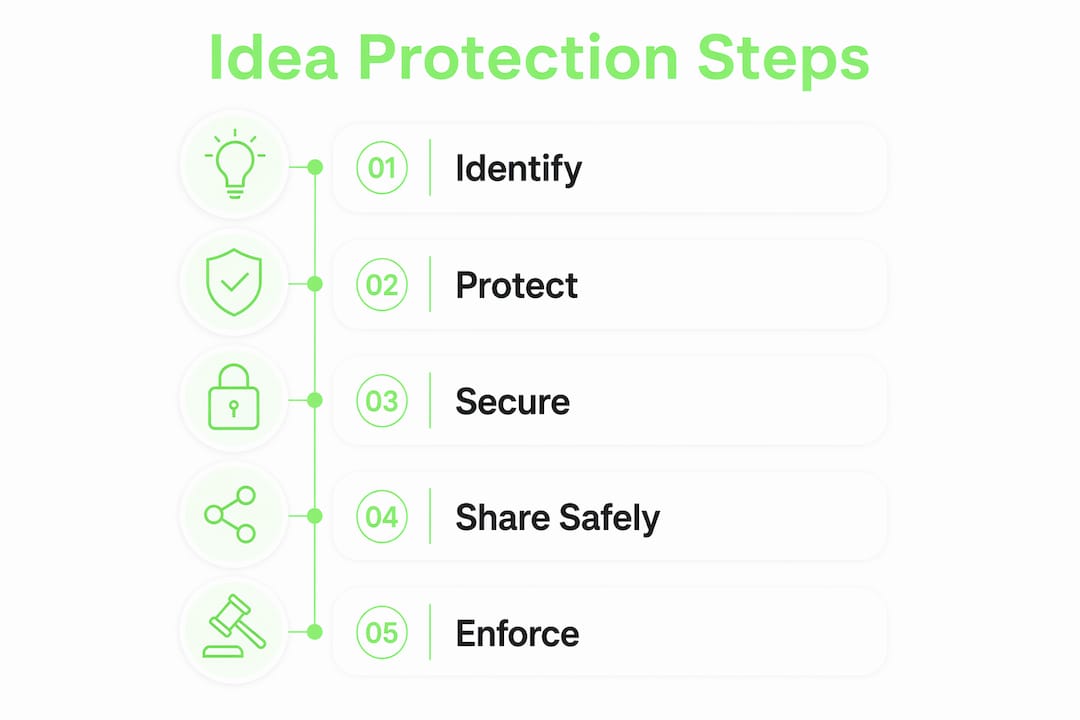
Here is a quick reference for when each tool applies:
Protection type | What it covers | Best used when |
|---|---|---|
Patent | Novel inventions and processes | You have a concrete, working invention |
Copyright | Written plans, code, designs | You have created original documents or software |
Trademark | Brand name, logo, slogan | You are building a recognizable brand |
Trade secret | Formulas, plans, algorithms | You need ongoing confidentiality without disclosure |
NDA | Disclosed confidential information | You are sharing details with third parties |
Pro Tip: File for copyright the moment you create a written business plan or pitch deck. It costs very little and gives you a dated, legal record of your expression.
How do NDAs actually protect your idea?
An NDA is a contract that restricts what another party can do with information you share. Detailed NDAs reduce risk when sharing with outsiders, investors, or developers. A vague NDA, though, is nearly worthless in court.
A well-drafted NDA covers five things clearly:
The parties involved. Name every individual and entity receiving the information. Generic “recipient” language creates loopholes.
The protected information. Describe the confidential information specifically. “Business concept related to on-demand logistics software” is better than “business ideas.”
The permitted use. State exactly why the recipient needs the information and what they are allowed to do with it.
The duration. Specify how long the confidentiality obligation lasts. Two to five years is standard for most startup contexts.
The remedies. Include injunctive relief as a remedy. This lets you seek a court order to stop a breach immediately, not just sue for damages after the fact.
Common NDA mistakes founders make include sending a template without customizing it, signing mutual NDAs when only one party is disclosing, and forgetting to include a governing law clause. Each of these weakens your position if you ever need to enforce it.
Pro Tip: Send the NDA before the meeting, not during it. Asking someone to sign on the spot creates pressure and often leads to pushback. Sending it a day ahead frames it as standard practice.
Enforcement also depends on specificity in your disclosures. The more precisely you describe what you are sharing, the easier it is to prove a breach occurred. Vague ideas are hard to protect even with a signed NDA.
Why trade secrets are a founder’s most flexible protection
Trade secrets protect confidential business information without requiring public disclosure. That is the key advantage over patents, which require you to publish your invention in exchange for protection. A trade secret can last indefinitely, as long as you keep it secret.
To qualify as a trade secret, information must meet three criteria:
It must be genuinely confidential, not publicly known.
It must provide a competitive advantage because of its secrecy.
You must take reasonable steps to protect it.
That third point is where most founders fail. Intellectual property attorneys consistently recommend NDAs and trade secret classifications as primary tools, but those tools only work if you back them with real operating controls.
“A firm with an impressive written policy may still fail without proper implementation and training.” Policies on paper mean nothing without the daily habits and access controls that enforce them.
Practical steps to maintain trade secret status include limiting access to confidential files on a need-to-know basis, using password protection and access logs for digital documents, marking all sensitive documents as “Confidential,” and requiring NDAs from every contractor, employee, and advisor who touches the information.
Businesses that conduct regular risk assessments experience fewer operational and financial disruptions than those that do not. Applying that same discipline to your IP controls dramatically reduces the chance of losing trade secret status through negligence.
Strong protection also requires layered controls: prevention, detection, escalation, record-keeping, and governance working together. No single measure is enough on its own.
How to secure ownership of what you build
Paying someone to build something does not automatically make you the owner. This surprises a lot of founders, but it is one of the most common and costly mistakes in early-stage startups.
Many founders wrongly assume that paying a contractor transfers ownership without a written IP assignment clause. Without a signed IP assignment agreement, the contractor may legally own the code, design, or content they created for you. That is a serious problem when you go to raise funding or sell the company.
Key steps to lock down ownership:
Sign IP assignment agreements before work begins. Every contractor, freelancer, and co-founder should sign one. Not after the project. Before.
Include assignment language in employment contracts. Any work created by employees within the scope of their role should automatically assign to the company.
Keep detailed development records. Dated emails, version histories, and project management logs all serve as evidence of what was created, when, and by whom.
Document your own contributions. Founders often forget to record their own ideation and development work. A dated journal or version-controlled repository creates a clear timeline.
The legal protection for content and IP follows whoever holds the written assignment. If that document does not exist, ownership becomes a dispute. Disputes cost time, money, and sometimes the company itself.
How to share your idea without giving it away
Sharing is unavoidable. You need investors, advisors, and developers to believe in your concept. The goal is not to hide everything. The goal is to control what you share, with whom, and when.
A staged disclosure approach works best:
Start with the problem, not the solution. In early conversations, describe the market gap you are solving. This builds interest without exposing your method.
Get the NDA signed before the solution reveal. Once someone is genuinely interested, introduce the NDA as a standard step before you go deeper.
Share implementation details only on a need-to-know basis. A potential investor does not need your full technical architecture in a first meeting. A developer does. Calibrate accordingly.
Follow up in writing. After every significant conversation, send a brief email summarizing what was discussed. This creates a paper trail and signals that you take confidentiality seriously.
Building a reputation for professionalism and discretion also matters. Partners and investors who see you handle your own IP carefully are more likely to respect it. Trust is built through consistent behavior, not just contracts.
Key Takeaways
Protecting a business idea requires combining legal tools, written contracts, and disciplined operating habits. No single method is sufficient on its own.
Point | Details |
|---|---|
Ideas alone are not protected | Only expressions, inventions, and confidential information qualify for legal protection. |
NDAs must be specific | Vague NDAs are hard to enforce; name the parties, the information, and the remedies clearly. |
Trade secrets require active guarding | Losing confidentiality means losing trade secret status, so implement real access controls. |
IP assignment agreements are non-negotiable | Always get signed agreements before contractors or partners create anything for you. |
Staged disclosure reduces risk | Share the problem first, then the solution, and only after an NDA is in place. |
What most founders get wrong about protecting their ideas
Here is something I have seen repeatedly: founders spend weeks perfecting their pitch deck and zero time on the legal scaffolding around it. They walk into investor meetings with a beautifully designed presentation and no NDA, no IP assignment agreements with their developer, and no documentation of when the idea originated. Then they are shocked when something goes sideways.
The uncomfortable truth is that most idea theft does not look like a dramatic heist. It looks like a contractor who built your MVP and technically owns the code. It looks like a co-founder who left and claims ownership of the original concept. It looks like an advisor who took your methodology and used it elsewhere because nothing was in writing.
The risk management habits that protect a startup are the same ones that protect an idea. Document everything. Sign before you share. Build the paper trail from day one, not after something goes wrong.
My honest advice: do not treat legal protection as a one-time checkbox. Treat it as an ongoing operating discipline. Review your NDAs annually. Update your IP assignment agreements when your team changes. Run a quick access audit on your confidential files every quarter. These habits take an hour a month and can save your company.
No method is foolproof. But founders who combine specific NDAs, active trade secret controls, and solid IP assignment agreements are in a dramatically stronger position than those who rely on trust alone. Be smart, be specific, and be proactive. The founders who protect their ideas well are the ones who build companies worth protecting.
— Samim
Siift helps you build a business worth protecting
Protecting your idea is only half the equation. The other half is building something so well-validated that execution becomes your real moat. Siift’s New Business OS guides founders step by step through ideation, validation, and go-to-market planning, so you are not just protecting a concept. You are building a defensible business. When you de-risk your startup idea with a structured strategy, you reduce the chances that a competitor can replicate your results even if they copy your concept. Siift helps you move faster and smarter than generic AI tools, giving you the clarity and confidence to share your idea on your own terms. Start building with Siift and turn your protected idea into a real business.
FAQ
Can you legally protect a raw business idea?
No. Raw, abstract business ideas cannot be patented or copyrighted. Legal protection applies to concrete inventions, original expressions, confidential information, and brand identity.
What is the fastest way to protect an idea before sharing it?
An NDA is the fastest protection available. Have the other party sign a specific, well-drafted NDA before you disclose any details about your concept or methodology.
Do I own the work a contractor builds for me?
Not automatically. Without a signed IP assignment agreement, contractors may retain ownership of what they create. Always get a written assignment clause before work begins.
How long does a trade secret last?
A trade secret lasts indefinitely, as long as you actively maintain its confidentiality. The moment the information becomes publicly known or you stop protecting it, the trade secret status is lost.
What is the difference between an NDA and an IP assignment agreement?
An NDA restricts what someone can do with information you share. An IP assignment agreement transfers ownership of created work to you. Founders need both, not one or the other.