
TL;DR:
- Millennials and recent grads have marketable skills that AI can help monetize quickly.
- Focus on validated demand, niche positioning, and human oversight rather than just automation.
- Starting small with essential AI tools and validating offers before scaling leads to success.
You already have skills that someone will pay for today. The frustrating part is that most millennial professionals and recent grads sit on a goldmine of marketable abilities, from writing and design to data analysis and social media strategy, without a clear path to turning those abilities into real income. That gap is closing fast. AI tools are now acting as a genuine catalyst, compressing what used to take months of setup into days of focused action. This guide walks you through exactly how to identify your most sellable skills, pick the right AI tools, build a simple workflow, and avoid the mistakes that trip up most first-time solopreneurs.
Table of Contents
- Assessing your skills and identifying marketable services
- Essential AI tools and resources to launch your side hustle
- Step-by-step: Monetizing your skills with a simple AI-powered workflow
- Pitfalls, risk management, and leveling up your AI-powered business
- A smarter path: What most guides miss about monetizing your skills
- Ready to launch your AI-powered side business?
- Frequently asked questions
Key Takeaways
| Point | Details |
|---|---|
| AI accelerates monetization | Using AI tools helps you launch and scale a side business faster than ever before. |
| Low-barrier entry | Freelancing, content creation, and digital services are easy ways to test monetizing your skills with AI. |
| Human value matters | Combining your expertise and human touch with AI is essential for standing out and earning more. |
| Start lean, scale smart | Use free tools and validate ideas before investing heavily—then automate and expand. |
Assessing your skills and identifying marketable services
Before you touch a single AI tool, you need an honest inventory of what you actually know how to do. Grab a blank document and list every skill you use at work, in hobbies, or for friends who keep asking for your help. Then rate each one on two dimensions: how good you are at it, and how much people are already paying for it online.
Some skills have obvious market demand right now. Here are categories that consistently convert for millennials and recent grads:
- Writing and editing: Blog posts, email sequences, product descriptions, and LinkedIn content
- Design: Social media graphics, pitch decks, brand kits, and print-on-demand assets
- Data and spreadsheets: Financial modeling, dashboard building, and process documentation
- Video and audio: Short-form video editing, podcast production, and YouTube scripting
- Marketing and growth: SEO audits, paid ad management, and email list strategy
- Education and coaching: Online courses, tutoring, and career coaching
The real shift in 2026 is that AI enhances side hustles by automating brainstorming, content drafting, research, and image generation, which means you can deliver more output in less time. A writer who once produced three blog posts a week can now produce eight. A designer who spent hours on mockups can generate polished concepts in minutes. Your skill becomes the quality filter and the strategic brain. AI is the engine.
Once you have your list, cross-reference it with freelance platforms like Upwork, Fiverr, and Contra. Look at what services are actively being purchased, not just what is listed. Pay attention to reviews, pricing tiers, and repeat buyers. That is real market validation, and it takes about 30 minutes.
Explore AI side hustle ideas that match your existing strengths before you try to learn something brand new. The fastest path to your first dollar is through what you already know.
Pro Tip: Use ChatGPT or Claude to brainstorm 20 service offerings based on your skill list. Then ask it to rank them by market demand and ease of delivery. You will surface ideas you would never have thought of alone, in under 10 minutes.
Essential AI tools and resources to launch your side hustle
Once you have a shortlist of monetizable skills, you will need the right AI tools to accelerate your launch. The good news is that most of the best tools have generous free tiers, so startup costs can be close to zero.
| Tool | Primary use | Free tier available |
|---|---|---|
| ChatGPT | Writing, research, ideation | Yes (GPT-4o limited) |
| Canva AI | Design, social media graphics | Yes |
| FormulaBot | Spreadsheet automation | Yes (limited) |
| ElevenLabs | AI voiceovers, audio content | Yes (limited credits) |
| Descript | Video editing, transcription | Yes |
| Notion AI | Project management, docs | Yes (with Notion plan) |
| Midjourney | Image generation | Paid only |
Practical AI side hustles include AI content creation, print-on-demand designs, YouTube automation, freelance writing with AI drafts, and workflow automation. Each of these maps directly to one or more tools in the table above.
Here is the critical mistake most beginners make: they install 12 tools in week one and end up paralyzed. Start with two. One for content or design, and one for research or writing. Master those before adding anything else.
Must-have tools by hustle type:
- Content creator or writer: ChatGPT plus Grammarly
- Graphic designer: Canva AI plus Adobe Firefly
- Video editor: Descript plus CapCut
- Data or operations freelancer: FormulaBot plus Notion AI
- Course creator or coach: ChatGPT plus Loom
For a broader look at what is working right now, the AI tools for entrepreneurs breakdown on siift.ai is one of the most practical resources we have seen. And if you want a current comparison of platforms, the best AI tools 2026 guide covers pricing, use cases, and integration options in detail.
The goal is frictionless execution. Every tool you add should save you more time than it costs you to learn it.
Step-by-step: Monetizing your skills with a simple AI-powered workflow
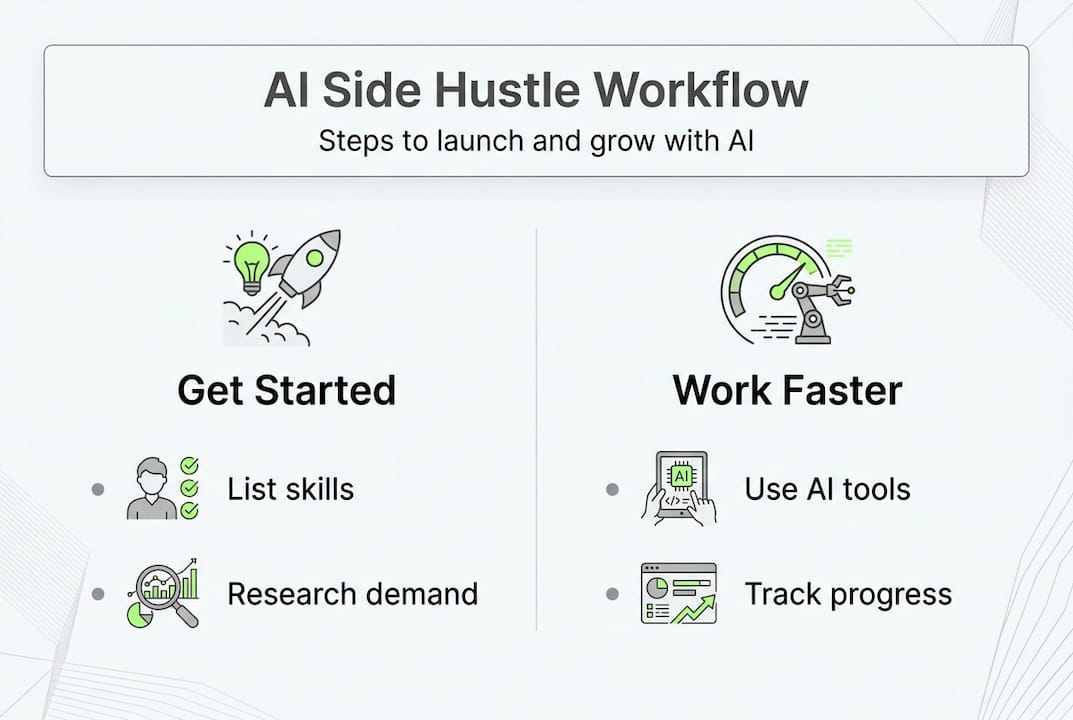
With your toolkit ready, it is time to put it into action. Here is exactly how to go from zero to your first paying customer.
- Define your offer clearly. Write one sentence: who you help, what you do for them, and what result they get. Use ChatGPT to sharpen the language until it is crisp and specific.
- Validate before you build. Post your offer in three relevant communities, a Reddit thread, a Facebook group, a LinkedIn post. Ask if anyone wants it before you create a full service package.
- Set your price and payment method. Use Stripe or PayPal for fast setup. Price based on value delivered, not hours spent.
- Promote with AI-assisted outreach. Draft personalized cold emails or DMs using ChatGPT templates. Aim for 20 outreach messages per day in your first two weeks.
- Deliver with AI-augmented quality. Use your tools to produce faster, then apply your human judgment to edit, refine, and personalize every deliverable.
- Collect payment and ask for a testimonial. That first review is worth more than the money. It opens the door to referrals.
| Factor | Classic freelancing | AI-augmented hustle |
|---|---|---|
| Time to first draft | 4 to 8 hours | 30 to 60 minutes |
| Client capacity | 2 to 3 per month | 8 to 12 per month |
| Startup cost | Low to moderate | Near zero |
| Output quality ceiling | High (skill-limited) | High (judgment-limited) |
The earning data is worth knowing clearly. 41% of side hustlers earn under $5,000 per year, while 32% reach under $20,000. But 7 to 8% break $100,000, and specialized AI trainers are earning $200 per hour. One solo operator built an AI tools business to $310,000 in annual recurring revenue. The ceiling is real.
For a deeper walkthrough, the step-by-step AI entrepreneurship guide on siift.ai covers the full founder journey. And if you want to know how to get early customers with AI, that resource is worth bookmarking right now.
Pro Tip: Build a simple Notion dashboard to track every outreach message, follow-up, and client status. It takes 20 minutes to set up and saves you hours of confusion once you have five or more active conversations running.
Pitfalls, risk management, and leveling up your AI-powered business
Having begun execution, let’s make sure you avoid the hidden traps that quietly kill most early side hustles.
“AI is a powerful accelerant, but it is not a business. You still need to sell, market, and deliver something people genuinely want. The founders who treat AI as a shortcut to skipping those fundamentals are the ones who stall out at month three.”
That reality check matters. AI needs human oversight for errors and hallucinations, it is not a full business substitute, and IP issues with AI-generated content are a real legal gray area. Validate your ideas first, always.
Common pitfalls to watch for:
- Hallucinations in deliverables: AI confidently produces wrong facts, statistics, or citations. Always verify outputs before sending to clients.
- IP and copyright ambiguity: AI-generated images and text may carry unresolved ownership questions. Know the terms of service for every tool you use.
- Over-automation: Clients can feel when something is purely machine-generated. Your human voice and judgment are your differentiation.
- Lack of niche: Generalists struggle. The solopreneurs who scale fastest pick one audience and one problem and own it deeply.
- Skipping validation: Building a full offer before confirming anyone wants it is the most expensive mistake you can make with your time.
Risk mitigation steps that actually work:
- Run every AI output through a manual review before delivery
- Build a short human touchpoint into every client interaction, a voice note, a personalized message, a custom tweak
- Keep a record of which AI tools generated which content for each project
- Revisit your niche positioning every 90 days based on what is actually converting
For a broader view of how to stay sharp while scaling, the navigating AI business risks resource covers the evolving landscape in practical terms.
A smarter path: What most guides miss about monetizing your skills
Here is the uncomfortable truth most how-to articles skip: the bottleneck in your AI-powered side hustle is almost never the tools. It is the absence of validated demand and a distinct human voice.
We see this pattern constantly. Someone discovers AI, automates their entire service delivery, and then wonders why clients do not return or refer others. The answer is that automation without personality produces forgettable work. And forgettable work does not scale through word of mouth, which is still the most powerful growth channel for solopreneurs.
The strongest earners we have observed combine three things: a validated niche with real buyer urgency, a unique perspective or voice that AI cannot replicate, and efficient tools that multiply their output without diluting their quality. That combination is rare. Most people get one or two of the three.
The fix is simpler than it sounds. Before you automate anything, spend two weeks doing the work manually. Talk to your first five clients. Understand exactly what they value and what language they use to describe their problem. Then, and only then, use AI to scale what you have already proven works. Smart ways to use AI always start with human insight, not the other way around.
Ready to launch your AI-powered side business?
If this guide has given you clarity, the next move is to act on it before the momentum fades. siift’s Intelligent Business Canvas is built exactly for this moment. It guides you step-by-step through ideation, validation, and go-to-market strategy, so you are not guessing what to do next or relying on generic advice that does not account for your specific skills and market. It filters out the noise, the biases, and the distractions that slow most founders down.
Whether you are still in the idea stage or already delivering your first projects, explore tools on siift.ai to see how an agentic AI platform purpose-built for entrepreneurs can accelerate your path to real traction. Your skills are ready. The tools are ready. The only variable left is you.
Frequently asked questions
What are the easiest skills to start monetizing with AI?
Freelance writing, social media management, graphic design, and video editing are among the easiest to start, since AI content creation and automation tools lower the barrier to professional-quality output almost immediately.
How much money can I realistically make from an AI-powered side hustle?
Most side hustlers earn under $20,000 per year, but the 7 to 8% who reach $100K+ typically combine a validated niche, strong human expertise, and consistent AI leverage rather than relying on automation alone.
What risks or limitations come with using AI for monetizing my skills?
AI can produce errors, hallucinations, and legally ambiguous content, so human oversight for errors and a manual review process are non-negotiable before delivering work to paying clients.
What is the biggest mistake new entrepreneurs make with AI-powered side gigs?
Relying entirely on automation while skipping market validation is the most common trap. Validate ideas first before building a full service, and always layer in your human judgment to stay competitive.