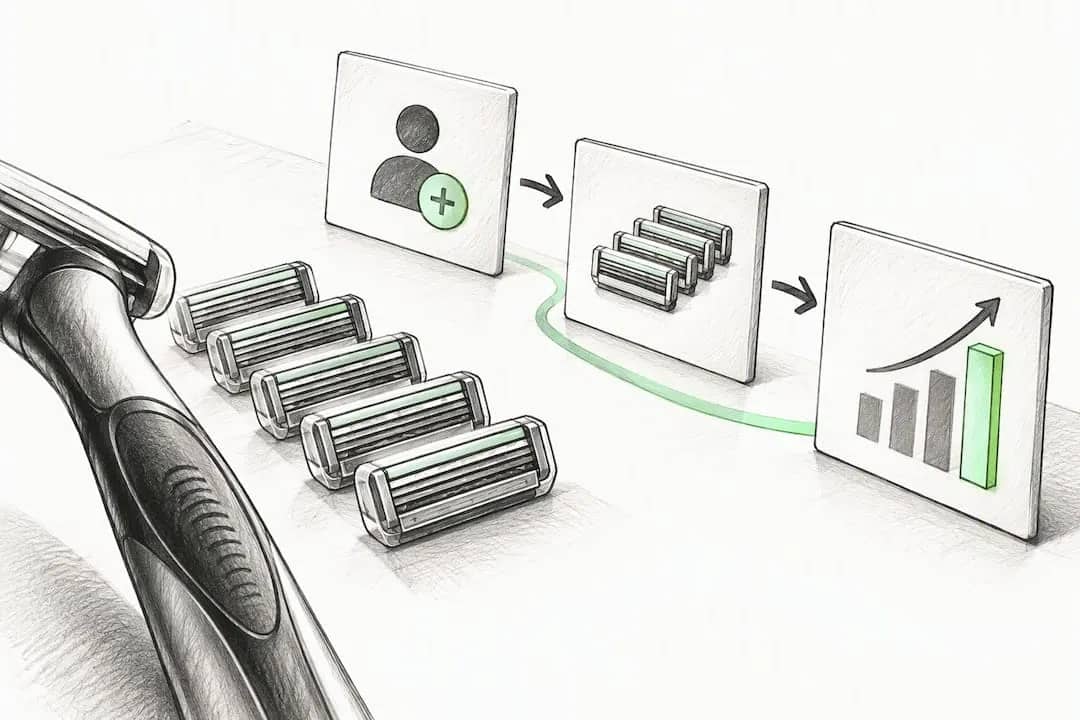

The razor-and-blades model sells a low-cost base product to capture an installed base, then makes its real profit on recurring, proprietary consumables. It works when you can create repeat purchases that are genuinely defensible and back them with a retention engine that keeps customers buying from you. The single biggest threat to the whole design is a third party selling the consumable cheaper.
TL;DR:
- Third-party substitutes capable of undercutting prices threaten the profitability of razor-and-blades models, especially if protections like patents or proprietary formats are weak.
- The billion-dollar razor blade market relies heavily on high repurchase rates and switching costs, making accurate modeling of customer lifetime value and acquisition costs essential.
- Building real defensibility through proprietary formats, patents, or ecosystem control is crucial to prevent easy replication and protect margins over time.
- Regulatory scrutiny around bundling and tying practices can pose legal risks, requiring thorough legal review before product launch.
- Successful pilots must measure actual repurchase behavior, run controlled pricing experiments, and set clear thresholds to avoid scaling flawed strategies.
Table of Contents
- How the razor-and-blades model works: mechanics and strategic levers
- Origin and the Gillette myth: why history changes your assumptions
- Concrete examples across industries: what success and failure look like
- Economics and metrics you must model before you commit
- When to use the model: a decision checklist for product teams
- Risks and mitigations: how razor models fail and how to fix them
- How to run a safe pilot: experiments, metrics, and cadence
- Using agentic AI to de-risk the razor-and-blades approach
- Author perspective: short, pragmatic takeaways for founders
- Adjacent alternative: validate your razor model with siift
- Sources
- FAQ
How the razor-and-blades model works: mechanics and strategic levers
Two-part pricing splits your offer into an entry product priced near cost (sometimes below it) and a recurring product priced for margin. The entry product’s job is adoption. The consumable’s job is profit, and it only works if switching away from your consumable costs the customer something: money, hassle, or compatibility. That’s the whole lever.
You’ll see the pattern show up in a few structural flavors:
- Hardware plus consumables, where the device is cheap and the refill is proprietary.
- Platform plus paid content, where the device or app is the entry point and licensed software or media carries the margin.
- Subscription plus add-ons, where a base tier is nearly free and premium features or usage tiers do the earning.
Printers and ink cartridges, razors and blades, coffee machines and pods: same skeleton, different packaging.
Origin and the Gillette myth: why history changes your assumptions
Here’s the plot twist most founders never hear: Gillette didn’t actually launch by giving away razors to sell blades. Academic critique of the Gillette origin myth-Picker.pdf) shows the company initially sold its handles at a premium, and the now-famous cheap-razor, pricey-blade pattern emerged later as the market and Gillette’s patent position matured.
That distinction isn’t trivia. It means the strategy wasn’t a clever pricing trick invented on day one. It was the product of patents, timing, and market structure that took years to align. If you’re borrowing the Gillette story as proof that “sell cheap, profit on refills” is a plug-and-play playbook, you’re borrowing the wrong lesson. Defensibility has to be built, not assumed.

Concrete examples across industries: what success and failure look like
The pattern recurs across categories, but the winners all share one thing: a mechanism that makes switching annoying, expensive, or both.
- Gillette (razors): proprietary blade formats and steady product line extensions keep the shave close and the refill locked in.
- HP (printers and cartridges): printers are priced to move, cartridges carry the margin, and chip-based authentication has historically discouraged generic refills.
- Keurig and Nespresso (coffee pods): the machine is the entry point, and pod compatibility (or lack of it) is the retention lever.
- Game consoles (Xbox and PlayStation): hardware often sells near cost or at a loss, while licensed software and subscriptions carry the profit over the console’s life.
- Dollar Shave Club and Harry’s: these direct-to-consumer challengers didn’t invent a new model so much as they attacked the old one’s weak point, undercutting incumbent pricing and replacing retail friction with a subscription and transparent cost per blade. FTC filings on the Edgewell and Harry’s matter document how that disruption forced incumbents to rethink both pricing and distribution.
Economics and metrics you must model before you commit
Before you fall in love with the idea, run the numbers. Four figures matter most: customer lifetime value (CLV), customer acquisition cost (CAC), consumable margin, and repurchase frequency. From those, calculate your payback period, meaning how long it takes the consumable stream to recover what you spent acquiring the customer and subsidizing the base product.

The global razor blade market was valued at $12.4 billion in 2022, projected to grow at a 5.2% CAGR through 2030, according to OpenLearn’s analysis of two-part pricing. That scale is exactly why incumbents fight hard to protect consumable margins and why challengers see an opening worth chasing.
Small shifts move the whole model. Drop your repurchase rate by a few points, or let a generic substitute grab even a modest share of consumable spend, and your payback period stretches fast. This is where a lot of founders get seduced by the base-product story and skip the unglamorous math on repeat behavior.
When to use the model: a decision checklist for product teams
Before you pilot anything, run through this list honestly.
- Do customers naturally need to repurchase the consumable, and often?
- Can you build real compatibility control through patents, proprietary formats, or ecosystem lock-in?
- Is the switching cost high enough to matter, but not so high it invites regulatory scrutiny?
- Do you have (or can you build) a measurable retention engine, not just a hope that people stick around?
- Has legal reviewed the tying and antitrust implications of bundling base and consumable pricing?
Ask your product and investor conversations one blunt question: if a generic competitor undercut your consumable tomorrow, would your margin survive? If the honest answer is no, that’s your red flag to stop and rework the model before spending real capital on it.
If the model breaks, your moat isn’t a moat yet.
Risks and mitigations: how razor models fail and how to fix them
Third-party consumables are the model’s most common killer. Generic ink, off-brand pods, and compatible blades erode margin fast once a substitute clears the technical or legal bar. Product hardening (unique formats, patents, subscription perks tied to genuine parts) buys time, though rarely forever.
Regulatory tying is the second risk, and it’s worth taking seriously rather than treating as a footnote. Bundling practices that lock customers into proprietary consumables can draw antitrust attention, so legal review before launch isn’t optional.
Operationally, here’s what reduces exposure: build retention as an operating model, with an owner, a budget, and ongoing experiments, not a one-off campaign.
- Build retention as an operating model, with an owner, a budget, and ongoing experiments, not a one-off campaign.
- Use predictive churn scoring to catch at-risk customers before they defect to a substitute.
- Layer lifecycle pricing (loyalty tiers, bundles) so repurchase stays attractive even as the market matures.
How to run a safe pilot: experiments, metrics, and cadence
You don’t need a huge budget to test this. You need discipline.
- Sell a limited run of base units with tightly measured consumable availability so you can watch real repurchase behavior, not guesses.
- Stagger consumable releases to detect the actual repurchase rate before scaling production.
- Run A/B pricing tests on consumable bundles to find the price point that maximizes margin without tanking retention.
- Deploy a 14-day predictive churn intervention after onboarding as your primary retention safety valve.
Set decision gates ahead of time: a minimum repurchase threshold, a maximum acceptable payback window, and a margin stress test against a hypothetical generic competitor. If the pilot misses two of three, don’t scale it yet.
Using agentic AI to de-risk the razor-and-blades approach
Modeling CLV, CAC, and consumable margin scenarios by hand is slow, and slow kills momentum when you’re testing a pricing hypothesis. siift’s New Business OS guides founders step-by-step through ideation and validation, helping map out business context and pressure-test assumptions like repurchase economics before capital gets committed. It’s built to filter out blind spots that generic AI chat tools tend to miss, so your unit-economics scenarios reflect your actual market, not a generic template.
Author perspective: short, pragmatic takeaways for founders
Don’t chase the Gillette myth. Build real defensibility first, model the downside honestly, and treat retention as infrastructure, not a marketing campaign. Long-term brand trust beats short-term lock-in every time.
— Samim Safaei
Adjacent alternative: validate your razor model with siift
If you’re weighing a two-part pricing bet, siift offers subscription plans designed to guide founders through validation and go-to-market planning without guesswork disguised as strategy. There’s also a Free tier and an Enterprise option with pricing available on request. Check the siift pricing page to see which plan fits the scenario you’re testing, or explore the startup idea validation tools built for exactly this kind of unit-economics stress test.
Sources
- OpenLearn: Two-part pricing / Razor-and-blades discussion
- FTC: Edgewell Personal Care Company and Harry’s, Inc. complaint (public redacted)
FAQ
Can you give an example of a razor and blade business model?
Gillette’s razor handles and blades are the classic case, alongside HP’s printers and cartridges and Keurig’s machines and coffee pods. Game consoles like Xbox and PlayStation follow a similar pattern, pricing hardware near cost while licensed software carries the margin.
Which business model is most profitable?
There’s no single “most profitable” model since profitability depends on execution, retention, and defensibility rather than the pricing structure alone. A well-defended razor-and-blades setup can generate strong recurring margin, but only when repurchase rates hold and third-party substitutes stay locked out.
How much is the razor blade market worth?
The global razor blade market was valued at $12.4 billion in 2022, with projected growth at a 5.2% compound annual rate through 2030. That scale explains why incumbents defend consumable margins so aggressively.
Is the Gillette razor-and-blades origin story true?
Not quite. Academic research into the Gillette myth shows the company initially sold handles at a premium, with the cheap-handle, costly-blade pattern developing later as patents and the market matured.
What’s the main risk in a razor-and-blades pricing strategy?
The biggest risk is third-party consumables undercutting your margin once compatible or generic alternatives clear the technical or legal bar. Regulatory tying concerns around bundled pricing are a secondary risk worth a legal review before launch.