

TL;DR:
- Retaining customers costs less and significantly boosts profits compared to acquiring new ones.
- Implementing follow-up, segmentation, loyalty programs, and community efforts enhances long-term retention.
- Focusing on retention drives sustainable growth and maximizes value from existing customers.
Acquiring new customers feels exciting. But here’s the uncomfortable truth: retaining costs 5-25x less than acquiring, and a 5% lift in retention can boost profits by 25-95%. Most founders pour budget into ads, referrals, and outreach while the customers they already won quietly walk out the back door. That’s the leaky bucket problem, and it quietly kills growth. This article gives you 10 proven, actionable retention strategies rooted in real data, built specifically for entrepreneurs and small business owners who want sustainable growth, not just vanity metrics.
Table of Contents
- Craft a follow-up system: The power of post-purchase outreach
- Personalize your customer experience with data-driven segmentation
- Deliver value through loyalty programs and exclusive perks
- Proactive service and community: Prevent churn and elevate loyalty
- Why retention-first thinking beats acquisition obsession
- Take your retention strategy further with Siift
- Frequently asked questions
Key Takeaways
| Point | Details |
|---|---|
| Retention saves money | Keeping customers costs much less than finding new ones and leads to bigger profits. |
| Personalization drives loyalty | Segmenting customers and tailoring offers enhances engagement and repeat business. |
| Proactive outreach prevents churn | Regular follow-ups, milestone check-ins, and re-engagement efforts can rescue at-risk customers. |
| Loyalty programs boost retention | Even basic rewards systems double the likelihood of customers staying loyal. |
| Community elevates emotional loyalty | Building groups and events creates deep, lasting connections beyond transactions. |
Craft a follow-up system: The power of post-purchase outreach
Most small businesses treat the sale as the finish line. It isn’t. The moment a customer completes a purchase is actually the starting line for a relationship that, if nurtured well, compounds in value over time. A structured follow-up system is your most reliable tool for keeping that relationship alive.
The timing matters more than most owners realize. Post-purchase outreach at 3-7 days, followed by additional touchpoints at 30 and 90 days, gives you three natural opportunities to add value, check in, and surface any friction before it becomes a reason to leave. Here’s a simple sequence you can build out:
- Day 3-7: Send a personalized thank-you message. Include a usage tip or quick-start guide relevant to their purchase.
- Day 30: Check in on their experience. Ask a single, open-ended question: “What’s working well so far?”
- Day 90: Offer a loyalty reward, a relevant upsell, or an invite to a customer community.
This system does two things simultaneously. It keeps your brand top-of-mind without being pushy, and it creates natural windows to catch dissatisfied customers before they churn. Proactive communication is one of the most underused retention tools available to small teams. You don’t need a large staff. A well-configured CRM like HubSpot or Zoho can automate these touchpoints so they go out on schedule without you lifting a finger.
Pro Tip: Set up a CRM workflow that tags customers by purchase date and triggers follow-up emails automatically. If a customer doesn’t open any of the three messages, flag them for a personal outreach call. That personal touch, at exactly the right moment, can recover relationships that email alone won’t.
For a deeper look at spotting customers before they leave, explore these churn analysis tips to build early warning systems into your retention playbook.
Personalize your customer experience with data-driven segmentation
With your follow-up system running, the next lever is relevance. Generic communication is noise. Personalized communication is signal. And in 2026, customers expect businesses of every size to know who they are and what they need.
CRM segmentation improves retention by allowing you to group customers based on shared behaviors and then tailor your outreach accordingly. The most useful segmentation variables for small businesses include:
- Purchase history: What did they buy, how often, and at what price point?
- Engagement level: Are they opening your emails, visiting your site, attending your events?
- Lifecycle stage: Are they brand new, repeat buyers, or lapsing customers?
- Support history: Have they raised complaints, or are they quietly satisfied?
Once you have these segments, you can create offers and content that actually match where each customer is. A first-time buyer needs reassurance. A loyal repeat customer wants exclusivity. A lapsing customer needs a reason to come back.
“The most effective service strategies balance standardization and customization, using data to detect at-risk customers before they make the decision to leave.” Harvard Business School
The good news for founders is that agentic AI personalization tools can now do much of this segmentation and outreach at scale, even for small teams. You don’t need a data science department. You need the right tools and a clear strategy.
Pro Tip: Create a “low-engagement” segment in your CRM for customers who haven’t purchased or interacted in 60 days. Build a targeted re-engagement sequence with a compelling offer and a clear call to action. This alone can bring back a meaningful share of customers who would otherwise be written off.
If you want to go further, these AI loyalty tactics and insights on personalization with AI show exactly how founders are scaling personal experiences without scaling headcount.
Deliver value through loyalty programs and exclusive perks
Once you understand your customer segments, the next move is to give them a compelling reason to keep coming back. Loyalty programs do exactly that. And the barrier to entry is much lower than most founders assume.
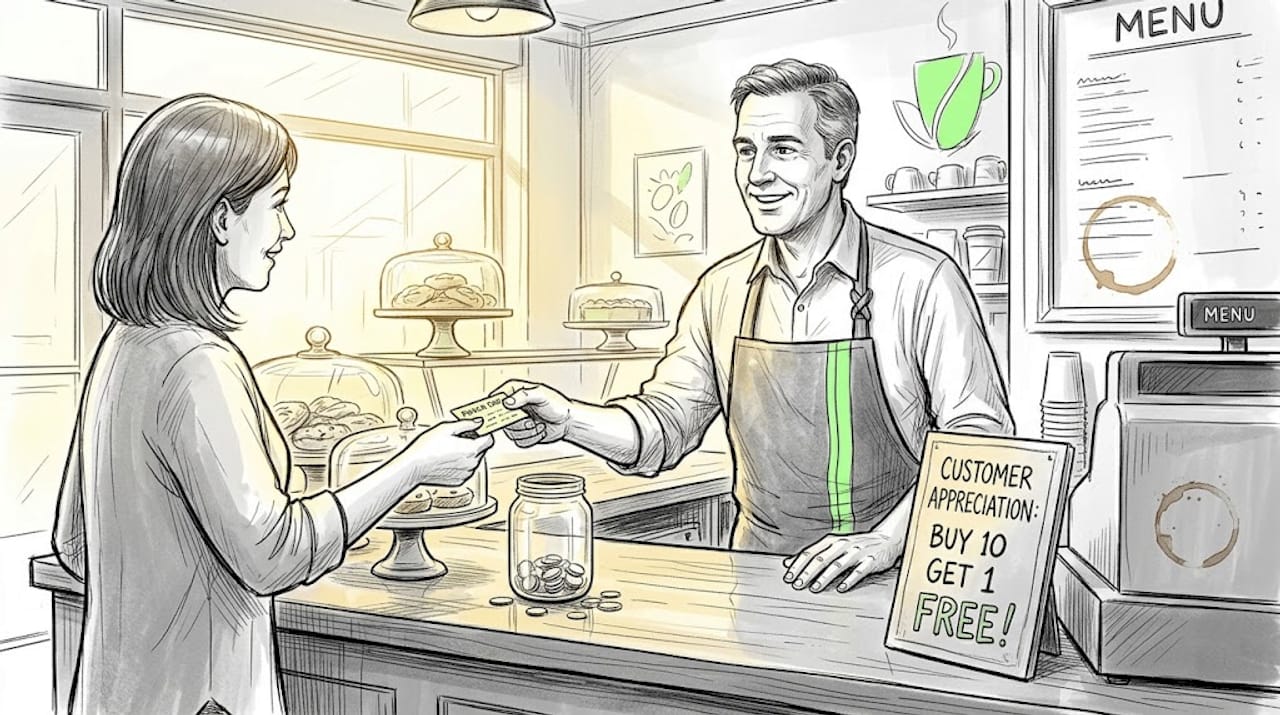
Simple loyalty programs like punch cards or spend-based thresholds are proven to increase return visits and average order value. But not all loyalty programs are created equal. Here’s a quick comparison to help you choose the right model:
| Program type | Best for | Cost to implement | Emotional impact |
|---|---|---|---|
| Punch card / stamp | Local, high-frequency businesses | Very low | Moderate |
| Spend-based rewards | E-commerce, retail | Low to medium | Moderate |
| VIP tier access | Premium or subscription businesses | Medium | High |
| Early access perks | Product launches, limited inventory | Low | High |
| Referral rewards | Community-driven brands | Low to medium | High |
The data is clear: loyalty members retain 1.5-2x more than non-members. That’s not a marginal gain. That’s a structural advantage built into your customer base.
Exclusive perks add another layer. Early access to new products, loyalty pricing, or members-only events create a sense of insider status that money can’t easily replicate. Customers who feel special are customers who stay. They also talk. Word-of-mouth from loyal customers carries far more weight than any paid ad.
A few high-impact perks you can launch quickly:
- Priority customer service for top-tier members
- Birthday or anniversary rewards
- Exclusive previews or beta access to new offerings
- Members-only content or community spaces
For a foundational look at designing programs that actually work, check out this guide to understanding loyalty programs.
Proactive service and community: Prevent churn and elevate loyalty
Loyalty programs create incentives. Proactive service and community create belonging. And belonging is the highest form of retention because it’s emotional, not transactional.
Monitoring usage signals and milestone check-ins are the backbone of proactive service. Here’s how to structure this in practice:
- Set usage alerts: If a customer’s activity drops below a baseline, trigger an outreach sequence within 7 days.
- Celebrate milestones: Six months as a customer, tenth purchase, or first anniversary are all moments worth acknowledging with a personal message or small reward.
- Create a community space: A private Facebook group, Slack channel, or in-person meetup gives customers a sense of connection beyond the transaction.
- Recover lapsed subscribers: For subscription businesses, payment recovery campaigns targeting involuntary churn can recover 40-60% of failed renewals with smart retry logic and personal outreach.
The win-back window is narrow. 7-14 day outreach recovers 20-30% of churned customers, but that window closes fast. Speed and personalization are both critical here.
“Community is not a marketing tactic. It’s a retention architecture. When customers feel they belong to something, leaving becomes a loss, not just a cancellation.”
Pro Tip: Use a simple retention dashboard with three columns: at-risk, lapsing, and churned. Review it weekly and assign a team member to personally reach out to at-risk customers. Even a brief, human message can change the outcome.
To build a stronger financial case for these efforts, read these lifetime value strategies and explore how community-driven retention compounds over time. For a technical lens on predicting who’s at risk, predictive retention modeling is a powerful complement to manual monitoring.
Why retention-first thinking beats acquisition obsession
Here’s a perspective that most growth playbooks skip: acquisition is glamorized because it’s visible. New customers are a story. Retained customers are a spreadsheet. But the spreadsheet is where the real business lives.
73% of Chief Sales Officers now prioritize existing customers over new acquisition, according to Gartner. And Forrester found that customer-obsessed firms achieve 51% better retention than their peers. These aren’t small margins. They’re the difference between a business that scales and one that stalls.
The deeper issue is this: over-discounting to retain customers is a trap many founders fall into. Slashing prices to keep someone who was already loyal erodes your margins without building real commitment. True retention is earned through value, trust, and experience, not desperation deals.
Fix the leaky bucket before you turn up the acquisition tap. Every dollar you spend bringing in new customers while losing existing ones is a dollar working against itself. Retention-first thinking isn’t conservative. It’s compounding.
Take your retention strategy further with Siift
You now have a clear framework: build follow-up systems, segment and personalize, reward loyalty, and create community. These aren’t abstract ideas. They’re tactics you can activate this week. But knowing what to do and having the strategic clarity to do it consistently are two different things.
That’s where siift comes in. Siift’s Intelligent Business Canvas is the agentic AI platform built specifically for founders who want to stop guessing and start building with confidence. From validating your retention strategy to mapping your full go-to-market approach, Siift helps you move faster and smarter. Explore AI tools for entrepreneurs to see what’s possible when your business runs on a real system, not a series of experiments.
Frequently asked questions
Why is customer retention more profitable than acquisition?
Existing customers spend 67% more than new ones and have a 60-70% repurchase probability, compared to just 5-20% for new prospects, making retention the higher-return investment.
How can small businesses detect customers at risk of leaving?
Use CRM data to flag low usage and missed renewals or a lack of repeat purchases, then trigger a proactive outreach sequence before the customer decides to leave.
What’s the best way to re-engage churned customers?
Act fast: 7-14 day outreach after churn recovers 20-30% of lost customers, with personalized messaging and a compelling reason to return performing best.
Are loyalty programs effective for startups?
Absolutely. Even simple punch cards or spend-based perks mean loyalty members retain at 1.5-2x the rate of non-members, making them one of the highest-ROI retention tools available.
Recommended
- Reflections on 10+ years as a Founder: Advice for New and Young Entrepreneurs | siift
- 10 Habits of Successful Entrepreneurs: Guide for 2026
- 7 Essential Tips for Bootstrapping a Startup Successfully | siift
- 7 Startup Mistakes to Avoid for First-Time Entrepreneurs | siift
- 5 Ways to Retain Personal Training Clients | TrainingPro