
Most entrepreneurs treat customer lifetime value like it’s a crystal ball that predicts exact revenue. It’s not. CLV is a strategic signal, not a financial guarantee, and misunderstanding this distinction costs businesses thousands in misdirected marketing spend. This guide cuts through the confusion to show you how to calculate CLV accurately, apply advanced predictive methods, avoid common pitfalls, and leverage these insights to optimize retention and acquisition strategies that drive sustainable growth.
Table of Contents
- Key takeaways
- What is customer lifetime value and how to calculate it
- Advanced methods and predictive modeling for customer lifetime value
- Benchmarks, common pitfalls, and expert insights on using customer lifetime value
- Practical strategies to leverage customer lifetime value for business growth
- Boost your business growth with AI driven customer insights
- Frequently asked questions
Key Takeaways
| Point | Details |
|---|---|
| CLV is strategic | Treat CLV as a directional metric for guiding marketing and retention, not a precise forecast of revenue. |
| CLV formula basics | CLV is computed as APV times PF times Lifespan, adjusted for margin and minus CAC. |
| Predictive modeling value | Advanced predictive models can improve insights but require substantial data and expertise. |
| Ideal CLV CAC ratio | Aim for a CLV to CAC ratio in the range of three to five to support sustainable growth. |
| Avoid common pitfalls | Do not ignore churn or hidden costs and avoid overreliance on static averages. |
What is customer lifetime value and how to calculate it
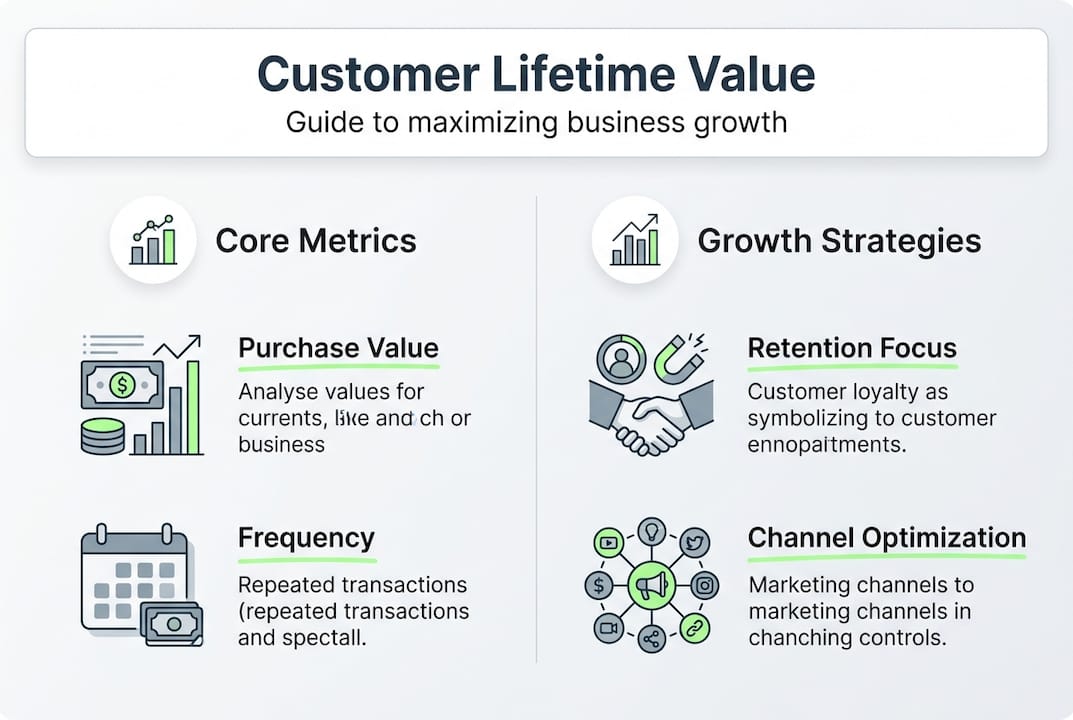
Customer lifetime value (CLV) measures the total profit a customer generates throughout their relationship with your business. It’s calculated using the basic formula: CLV = Average Purchase Value × Purchase Frequency × Average Customer Lifespan, adjusted for profit margin as CLV = (APV × PF × Lifespan) × Margin minus CAC. Understanding this metric helps you determine how much to invest in acquiring and retaining customers without burning cash on unprofitable channels.
Start with your average purchase value. If customers spend $50 per transaction and buy four times per year, that’s $200 annually. Multiply by average customer lifespan, say three years, and you get $600. Apply your profit margin (if it’s 40%, that’s $240), then subtract your customer acquisition cost. If CAC is $60, your net CLV is $180.

Here’s how different business models calculate CLV:
| Business type | Avg purchase | Frequency/year | Lifespan (years) | Margin | CAC | Net CLV |
|---|---|---|---|---|---|---|
| Hair salon | $85 | 6 | 4 | 50% | $40 | $980 |
| Ecommerce store | $45 | 3 | 2 | 35% | $25 | $69.50 |
| Subscription box | $30 | 12 | 3 | 60% | $35 | $613 |
| Coffee shop | $6 | 104 | 2 | 65% | $5 | $806.20 |
Five factors directly impact your CLV calculation:
- Purchase frequency drives revenue velocity and compounds over customer lifespan
- Average order value increases total revenue without adding acquisition costs
- Customer lifespan extends the earning window and amortizes CAC
- Profit margin determines actual money you keep from each transaction
- Customer acquisition cost subtracts upfront investment from lifetime profit
Pro Tip: Use your POS system or ecommerce dashboard to pull real transaction data monthly. Track these five metrics separately for different customer segments to spot early customer acquisition strategies that deliver higher returns.
The basic formula works for initial estimates, but it assumes all customers behave identically and ignores churn patterns. CLV calculation basics provide a foundation, but advanced methods deliver more actionable insights by accounting for behavioral variation and predictive patterns.
Advanced methods and predictive modeling for customer lifetime value
Probabilistic models like BG/NBD predict future transaction probability while Gamma-Gamma models estimate monetary value per transaction. These statistical approaches recognize that customer behavior varies, some buy frequently then disappear, others purchase sporadically over years. RFM segmentation (recency, frequency, monetary) groups customers by behavior patterns, letting you target high value segments differently than one time buyers.
Cohort analysis tracks customer groups by acquisition date to reveal how behavior changes over time. You might discover customers acquired through paid ads have 30% shorter lifespans than referrals, or that holiday shoppers rarely return. Survival analysis applies actuarial methods to forecast customer tenure, calculating the probability a customer remains active at any future point.
Machine learning models like Random Forest and Gradient Boosting incorporate dozens of variables simultaneously: browsing behavior, support tickets, email engagement, seasonal patterns, product categories. These algorithms identify complex patterns humans miss and achieve 80-92% prediction accuracy when trained on sufficient data. They adapt as new information arrives, continuously refining estimates.
Before implementing advanced models, verify you have:
- At least 12 months of transaction history with 1,000+ customers
- Clean data tracking customer IDs across all touchpoints
- Behavioral metrics beyond purchase (email opens, site visits, support interactions)
- Technical capability to maintain and update models quarterly
Pro Tip: Validate predictive models using holdout datasets. Train on 70% of historical data, test against the remaining 30%, and compare predicted vs actual CLV. If accuracy drops below 75%, your model is either overfitting or missing critical variables.
Machine learning CLV models achieve 80-92% accuracy by processing behavioral signals that simple formulas ignore, but they require robust data infrastructure and ongoing maintenance.
The gap between basic formulas and machine learning for CLV predictions can mean the difference between profitable scaling and cash drain. Advanced methods reveal which acquisition channels deliver customers who stick around and spend more, not just which ones fill your funnel cheapest. Cohort analysis techniques expose retention patterns that static averages hide, showing you exactly where to focus retention efforts for maximum impact.
Benchmarks, common pitfalls, and expert insights on using customer lifetime value
Industry benchmarks provide context for evaluating your CLV performance:
| Industry | Average CLV | Typical CAC | CLV:CAC ratio |
|---|---|---|---|
| Ecommerce (Shopify avg) | $168 | $45 | 3.7:1 |
| Hair salons | $975-$3,400 | $200-$400 | 3.5:1 to 8.5:1 |
| Beauty/cosmetics | $285 | $65 | 4.4:1 |
| Subscription boxes | $450 | $85 | 5.3:1 |
| Coffee shops | $800 | $120 | 6.7:1 |
The ideal CLV:CAC ratio sits between 3:1 and 5:1 for sustainable growth. Below 3:1 signals you’re spending too much acquiring customers relative to their value. Above 5:1 might indicate you’re underinvesting in growth, leaving market share on the table for competitors willing to pay more for customers.
Entrepreneurs make predictable mistakes estimating CLV:
- Ignoring churn rates creates inflated projections that don’t match reality
- Hidden costs like returns, refunds, and customer service eat into margins
- Static averages mask critical differences between customer segments
- Overfitting machine learning models to historical data that won’t repeat
- Treating CLV as precise accounting rather than directional guidance
Pro Tip: Recalculate CLV quarterly and segment by acquisition channel, product category, and customer cohort. A single average CLV tells you almost nothing useful. Segmented CLV reveals that email subscribers might be worth 3x more than social media followers, or that customers who buy Product A have twice the lifespan of those starting with Product B.
A CLV:CAC ratio above 5:1 often signals opportunity cost. You could profitably spend more acquiring customers, scaling faster than competitors stuck optimizing existing channels. Common CLV estimation errors include confusing correlation with causation (customers who engage more aren’t necessarily more valuable because they engage, they might engage more because they already decided to stay), and failing to account for cannibalization (new customers replacing existing ones rather than adding incremental revenue).
View CLV as a relative ranking tool for prioritizing marketing investments, not an absolute financial projection. It tells you Channel A customers are worth 40% more than Channel B customers, so you can justify paying 40% more to acquire them. CLV benchmarks and ratios help you evaluate whether your acquisition economics support profitable scaling or require retention improvements first.
Practical strategies to leverage customer lifetime value for business growth
Translate CLV insights into growth with these steps:
- Calculate segmented CLV by acquisition channel to identify your most profitable sources
- Set maximum CAC targets at 30-35% of segment CLV to maintain healthy unit economics
- Reallocate budget from low CLV channels to high CLV channels even if cost per acquisition increases
- Build retention programs targeting customers in the top 20% CLV segment first
- Test pricing and product bundles on high CLV segments where margin for error is larger
Retention tactics that boost CLV:
- Email marketing nurtures relationships and drives repeat purchases at minimal cost
- Loyalty programs reward frequent buyers and extend customer lifespan
- Personalized offers based on purchase history increase order value
- Proactive support reduces churn by solving problems before customers leave
- Post purchase engagement maintains brand presence between transactions
Pro Tip: Stop chasing ROAS (return on ad spend) alone. A channel delivering 2x ROAS might generate customers worth half as much long term as a 1.5x ROAS channel. Optimize for CLV:CAC ratio instead, and you’ll build a more profitable business even if short term metrics look worse.
Entrepreneurs who use CLV to justify higher CAC on valuable channels and focus on retention see 25-95% profitability improvements from small retention increases. A 5% improvement in retention can boost profits by 25-95% because you’re extracting more value from customers you already paid to acquire. Building email lists increases customer loyalty and LTV by 35-45% by maintaining direct communication outside algorithm controlled platforms.
Leveraging CLV alongside metrics like incrementality (measuring true new revenue vs cannibalized sales) improves marketing ROI significantly. You stop wasting budget on channels that look good on surface metrics but deliver low quality customers who churn quickly. Instead, you double down on acquisition sources that fill your business with customers who stick around and spend more over time.
Value ladder marketing strategies naturally increase CLV by moving customers from low priced entry offers to premium products. Map your customer journey and identify opportunities to introduce higher margin offerings at each stage. Startup growth metrics like CLV, CAC, and retention rate form the foundation for sustainable scaling that doesn’t require constant fundraising to cover acquisition costs.
Boost your business growth with AI driven customer insights
Calculating and applying CLV manually works for initial estimates, but AI tools for customer insights automate the heavy lifting and surface patterns you’d miss in spreadsheets. siift’s Intelligent Business Canvas helps entrepreneurs and small business owners validate strategies and accelerate their path to product market fit by filtering out biases and blindspots that lead to costly mistakes.
AI driven platforms deliver:
- Automated CLV calculation across customer segments updated in real time
- Predictive segmentation identifying high value customers before they prove it
- Marketing ROI insights connecting spend to actual customer lifetime value
- Strategic guidance on retention tactics with highest expected return
Pro Tip: Start with free tools or demos to see immediate value before committing to paid platforms. Many AI analytics tools offer trial periods where you can connect your data and get instant CLV calculations segmented by channel, cohort, and behavior.
AI increases CLV prediction accuracy by over 20% compared to manual calculations by processing behavioral signals and identifying patterns across thousands of customer interactions.
Entrepreneurs using AI powered customer insights achieve measurable growth by making data driven decisions about where to invest acquisition budget and which retention tactics deliver returns. The value ladder guide and early customer acquisition guidance provide frameworks for applying these insights systematically rather than chasing random tactics that worked for someone else’s business.
Frequently asked questions
What is customer lifetime value and why does it matter?
CLV measures total profit a customer generates throughout their relationship with your business. It matters because it tells you how much you can afford to spend acquiring customers while remaining profitable. Without CLV insights, you’re flying blind on marketing investments.
How do you calculate customer lifetime value?
CLV equals average purchase value times purchase frequency times customer lifespan, adjusted for profit margin and subtracting acquisition cost. Use sales and purchase data from POS or ecommerce platforms to calculate these components. Segment by channel and cohort for actionable insights rather than relying on single average numbers.
What are common mistakes when using customer lifetime value?
Ignoring customer churn rates and hidden costs like returns inflates projections. Using static averages masks important segment differences that determine where to focus resources. Treating CLV as an exact financial figure rather than directional guidance leads to misplaced confidence in unreliable projections. Visit the startup validation guide for frameworks that help avoid these traps.
How can I use customer lifetime value to grow my business?
Prioritize marketing spend on high CLV customer segments and channels even if cost per acquisition increases. Use retention programs and build email lists to boost customer value by 35-45%. Recalculate CLV quarterly and segment customers for targeted tactics that address specific behavior patterns. Value ladder strategies show how to systematically increase CLV by moving customers to higher value offerings.