
When Russell Brunson’s ClickFunnels reached nine-figure revenue, the secret wasn’t a single product. It was a strategic progression of offers that guided customers from free content to premium services, systematically building trust and revenue at each step. This marketing framework, called a value ladder, transforms how entrepreneurs monetize their expertise and scale their businesses. If you’re struggling to convert leads or maximize customer lifetime value, understanding value ladders could be the breakthrough you need in 2026.
Table of Contents
- What Is A Value Ladder And Why It Matters For Entrepreneurs
- Micro And Macro Value Ladders: Tailored Approaches To Business Growth
- Structuring Your Value Ladder: Stages And Pricing Frameworks
- Applying The Value Ladder To Maximize Revenue And Customer Relationships
- Explore Siift.ai To Build Your Value Ladder And Scale Faster
- Frequently Asked Questions
Key takeaways
| Point | Details |
|---|---|
| Value ladders guide revenue growth | A marketing strategy that maps progressive offers from free to premium, building customer relationships and revenue systematically. |
| Micro vs macro ladders serve different needs | Micro ladders focus on specific funnels or segments, while macro ladders visualize the entire customer journey across all offerings. |
| Structure matters for customer clarity | Using frameworks like Good-Better-Best pricing alongside value ladder stages prevents confusion and maximizes conversions. |
| Strategic application builds trust | It typically takes 6-8 interactions to convert a lead, making the progressive value approach essential for sustainable growth. |
What is a value ladder and why it matters for entrepreneurs
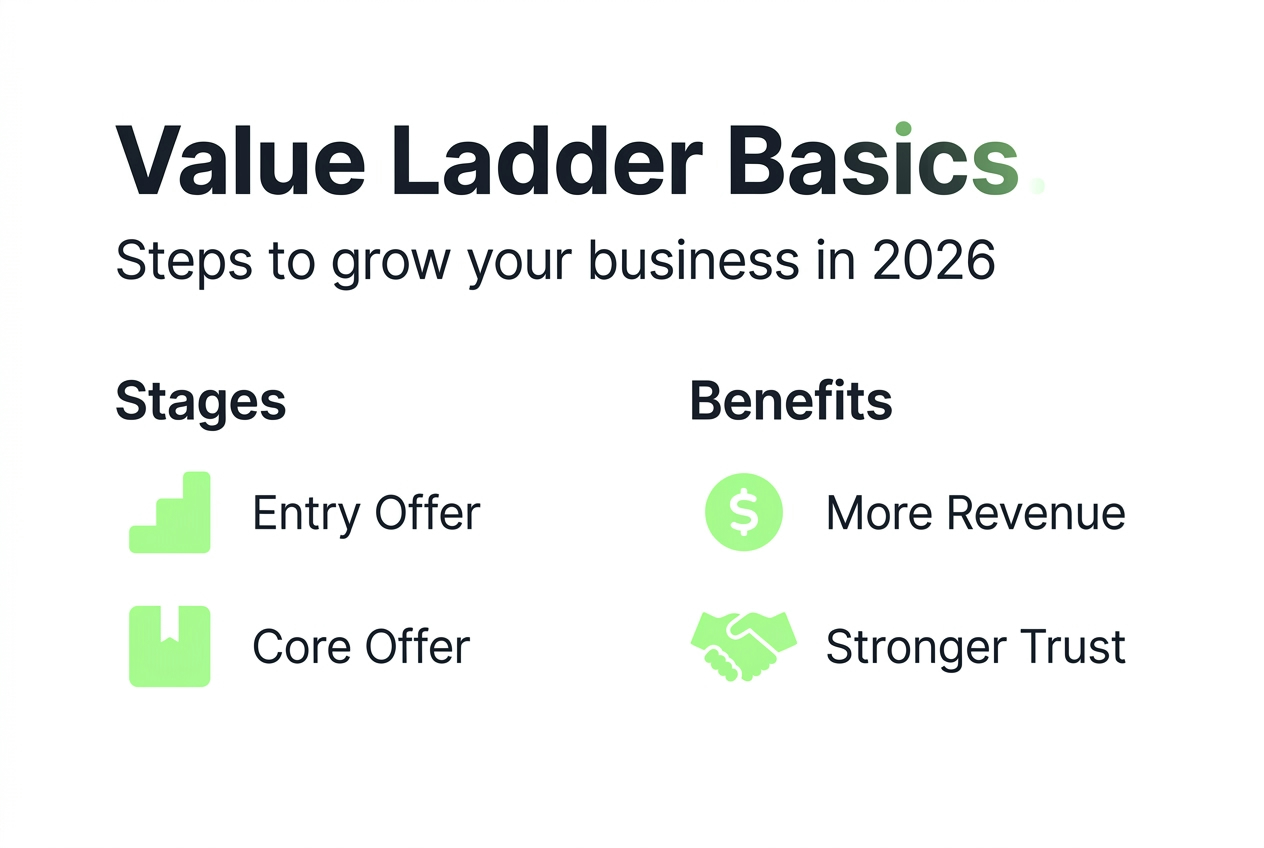
A value ladder is a marketing concept that maps your products and services into a progressive sequence of offers. Each step provides increasing value at higher price points, naturally guiding customers from initial awareness to premium purchases. The primary goal is straightforward: increase revenue by guiding customers through a series of offers that build trust while delivering genuine value.
Russell Brunson popularized this framework through ClickFunnels, demonstrating how strategic offer sequencing drives exponential growth. The ladder works because it reduces purchase risk at each stage. A free ebook introduces your expertise without financial commitment. A low-cost workshop deepens engagement. A mid-tier course demonstrates tangible results. Finally, premium coaching or software delivers transformative outcomes for invested customers.
For aspiring entrepreneurs, value ladders deliver multiple benefits:
- More predictable revenue streams as customers naturally ascend your offers
- Stronger customer relationships built on progressive value delivery
- Better engagement through relevant, timely offers matched to customer readiness
- Increased lifetime customer value without aggressive sales tactics
- Clear strategic roadmap for product development and marketing
Incorporating value ladders early in your business strategy prevents the common trap of random product creation. Instead of launching disconnected offerings, you build a cohesive system where each product naturally leads to the next. This approach aligns perfectly with modern sales funnel basics for solopreneurs, creating a sustainable path from idea to profitable business.
Micro and macro value ladders: tailored approaches to business growth
Understanding the distinction between micro and macro value ladders helps you apply the right strategy for specific business needs. These two approaches serve different purposes and scale differently based on your goals.
Micro value ladders are tied to specific funnels or product paths, focusing on a narrow segment of your business. For example, you might create a micro ladder for your email marketing audience: free checklist, $47 mini-course, $297 comprehensive program, $997 implementation coaching. This focused approach lets you test messaging, pricing, and offer sequencing with a specific customer segment before scaling.
In contrast, macro value ladders take a broader view, visualizing the complete customer journey across all your offerings. A software company’s macro ladder might include: free trial, basic monthly subscription, professional annual plan, enterprise custom solution, ongoing consulting retainer. This holistic perspective ensures all products work together strategically.
Strategic use cases differ significantly:
- Micro ladders excel for niche campaigns, product launches, or testing new market segments
- Macro ladders provide the big picture for brand positioning and long-term business planning
- Micro ladders allow rapid iteration and optimization without disrupting your entire business
- Macro ladders prevent product overlap and ensure logical progression across all offerings
Pro Tip: Start with micro value ladders to validate customer interest and willingness to ascend offers before investing in a comprehensive macro ladder. This reduces risk and provides real data to inform your broader strategy.
The key is avoiding confusion by clearly mapping each ladder’s purpose. Customers should never feel lost in a maze of disconnected offers. Whether you choose micro or macro, each step must feel like a natural, valuable progression. This clarity becomes even more important as you work on how to get traction for my startup and scale your business systematically.
Structuring your value ladder: stages and pricing frameworks
Building an effective value ladder requires understanding typical progression stages and how pricing frameworks enhance your structure. The value ladder typically consists of five core stages:
- Free Offer: Lead magnets like ebooks, webinars, or tools that attract prospects and demonstrate your expertise
- Front End: Low-commitment paid entry points, typically $7 to $97, that convert interested prospects into paying customers
- Middle: Core offerings priced $100 to $1,000 that deliver significant value and results
- Back End: Premium products or services ranging $1,000 to $10,000 for committed, results-driven customers
- Peak Offer: Highest-value offering, often $10,000+, providing transformative results through intensive work or exclusive access
Each stage increases both value and price, deepening customer commitment and trust. The progression should feel natural, with each offer addressing the next logical need or desire your customer develops.

Complementing this structure, the Good-Better-Best pricing ladder provides a proven framework for tiering offers within each stage:
| Aspect | Good-Better-Best Pricing | Value Ladder Stages |
|---|---|---|
| Primary Purpose | Simplify purchase decisions within a product category | Guide customers through increasing commitment levels |
| Pricing Strategy | Three tiers at one decision point | Progressive pricing across multiple touchpoints |
| Customer Journey | Single transaction focus | Long-term relationship building |
| Implementation | Apply within each value ladder stage | Structure entire business offering ecosystem |
To structure your offers logically:
- Map your existing or planned products to the five stages, identifying gaps
- Ensure each stage solves a specific problem or delivers a clear outcome
- Price based on value delivered, not just cost or competitor pricing
- Create natural transitions where completing one stage reveals the need for the next
- Test progression with real customers and refine based on conversion data
Pro Tip: Design your value ladder to avoid creating a “value maze” where customers feel overwhelmed by choices. Each offer should be the obvious next step for customers who complete the previous stage, not a confusing array of options.
Avoid common pitfalls in value ladder design by keeping the path simple and valuable. When customers clearly see how each offer builds on the last, they naturally ascend your ladder, maximizing both their results and your revenue.
Applying the value ladder to maximize revenue and customer relationships
Implementing value ladders strategically transforms how you generate revenue and build lasting customer relationships. The framework works because it takes 6-8 interactions to turn a lead into a customer, and value ladders provide structured, value-driven touchpoints throughout this journey.
Each incremental offer serves multiple purposes beyond immediate revenue. First, it builds trust. Customers who receive value from your free offer become more receptive to paid offerings. Those who succeed with a low-cost product trust you enough to invest in premium services. Second, it improves monetization. You capture revenue at every readiness level instead of losing prospects who aren’t ready for your highest-priced offering.
“Value ladders build trust by providing increasing value at each step, strengthening customer relationships and establishing your expertise through demonstrated results rather than promises.”
This trust-building progression creates loyal customers who advocate for your business, reducing acquisition costs over time.
Actionable tips for applying value ladders effectively:
- Map your offers carefully to customer journey stages, ensuring each addresses a specific need or pain point
- Test different segments with micro ladders before committing to a full macro ladder structure
- Use metrics like conversion rates between stages to identify and fix progression bottlenecks
- Align your marketing funnels with your value ladder so messaging matches customer readiness
- Regularly survey customers to understand which offers provide the most value and where confusion exists
- Automate transitions between stages using email sequences and targeted content
ClickFunnels exemplifies successful application. By offering free training, low-cost books, mid-tier courses, and premium software, they guided customers from curiosity to significant investment. Each step delivered genuine value while naturally revealing the next logical offer.
Combine your value ladder with insights from value proposition examples new entrepreneurs use to sharpen your messaging at each stage. Understanding the basic marketing funnel for beginners helps you align funnel mechanics with ladder strategy for optimal results.
Avoid offer overload by limiting choices at each stage. Three options maximum prevents decision paralysis. Ensure progression feels natural, not forced. Customers should ascend because they want the next level of value, not because you pushed them.
Explore siift.ai to build your value ladder and scale faster
Designing an effective value ladder requires deep customer understanding and strategic thinking. Siift.ai’s founder intelligence platform helps you systematically build this framework by guiding you through ideation, validation, and go-to-market strategies that align with your target audience’s needs.
The platform provides personalized feedback and actionable insights to refine your offers, ensuring each ladder stage delivers genuine value and drives conversions. By filtering out biases and blindspots, siift.ai accelerates your journey from concept to product-market fit, making value ladder implementation faster and more data-driven.
If you’re serious about scaling your business in 2026, leverage siift.ai to map your customer journey, optimize offer sequencing, and build a value ladder that transforms leads into loyal, high-value customers.
Frequently asked questions
What is a value ladder in marketing?
A value ladder is a marketing model that guides customers through a series of progressively valuable offers, starting from free or low-cost entry points and ascending to premium products or services. Each stage builds trust while increasing both the value delivered and the price point, creating a natural path for revenue growth and deeper customer relationships.
How do micro and macro value ladders differ?
Micro value ladders focus on specific funnels or customer segments, allowing you to test and optimize narrow product paths quickly. Macro value ladders provide a holistic view of your entire business, mapping all offerings across the complete customer journey to ensure strategic alignment and prevent product overlap.
How many customer interactions does it take to make a sale?
Research shows it typically takes 6-8 touchpoints to convert a lead into a paying customer. Value ladders facilitate this process by providing structured, value-driven interactions at each stage, building trust and demonstrating expertise through progressive offers rather than aggressive one-time sales pitches.
Why is strategic planning important for value ladders?
Without careful mapping, you risk creating a confusing array of offers that overwhelm customers rather than guide them. Strategic planning ensures each stage addresses a specific need, prices appropriately for value delivered, and creates natural transitions that make ascending the ladder feel obvious and desirable rather than forced.
How does a value ladder differ from Good-Better-Best pricing?
Good-Better-Best pricing structures three tiers within a single product category to simplify purchase decisions at one moment. Value ladders orchestrate multiple offers across the entire customer journey, building long-term relationships through progressive engagement. You can use Good-Better-Best pricing within individual value ladder stages for maximum effectiveness.
What are the typical stages in a value ladder?
Most value ladders include five stages: Free Offer (lead magnets), Front End ($7-$97 entry products), Middle ($100-$1,000 core offerings), Back End ($1,000-$10,000 premium services), and Peak Offer ($10,000+ transformative programs). Each stage increases value and price, deepening customer commitment and trust systematically.