
Most aspiring solopreneurs struggle with the same frustrating problem: traffic arrives, but customers don’t convert. You invest time and money driving visitors to your offer, yet sales remain stagnant. The culprit isn’t lack of traffic or poor products, but misunderstanding how sales funnels systematically guide prospects from awareness to purchase, turning interest into revenue.
Table of Contents
- What Is A Sales Funnel And Why It Matters
- Understanding The Core Stages Of A Sales Funnel
- Common Misconceptions About Sales Funnels
- Conceptual Framework: The AIDA Mental Model
- Optimizing The Sales Funnel: Practical Steps For Solopreneurs
- Case Studies And Real-World Examples
- Bridging Sales Funnels To Product-Market Fit
- Explore Tools To Build And Optimize Your Sales Funnels
- Frequently Asked Questions
Key takeaways
| Point | Details |
|---|---|
| Sales funnels guide customers | Visual models that systematically move prospects from awareness through interest and decision to purchase action. |
| Four core stages reduce drop-offs | Awareness, interest, decision, and action stages each require targeted content to nurture leads and prevent 30-70% typical leakage. |
| Common myths waste resources | Traffic alone doesn’t guarantee sales; simple funnels work for solopreneurs without complex tools or large teams. |
| AIDA framework simplifies design | Awareness, Interest, Desire, Action model aligns marketing with sales and enables clear KPI tracking for optimization. |
| Funnel metrics validate market fit | Conversion data, acquisition costs, and engagement rates guide product iterations and confirm product-market alignment. |
What is a sales funnel and why it matters
A sales funnel is a visual model mapping the customer journey from first awareness of your solution through final purchase. Think of it as a roadmap guiding prospects systematically through stages where you educate, build trust, and address objections before asking for commitment. Without this structure, potential customers fall through cracks at every touchpoint.
The funnel typically includes four stages: awareness (prospect discovers you), interest (they explore your offering), decision (they evaluate alternatives), and action (they buy). Each stage requires different content and touchpoints. For solopreneurs, this clarity transforms scattered marketing efforts into a strategic system that consistently converts leads into paying customers.
Most business ideas fail not from lack of demand but from inability to monetize that demand. A well-designed funnel addresses this by nurturing relationships at scale. You can’t personally call every website visitor, but automated email sequences, targeted content, and strategic touchpoints move prospects forward even while you sleep. This systematic approach is essential for turning ideas into viable businesses.
Without funnel management, you lose leads constantly. Someone visits your site, gets distracted, and never returns. Effective funnels recapture attention through retargeting, email follow-ups, and value-driven content that keeps your solution top of mind. Tools and frameworks exist to simplify this process, as outlined in comprehensive solopreneur tools guide resources.
Understanding the core stages of a sales funnel
The awareness stage brings prospects into your ecosystem through content marketing, social media, ads, or referrals. At this point, visitors recognize a problem but may not know solutions exist. Your job is educating them about the challenge and positioning your approach as worth exploring. Typical awareness content includes blog posts, videos, and social updates that attract broad audiences.

Interest develops when prospects actively research solutions and compare options. They download resources, subscribe to emails, or follow your content regularly. Here you demonstrate expertise through case studies, detailed guides, and product demonstrations. The goal is building trust and showing you understand their specific pain points better than competitors.
Decision stage prospects narrow choices and evaluate specific features, pricing, and fit. They’re comparing your offer directly against alternatives. Address objections proactively with testimonials, comparison charts, free trials, or consultations. This stage has highest intent but also highest scrutiny, so transparency and proof matter most.
Action converts interest into revenue when prospects purchase, sign up, or commit. Make this stage frictionless: simplify checkout, offer guarantees, and provide clear next steps. Even small obstacles here kill conversions. Post-purchase, nurture customers for retention, upsells, and referrals to feed the top of the funnel again.
Pro Tip: Typical funnels lose 30-70% of leads between stages due to poor messaging, timing, or relevance. Mapping content specifically to each stage dramatically reduces this leakage and improves overall conversion rates.
| Funnel Stage | Primary Goal | Typical Content Types | Average Drop-Off Rate |
|---|---|---|---|
| Awareness | Attract attention | Blog posts, social media, ads | 40-50% |
| Interest | Build trust | Email series, webinars, guides | 30-40% |
| Decision | Address objections | Case studies, demos, trials | 50-70% |
| Action | Drive conversion | Landing pages, checkout flows | 20-30% |
Understanding these stages aligns with broader marketing principles explored in resources like basic marketing funnel guides that help solopreneurs build systematic customer acquisition.
Common misconceptions about sales funnels
Many solopreneurs believe traffic volume alone drives sales, pouring resources into ads and SEO while neglecting conversion optimization. Reality: 1,000 targeted visitors with a 5% conversion rate outperform 10,000 random visitors converting at 0.5%. Funnel quality matters far more than traffic quantity. Without proper nurturing, most visitors leave and never return regardless of volume.
Another myth positions funnels as purely closing tools focused only on final purchase decisions. Actually, funnels operate across the entire customer journey from initial awareness through post-purchase retention. Early-stage funnel content educates and builds relationships long before selling. This extended nurturing is how solopreneurs compete against larger competitors with bigger budgets.
Complexity assumptions discourage adoption. Many think funnels require expensive software, marketing teams, or technical expertise. Truth: Simple funnels like the AIDA model work exceptionally well for solopreneurs using basic tools. An email series, landing page, and tracking spreadsheet create a functional funnel without enterprise solutions or specialized staff.
“The most effective funnels aren’t the most complex. They’re the ones that consistently deliver personalized value at each stage, building trust through relevance rather than overwhelming prospects with options.” – Marketing strategy consultant
Personalized communication at scale separates winning funnels from generic campaigns. Technology enables solopreneurs to segment audiences and tailor messaging based on behavior, interests, and stage. Simple automations like welcome sequences or abandoned cart emails dramatically improve conversions without manual effort.
Avoid overcomplicating your approach. Start with core stages, measure what works, and iterate. Resources like solopreneur tools demonstrate how accessible funnel building has become for individual founders.
Conceptual framework: the AIDA mental model
AIDA stands for Awareness, Interest, Desire, Action, a mental model used by over 65% of marketing professionals for funnel strategy. This framework maps perfectly to sales funnel stages, providing a simple structure to design campaigns that move prospects systematically toward purchase.
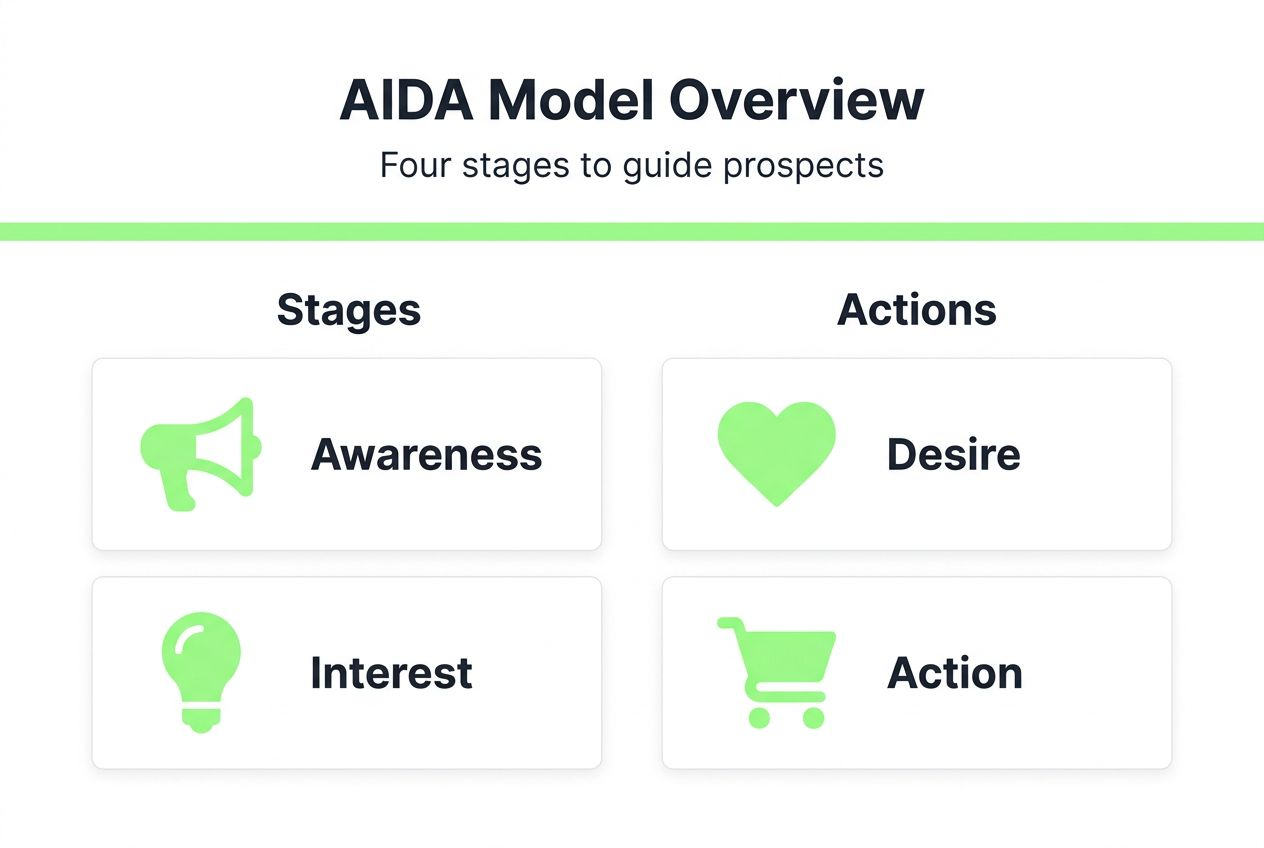
Awareness captures attention through compelling hooks that interrupt scrolling or searching. Interest builds by connecting your solution to prospect needs through educational content. Desire transforms interest into emotional want by highlighting benefits, social proof, and transformation. Action converts desire through clear calls and frictionless processes.
The AIDA model aligns marketing (top funnel awareness and interest) with sales (bottom funnel desire and action), creating shared language across functions. For solopreneurs wearing both hats, this alignment prevents wasted effort on mismatched messaging. Marketing content naturally feeds sales conversations when both follow the same progression.
Benefits include measurement clarity: you can track performance at each AIDA stage with specific KPIs. Awareness metrics include reach and impressions. Interest tracks engagement and content consumption. Desire measures comparison actions like demo requests. Action monitors conversion rates and revenue.
Pro Tip: Use AIDA to audit existing content and identify gaps. If you have strong awareness content but weak desire-stage materials, that explains drop-offs before purchase and shows exactly where to focus improvement efforts.
| Framework | Primary Focus | Best For | Complexity |
|---|---|---|---|
| AIDA | Linear progression through emotional states | Solopreneurs, simple products | Low |
| TOFU/MOFU/BOFU | Content alignment by funnel depth | Content marketers | Medium |
| Pirate Metrics (AARRR) | SaaS growth and retention loops | Subscription businesses | High |
| Flywheel | Customer-driven growth momentum | Established businesses | Medium |
AIDA’s simplicity makes it ideal for solopreneurs building initial funnels without overengineering. As you grow and achieve product market fit startup success, you can layer additional sophistication.
Optimizing the sales funnel: practical steps for solopreneurs
Start by mapping your current customer journey. Document every touchpoint from first discovery through purchase and beyond. Identify where prospects enter, what content they consume, and where they drop off. This visibility reveals specific leaks to address rather than guessing at improvements.
Implement email nurturing to stay connected with prospects not ready to buy immediately. Create a welcome sequence introducing your approach, a value-driven newsletter sharing expertise, and targeted campaigns for specific segments. Email remains the highest-ROI channel for solopreneurs because it’s permission-based, owned (not rented from platforms), and highly measurable.
Track metrics religiously: conversion rates between stages, time in each stage, cost per lead, and customer acquisition cost. Set up simple dashboards (even spreadsheets work initially) to monitor trends weekly. Data reveals whether problems stem from traffic quality, messaging misalignment, or friction in the buying process.
Use AI and automation to scale personalization without proportional time investment. Tools can segment audiences based on behavior, trigger relevant follow-ups automatically, and surface insights about which content drives conversions. This technology levels the playing field, letting solopreneurs compete with teams through intelligent systems, as detailed in AI tools for product market fit success guides.
- Define your target customer and map their journey from awareness to purchase
- Create stage-specific content addressing questions and objections at each level
- Set up email sequences to nurture leads who aren’t ready to buy immediately
- Implement tracking to measure conversion rates between funnel stages
- Test messaging variations to identify what resonates most with your audience
- Review funnel data monthly and iterate based on where prospects drop off
Pro Tip: Small optimizations compound dramatically. Improving conversion from 2% to 3% at three funnel stages (1.5x each) creates 3.4x overall improvement (1.5 × 1.5 × 1.5). Focus on incremental gains across the entire funnel rather than chasing home runs at a single stage.
Case studies and real-world examples
A SaaS startup serving freelancers achieved 120% revenue growth by restructuring their funnel around clear stages. Previously, they drove traffic directly to pricing pages, assuming awareness automatically converted to action. By inserting educational content addressing common freelancer challenges at the awareness stage, case studies at interest, and comparison charts at decision, they tripled conversion rates without increasing traffic costs.
Targeted content drives engagement when aligned with funnel stages. An e-commerce solopreneur selling productivity planners created awareness through viral social posts about time management struggles, built interest with free downloadable templates, generated desire through customer transformation stories, and drove action with limited-time discount codes. This staged approach converted 8% of email subscribers compared to 1.5% previously.
Lessons learned emphasize the importance of patience. Prospects rarely buy on first exposure, especially for considered purchases or higher price points. One coaching business found their average customer required seven touchpoints across 28 days before purchasing. Previously, they abandoned leads after one or two interactions, losing 85% of eventual customers through impatience.
Lead nurturing through consistent value delivery builds trust that makes closing natural rather than pushy. A B2B consultant shared weekly insights for six months before prospects engaged for paid services. This long game felt inefficient initially but created a qualified pipeline of warm leads who already trusted his expertise, closing at 40% versus 8% for cold outreach.
- Educational content at awareness stages reduces skepticism and positions you as a trusted resource
- Social proof and case studies at decision stages overcome final objections more effectively than discounts
- Post-purchase nurturing for referrals and upsells often delivers higher ROI than acquiring new customers
- Simplicity wins: Basic funnels executed consistently outperform complex systems implemented poorly
Real-world examples like these and strategies for early customers case studies show how systematic funnels transform sporadic sales into predictable revenue.
Bridging sales funnels to product-market fit
Sales funnel metrics directly validate whether your product solves real market needs. High awareness but low interest suggests your messaging attracts the wrong audience or fails to communicate value clearly. Strong interest but poor conversion at decision indicates competitors offer superior solutions or your pricing misaligns with perceived value. These signals guide strategic pivots before burning resources.
Well-optimized funnels lower customer acquisition costs, making testing and iteration economically viable. When acquisition costs exceed lifetime value, growth becomes unsustainable. Funnel improvements that double conversion rates effectively halve acquisition costs, buying runway to refine your offering until product-market fit emerges.
Funnel data guides iteration by showing which messages, features, and benefits resonate most. If prospects convert best after seeing specific case studies, that reveals the use case to emphasize. If certain objections appear repeatedly at decision stage, that highlights product improvements or messaging adjustments to prioritize.
Sustainable growth requires alignment between what you build and what markets want. Funnels provide the feedback loop connecting product development to market response. Rather than building in isolation and hoping customers appear, you systematically test positioning, messaging, and offers, using conversion data to validate assumptions, as explored in validate product market fit new entrepreneurs resources.
- Track leading indicators like email engagement and demo requests alongside lagging indicators like revenue
- Use A/B testing to validate which value propositions resonate before overhauling positioning
- Monitor cohort retention to confirm initial conversions represent genuine fit, not just effective marketing
- Let funnel bottlenecks inform product roadmap priorities by revealing friction points prospects care about most
Achieving product market fit startup success requires both building something people want and communicating that value effectively. Funnels serve both purposes by systematically testing market response and optimizing how you present solutions.
Explore tools to build and optimize your sales funnels
Mastering sales funnel basics positions you to convert ideas into viable businesses systematically. The concepts covered here provide the foundation, but implementation requires tools designed specifically for solopreneurs navigating the founder journey. siift.ai solutions for solopreneurs offer AI-driven insights and step-by-step guidance to design, measure, and improve your funnels without requiring marketing teams or technical expertise. The platform helps you validate assumptions, prioritize actions, and accelerate progress toward product-market fit by filtering out distractions and focusing on what actually drives conversions. Explore how data-driven frameworks and intelligent tools can transform your approach from guesswork to systematic growth.
Frequently asked questions
What are the most important metrics to track in a sales funnel?
Focus on conversion rates between each stage to identify where prospects drop off most severely. Customer acquisition cost (CAC) reveals whether your funnel economics support sustainable growth. Track lead nurturing engagement rates like email opens and content consumption to gauge interest levels. Monitor funnel leakage percentages at each transition point to prioritize optimization efforts where they’ll have the greatest impact.
Is the AIDA model suitable for novice solopreneurs?
Absolutely. AIDA provides a simple framework that aligns marketing content with sales progression without requiring specialized tools or teams. It’s used by over 65% of marketing professionals precisely because it works across industries and scales. The model helps novices think systematically about customer journeys rather than creating random content, making it ideal for solopreneurs building their first funnels.
How often should I review and update my sales funnel?
Review funnel performance data monthly at minimum, quarterly for more established businesses. Use conversion metrics to identify weak points where prospects abandon the journey. Iterate messaging, content, and tactics regularly based on what data reveals about audience behavior and preferences. Markets and customer needs evolve constantly, so static funnels decline in effectiveness over time even if they initially performed well.
Can a sales funnel help achieve product-market fit?
Definitely. Funnel metrics provide early signals about whether your positioning resonates with target markets before scaling. Lower customer acquisition costs enabled by optimized funnels create budget to test variations and iterate toward fit. Conversion data at each stage reveals which messages, features, and benefits matter most to prospects, directly informing product development priorities. Funnels serve as the feedback mechanism connecting what you build to what markets actually want and will pay for.