
Most small business owners treat customer loss like bad weather. Unfortunate, sure, but ultimately outside their control. That belief is costing you more than you realize. The truth is, churn is not random. Customers leave for patterns you can identify, predict, and act on before they walk out the door. Churn analysis transforms raw customer data into a clear picture of what is working and what is quietly eroding your revenue. For entrepreneurs who want to compete smarter and retain more of the customers they worked hard to win, understanding churn analysis is not optional. It is one of the most powerful strategic tools available to you right now.
Table of Contents
- What is churn analysis and why does it matter?
- Core methods of churn analysis
- Step-by-step process for conducting churn analysis
- How to use churn analysis to boost retention and strategy
- Why most churn analysis projects fail: Lessons from the real world
- Take your retention strategy further with siift.ai
- Frequently asked questions
Key Takeaways
| Point | Details |
|---|---|
| Churn analysis deciphers lost customers | It uses behavioral and billing data to help you understand and reduce customer loss. |
| Multiple methods suit any business | Whether through quantitative or qualitative approaches, churn analysis can be adapted to your needs. |
| Step-by-step action simplifies the process | Defining churn, cleaning data, and prioritizing action makes analysis manageable and effective. |
| Real value comes from action | Applying churn insights boosts retention rates and sharpens overall business strategy. |
| Overcomplicating wastes time | Focus on practical changes—instead of perfection—for the biggest gains. |
What is churn analysis and why does it matter?
Churn, at its simplest, is when a customer stops doing business with you. It could mean canceling a subscription, going silent after a purchase, or switching to a competitor. Churn analysis is the discipline of understanding exactly when and why that happens.
Churn analysis is the process of studying customer data to identify when and why customers leave, using behavioral, billing, and support data to predict and prevent churn.
For small businesses, the cost of churn is not just the lost sale. It is the marketing spend to acquire that customer, the onboarding time, the relationship capital built over months. Studies consistently show that acquiring a new customer costs five to seven times more than retaining an existing one. When you multiply that across dozens or hundreds of churned customers per year, the financial impact becomes impossible to ignore.
Here is why churn analysis matters specifically to entrepreneurs:
- It reveals which customers are most at risk before they leave, giving you a window to intervene
- It uncovers product or service gaps that your team may be too close to see
- It helps you allocate retention budget toward the customers who generate the most value
- It gives you data to prioritize improvements instead of guessing what to fix
- It connects directly to growth strategies for startups, because sustainable growth requires keeping the customers you already have
The predictive potential here is what makes churn analysis genuinely exciting. You are not just looking backward at who left. You are building a forward-looking radar that flags risk early. That shift from reactive to proactive is where small businesses start to compete like much larger ones.
Core methods of churn analysis
Once the concept is clear, it helps to understand the main approaches used to analyze why customers leave. The good news is that you do not need a data science team to get started. Several methods are accessible even to solo founders.
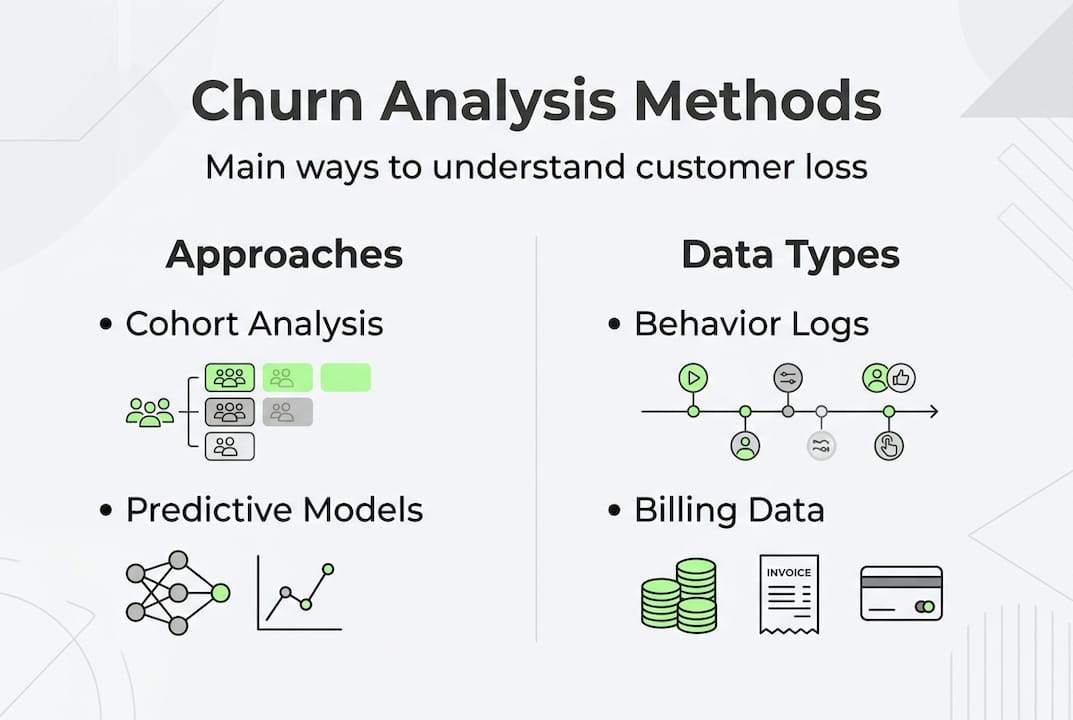
Key methodologies include cohort analysis, RFM analysis, predictive modeling, and qualitative methods like exit surveys and interviews. Each serves a different purpose depending on your data maturity and business model.
Here is a quick breakdown:
- Cohort analysis groups customers by the date they joined and tracks their behavior over time. This shows whether customers acquired in January retain better than those acquired in June, pointing to seasonal or campaign-driven differences.
- RFM analysis scores customers on Recency (how recently they bought), Frequency (how often), and Monetary value (how much they spend). High-value customers who suddenly go quiet are your most urgent churn risks.
- Predictive modeling uses statistical techniques like logistic regression or random forests to score every customer’s probability of churning. This is more advanced but increasingly accessible through modern analytics tools.
- Qualitative research such as exit surveys and customer interviews fills in the “why” that numbers alone cannot explain. A customer who churned because of poor onboarding will not show up differently in your billing data without this layer.
| Method | Data needed | Best for |
|---|---|---|
| Cohort analysis | Sign-up dates, activity logs | Spotting retention trends over time |
| RFM analysis | Purchase history, dates, amounts | Identifying high-risk valuable customers |
| Predictive modeling | Large behavioral datasets | Scaling proactive outreach |
| Qualitative research | Surveys, interviews | Understanding root causes |
Pro Tip: If you are just starting out, skip the complex models. A simple RFM analysis in a spreadsheet can surface your most at-risk customers in an afternoon. Complexity is not a prerequisite for insight. Many founders avoid common startup mistakes by starting with the simplest method that gives them actionable answers.
Step-by-step process for conducting churn analysis
Understanding methodologies is key, but entrepreneurs need a relatable playbook to actually get started. Here is how to run your first churn analysis without getting lost in the weeds.
The core steps are: define churn, collect and clean your data, segment and explore patterns, build models if needed, and prioritize actions on high-value at-risk customers.
- Define what churn means for your business. This sounds obvious but it is where most analyses go wrong. Is a customer churned after 30 days of inactivity? 60 days? After a missed renewal? Get specific. A vague definition produces vague insights.
- Collect and clean your data. Pull from your analytics platform, billing system, and support tickets. Messy or incomplete data will skew every conclusion you draw. Deduplicate records and fill gaps where possible.
- Segment and explore patterns. Break your churned customers into groups. Did they leave after a specific product update? Did they share a common acquisition channel? Were they all on a particular pricing tier? Patterns hide in segments.
- Build a model or scoring system. Even a simple rule-based score (customers who have not logged in for 45 days and have open support tickets get flagged) can be powerful. You do not need machine learning to start.
- Act on your insights. This is the step most founders skip. Insights without action are just interesting trivia.
Businesses that act on churn signals early retain significantly more revenue than those that wait for cancellation to trigger a response.
A critical part of derisking your startup strategy is building systems that catch problems before they compound. Churn analysis is exactly that kind of system. And as you build startup traction step by step, retention becomes the multiplier that makes every new customer acquisition count more.

How to use churn analysis to boost retention and strategy
With a process in hand, it is time to translate churn analysis into retention action and smarter strategy. Data without a plan is just noise.
Churn analysis helps you prioritize actions on high-value at-risk customers, which means your energy goes where it generates the most return. Here are practical moves you can make once you have your churn data in hand:
- Trigger personalized outreach to customers showing early warning signs, before they decide to leave
- Fix onboarding gaps that cause early-stage churn, which is often the highest-volume churn segment for new businesses
- Redesign pricing or packaging if analysis reveals that customers on a specific plan churn at disproportionate rates
- Create loyalty incentives for high-value customers who are showing reduced engagement
- Invest in employee retention solutions because internal team stability directly affects the quality of customer experience you deliver
| Churn signal | Intervention | Expected outcome |
|---|---|---|
| No login in 30 days | Personalized re-engagement email | 15 to 25% reactivation rate |
| Support ticket unresolved 7+ days | Priority escalation and follow-up | Reduced frustration-driven churn |
| Downgrade from premium plan | Targeted value demonstration call | Potential upsell or save |
| Negative survey response | Direct outreach from founder | Relationship repair and feedback loop |
Pro Tip: Use churn insights to sharpen your entire business strategy, not just your retention campaigns. If a specific customer segment churns at three times the rate of others, that is a signal to reconsider whether that segment is your real target market. The best founders use churn data to get traction for their startup by doubling down on the customers who stay and thrive. This is also one of the most practical ways to reduce risk in your business model.
Why most churn analysis projects fail: Lessons from the real world
Here is an uncomfortable truth most articles will not tell you. The majority of churn analysis projects in small businesses stall not because of bad data, but because of overcomplication and unrealistic expectations.
Founders read about machine learning models and survival analysis, then either hire someone expensive to build something they cannot maintain, or they abandon the project entirely. Both outcomes are avoidable. The real lesson from the front lines is that simple, consistent analysis beats sophisticated, occasional analysis every time.
Another hard truth: not every lost customer is a failure. Some customers were never a good fit. Some churn because of life changes, budget cuts, or circumstances entirely outside your control. Treating all churn as preventable leads to wasted resources and demoralizing campaigns targeting people who were never going to stay.
What actually works is narrowing your focus. Identify the churn that is controllable, the customers who left because of something you could have fixed, and build your systems around preventing that specific loss. Following founder best practices means knowing where your leverage is and applying it precisely, not trying to solve every problem at once. Start small, stay consistent, and let the data guide your priorities over time.
Take your retention strategy further with siift.ai
Understanding churn analysis is a powerful first step. Putting it into consistent, strategic action is where the real growth happens. That is exactly where siift.ai was built to help. siift’s Intelligent Business Canvas is an agentic AI platform designed for founders and small business owners who want to build validated, data-informed strategies without the guesswork. It guides you step by step through ideation, validation, and go-to-market planning, helping you identify the customers worth fighting for and the strategies most likely to keep them. If you want to see how other founders are turning insights into traction, explore real startup success stories and discover what a sharper retention strategy can unlock for your business.
Frequently asked questions
How do you calculate churn rate for a small business?
Divide the number of customers lost during a period by the total number of customers at the start of that period, then multiply by 100 to get a percentage. Tracking churn clearly, such as by inactivity threshold or lost accounts, is the essential first step.
What tools or software are best for churn analysis?
Popular options include analytics platforms like Amplitude or Mixpanel, CRM systems like HubSpot, dedicated churn tools like ChurnZero, and survey tools for qualitative feedback. The best choice depends on where your behavioral, billing, and support data currently lives.
Can churn analysis work for non-subscription businesses?
Absolutely. Any business where you can track repeat customer behavior can benefit. Cohort or RFM analysis works just as well for retail, services, or project-based businesses as it does for SaaS companies.
What are early warning signs that a customer may churn?
Watch for declining purchase frequency, reduced platform logins, increased or unresolved support tickets, and negative survey scores. Behavioral and support data are your earliest and most reliable churn signals.
Is churn always preventable with analysis?
No, and accepting that is actually freeing. Churn analysis prioritizes your energy on controllable losses, helping you reduce avoidable churn without burning resources chasing customers who were never going to stay.