
TL;DR:
- Modern loyalty prioritizes emotional connection, personalization, and community over discounts.
- Building an AI-driven loyalty system requires a CRM, feedback loop, personalization, and privacy policies.
- Successful loyalty relies on authenticity, micro-communities, and human touch, not just technology.
You spend weeks, sometimes months, attracting a first-time customer. They buy once, and then they vanish. Sound familiar? This is one of the most painful and expensive cycles in early-stage entrepreneurship, and it hits hardest when you’re building an AI-driven venture with limited runway. The good news: acquiring new customers costs 5x more than keeping existing ones, and a 5% lift in retention can grow profits by up to 95%. For millennial and Gen Z founders building the next wave of AI-powered businesses, the loyalty playbook has changed completely. Let’s break down what actually works in 2026.
Table of Contents
- Understanding the new loyalty landscape
- Laying the foundation: Essentials for loyalty success
- Step-by-step: Building an AI-powered loyalty loop
- Avoiding pitfalls: Common mistakes and how to fix them
- Measuring, optimizing, and scaling loyalty efforts
- What most guides miss about loyalty: Our take
- Accelerate loyalty growth with the right AI partner
- Frequently asked questions
Key Takeaways
| Point | Details |
|---|---|
| Tech alone isn’t enough | Successful loyalty strategies blend AI-powered personalization with authentic community and feedback touchpoints. |
| Focus on retention ROI | Boosting customer retention even slightly leads to outsized profit growth and long-term stability. |
| Design rewards for new generations | Millennials and Gen Z engage most with gamified, privacy-first, and value-driven loyalty experiences. |
| Track and tweak relentlessly | Continuously monitor and optimize loyalty metrics using AI insights and real customer input. |
Understanding the new loyalty landscape
Loyalty used to mean a punch card or a points balance. That era is over. Today’s customers, especially millennials and Gen Z, expect something far more meaningful before they commit to a brand. They want to feel seen, heard, and genuinely valued. And if your loyalty strategy is purely transactional, they’ll sense it immediately and walk.
What does modern loyalty actually look like? Think emotional connection over discounts, community over coupons, and personalization over generic rewards. According to loyalty strategy insights, the brands winning long-term customer relationships are those that create experiences, not just incentives.
Here’s what millennials and Gen Z specifically demand from loyalty programs:
- Hyper-personalization: Recommendations and rewards that feel tailored, not templated
- Gamification: Progress bars, challenges, streaks, and status tiers that make loyalty feel like a game worth playing
- Privacy-first AI: Transparency about how data is used, with opt-in rather than opt-out defaults
- Sustainability signals: Alignment with values around environmental and social responsibility
- Exclusivity and community: Access to insider content, early product drops, or a tribe of like-minded people
As research confirms, millennials and Gen Z prefer hyper-personalized experiences, gamification, and privacy-first AI over traditional points. That’s not a preference. That’s a requirement.
| Loyalty type | What it looks like | Customer response |
|---|---|---|
| Transactional | Points, discounts, cashback | Short-term repeat purchase |
| Emotional | Community, exclusivity, shared values | Long-term brand advocacy |
| AI-powered | Predictive personalization, proactive outreach | Deep engagement and retention |
For solo founders and small teams, this shift is actually an opportunity. You don’t need a massive budget to build emotional loyalty. You need the right strategy, the right tools, and a genuine desire to serve your customers well. Using AI-powered customer research from day one helps you understand who your customers really are before you even design your loyalty approach.
Laying the foundation: Essentials for loyalty success
Before you execute any loyalty tactic, you need the right infrastructure. Most founders skip this step and wonder why their campaigns don’t stick. Loyalty isn’t a campaign. It’s a system.
As Gen Z entrepreneur trends show, solopreneurs should treat loyalty as an ongoing system, not a series of one-off campaigns, using AI tools for personalization without needing large teams. That reframe alone changes everything.
Here’s what your foundation needs to include:
- A CRM (customer relationship management tool) that captures behavioral data, not just contact info
- An AI personalization layer that can segment customers and trigger relevant communication
- A feedback collection system that runs continuously, not just after complaints
- A privacy policy that’s clear, honest, and compliant with current data regulations
- A reward structure that’s sustainable and doesn’t erode your margins
Pro Tip: If you’re using Shopify for e-commerce and HubSpot for CRM, connect them through a tool like Zapier or a native integration. This sync gives you a unified view of purchase behavior, email engagement, and customer lifetime value, which is the data you need to personalize loyalty at scale without hiring a team.
Not all actions are equal when building loyalty. Here’s a quick comparison to help you prioritize:
| Approach | Quick fix | Foundational action |
|---|---|---|
| Rewards | Launch a discount code | Build a tiered value program |
| Personalization | Send a birthday email | Use AI to predict next purchase |
| Feedback | Run a one-time survey | Embed feedback loops into every touchpoint |
| Community | Create a Facebook group | Build a branded community with rituals and identity |
Exploring AI tools for small teams can help you find the right stack without overspending. And if you want a curated shortlist, the top AI tools for founders in 2026 cover everything from personalization engines to churn prediction. The right loyalty program essentials don’t require enterprise budgets. They require intentional design.
Step-by-step: Building an AI-powered loyalty loop
With your foundation in place, it’s time to build the loop itself. This is where AI becomes a genuine force multiplier for solo founders.
-
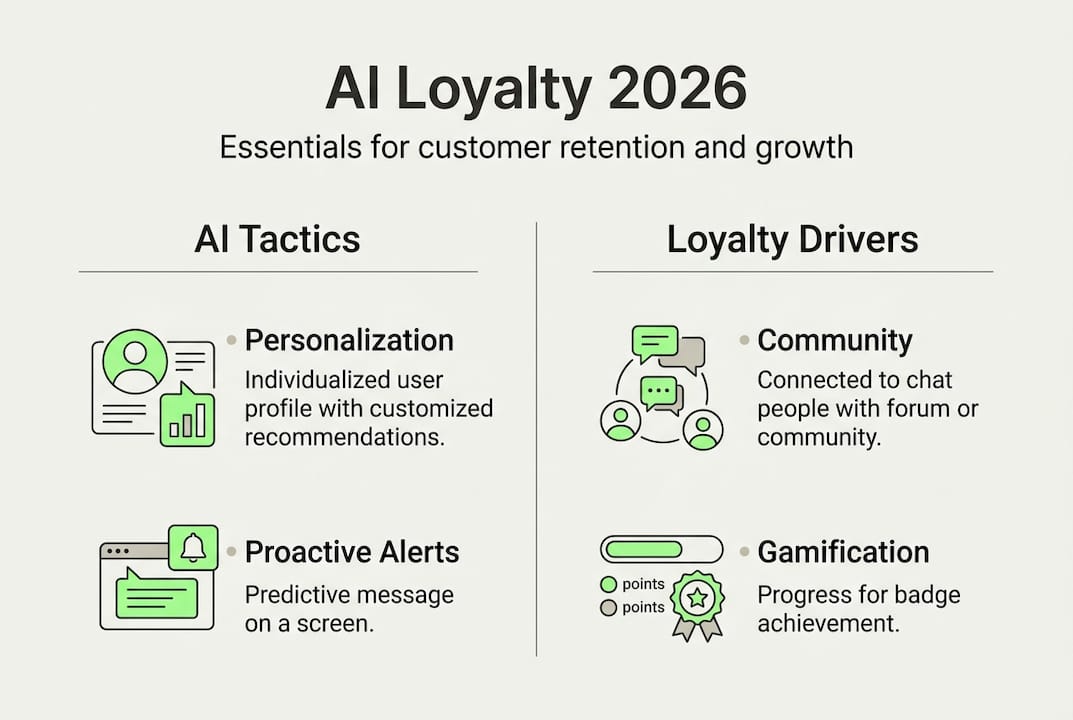
Personalized onboarding: First impressions shape long-term behavior. Use AI to tailor the onboarding experience based on how a customer found you, what they bought, and what similar customers did next. A personalized welcome sequence outperforms a generic one by a wide margin.
-
Community touchpoints: Create spaces where your customers connect with each other, not just with you. Discord servers, Slack communities, or even a curated newsletter with reader spotlights build emotional investment that no discount can replicate.
-
Gamified rewards: Replace static point balances with dynamic challenges, progress milestones, and status tiers. Let customers earn access to exclusive content, early releases, or co-creation opportunities. This is what loyalty program ROI data consistently shows drives repeat engagement.
-
Proactive AI communication: Don’t wait for customers to go quiet. Use predictive analytics to identify customers at risk of churning before they leave. A well-timed, personalized message at the right moment can recover a relationship that would otherwise be lost. Digging into churn analysis strategies gives you the framework to act early.
-
Feedback integration: Close the loop by asking customers what they love, what’s missing, and what would make them refer a friend. Then act on it visibly. When customers see their feedback reflected in your product or service, loyalty deepens fast.
As key loyalty strategies confirm, personalized onboarding, community building, gamified rewards, proactive communication, and predictive analytics are the core pillars of modern loyalty. And for AI-driven ventures specifically, hyper-personalization and churn prevention are where AI delivers the highest return.
If you’re still figuring out how to get early AI customers, building your loyalty loop early, even before you scale, sets the behavioral foundation that makes growth sustainable.

| Traditional loyalty | AI-enabled loyalty |
|---|---|
| Static points balance | Dynamic, behavior-based rewards |
| Batch email campaigns | Predictive, personalized outreach |
| Annual surveys | Continuous feedback loops |
| One-size-fits-all tiers | Individualized progression paths |
Avoiding pitfalls: Common mistakes and how to fix them
Even well-intentioned loyalty programs fail. Usually, it’s not because founders don’t care. It’s because they fall into predictable traps.
Here are the most common mistakes and how to fix them:
- Mistaking discounts for loyalty: Discounts attract bargain hunters, not brand advocates. If your loyalty program is built on price cuts, you’re training customers to wait for sales, not to value your brand.
- Over-automating human touchpoints: AI is powerful, but customers can feel when they’re talking to a bot pretending to be a person. Use automation for efficiency, but preserve genuine human moments for high-stakes interactions.
- Ignoring your best customers: 67% of consumers feel that brands prioritize new customers over loyal ones. That’s a massive trust gap. Your most loyal customers deserve recognition, not just your acquisition budget.
- Neglecting privacy: Personalization without transparency feels invasive. Always be clear about what data you collect and why.
“Traditional points-based programs erode margins over time and fail to build the emotional connection that drives true brand advocacy. The brands that win long-term are those that invest in relationships, not just transactions.”
Pro Tip: Turn your customer feedback into a predictive asset. Instead of reading feedback reactively, tag recurring themes and feed them into your AI tools to spot patterns before they become problems. This transforms complaints into a competitive advantage. For founders looking to stay lean while staying loyal to their customers, lean loyalty tactics offer a practical starting point.
Also worth noting: AI adoption in loyalty sits between 37% and 50% across businesses, yet execution lags significantly. The gap between planning and doing is where most founders lose ground. Move fast, test small, and iterate.
Measuring, optimizing, and scaling loyalty efforts
You can’t improve what you don’t measure. Once your loyalty loop is running, tracking the right metrics separates founders who scale from those who stall.
Here are the essential loyalty KPIs to monitor:
- Churn rate: The percentage of customers who stop buying within a set period
- Engagement frequency: How often customers interact with your brand, content, or community
- Net Promoter Score (NPS): A simple measure of how likely customers are to recommend you
- Reward ROI: Revenue generated per dollar spent on loyalty incentives
- Repurchase rate: The percentage of customers who buy again within 90 days
| Metric | What to track | Benchmark to aim for |
|---|---|---|
| Churn rate | Monthly customer loss | Below 5% monthly |
| NPS | Promoter minus detractor % | Above 50 |
| Reward ROI | Revenue per loyalty dollar spent | 5x or higher |
| Repurchase rate | 90-day repeat buyers | 30% or higher |
| Engagement frequency | Monthly active loyalty members | 60% or higher |
The numbers back this up. Loyalty program data shows average loyalty ROI of 5.2x, with 72% of customers more likely to spend with brands that have loyalty programs, and 64% monthly repurchase rates in high-performing sectors. Those aren’t vanity metrics. They’re signals that the right system creates compounding returns.
Automation handles the heavy lifting, but don’t automate your way out of authenticity. A handwritten thank-you note, a founder video message, or a personal check-in call can do more for loyalty than a hundred automated emails. Use AI tools for PMF to keep your strategy aligned with what customers actually want as you scale.
What most guides miss about loyalty: Our take
Here’s the uncomfortable truth most loyalty guides won’t tell you: technology is not the differentiator. Mindset is.
We’ve seen founders invest heavily in AI personalization engines and loyalty platforms, only to watch customers drift away because the brand never felt human. The founders who build the most loyal communities are the ones who treat feedback as a gift, not a threat. They create micro-communities where customers feel ownership, not just membership.
Discount-driven loyalty is a slow leak. Every coupon you send trains your audience to expect less from you, not more. The real leverage is in building non-transactional relationships, where customers stay because they believe in what you’re building, not because they’re waiting for the next sale.
For solo founders, this is actually your superpower. You can move faster, personalize more genuinely, and build community more authentically than any enterprise brand. Use AI as an amplifier for your human instincts, not a replacement for them. If you’re just starting out, AI tools for first-time founders can help you build these systems without the overwhelm. Start with one loyalty loop, measure it honestly, and iterate from there.
Accelerate loyalty growth with the right AI partner
Building real customer loyalty, the kind that compounds over time, requires more than a great product. It requires a validated strategy, the right tools, and a clear-eyed view of what your customers actually need. That’s exactly what siift is built for. siift’s Intelligent Business Canvas guides founders step-by-step through ideation, validation, and go-to-market, helping you build loyalty into your business model from day one, not as an afterthought. If you’re ready to stop guessing and start building with confidence, siift gives you the AI-powered clarity to move faster, smarter, and with far less risk.
Frequently asked questions
Why is building customer loyalty more valuable than acquiring new customers?
Retaining customers is 5x cheaper than acquiring new ones, and a 5% improvement in retention can boost profits by up to 95%, making loyalty the highest-ROI investment for early-stage founders.
What types of loyalty rewards actually work for Gen Z and millennials?
Gamified, experiential, and community-based rewards consistently outperform traditional points because they create emotional investment and a sense of belonging that discounts simply cannot replicate.
How can AI help small businesses build customer loyalty?
AI enables hyper-personalization and churn prevention at scale, giving even solo founders the ability to deliver standout experiences that feel tailored and proactive without a large team.
What’s the biggest mistake founders make in loyalty programs?
Over-relying on generic discounts and points while ignoring loyal customers erodes both margins and trust, making it the single most common and costly loyalty mistake in early-stage ventures.
Recommended
- Unlock your business growth with customer lifetime value | siift
- AI-Assisted Customer Discovery and Market Research (Founder’s Guide 2026) | siift
- How to Get Early Customers for My Startup With AI Tools | siift
- Master Business Strategy to Launch Your AI Venture | siift
- Role of AI in customer support: improving efficiency in 2026