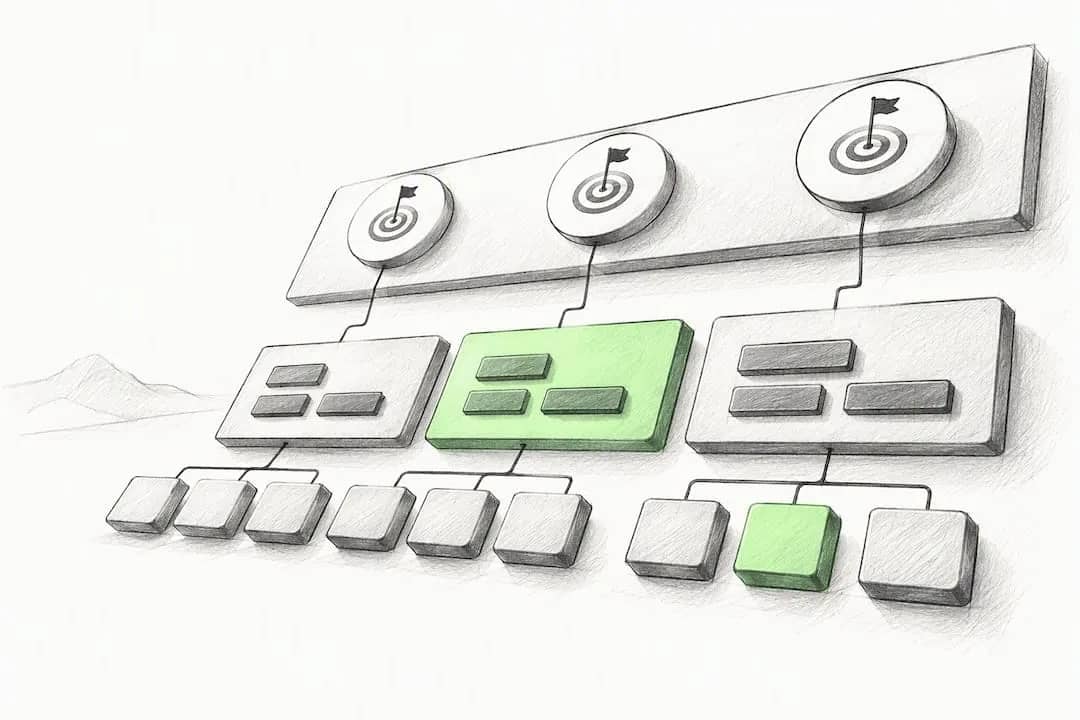

A software roadmap is a high-level visual plan that links your product vision to the major initiatives and outcomes you’re chasing over time. It is not a sprint board and it is not a detailed backlog. Its job is simple: help teams prioritize, stay aligned, and measure whether the work is actually moving the business forward.
TL;DR:
- A successful roadmap must explicitly connect initiatives to measurable business outcomes, not just list features or dates.
- Different visual formats serve specific purposes, such as outcome themes for leadership or timelines for execution sequencing.
- Building a roadmap requires clarifying the vision, defining success metrics first, and prioritizing based on value, risk, and dependencies.
- Using stage labels and audience-specific views helps maintain stakeholder trust when updating or sharing the roadmap.
- AI tools like siift simplify maintaining a connected, outcome-driven roadmap by integrating vision, metrics, and business cases in a guided workflow.
Table of Contents
- What a software roadmap is and what it is not
- Why teams need a roadmap: benefits and business value
- Common roadmap types and visual examples
- Step-by-step: build an outcome-first software roadmap
- How to share, maintain, and update roadmaps without losing trust
- Templates and tool categories to get started quickly
- How an AI-guided business OS helps teams execute outcome-first roadmaps
- Author perspective on priorities for modern roadmap practice
- siift: a practical next step to build and operationalize outcome-first roadmaps
- Sources
- FAQ
What a software roadmap is and what it is not
A real roadmap has a handful of core ingredients: a clear tie back to the product vision, themes or goals, the initiatives that support them, time horizons (near, mid, far), and the assumptions behind each bet. Think of it as a layered document. At the top sits strategic themes. One level down, release or epic groupings. At the most granular level, individual features, though that detail usually belongs closer to delivery, rather than on the roadmap itself.
Here’s where founders trip up: they confuse the roadmap with the backlog. A backlog is a queue of tasks. A roadmap is a story about outcomes. Mixing the two turns a strategic document into a to-do list nobody trusts, because every date starts looking like a promise instead of a plan.

Why teams need a roadmap: benefits and business value
A roadmap earns its keep in four ways. It gets engineering, sales, marketing, and leadership looking at the same map instead of four different ones. It forces trade-off conversations before they become fire drills. It gives you something concrete to show investors, customers, or your board when they ask “what’s next.” And when it’s built well, it connects delivery work directly to the business outcomes you’re accountable for, not just to a list of shipped features.

That last point is the one most teams skip, and it’s the one AWS’s product-strategy guidance leans on hardest: a roadmap without measurable outcomes attached is just a wish list with a timeline.
Common roadmap types and visual examples
Different audiences need different views, and picking the wrong format is a fast way to lose a room. Here’s how the major formats map to their best use case:
- Now/Next/Later: best for public-facing or customer-friendly summaries where exact dates would be a liability.
- Goals and themes (outcomes roadmap): best for strategy conversations with leadership or the board, where the “why” matters more than the “when.”
- Timeline or release roadmap: best when sequencing and dependencies actually drive the plan, like a multi-team launch.
- Portfolio or epic/feature view: best for engineering planning across multiple products, where teams need to see overlap and shared dependencies.
Pick the format based on who’s reading it and what decision they need to make, not on what looks impressive in a slide deck.
Step-by-step: build an outcome-first software roadmap
Building a roadmap that actually holds up under scrutiny follows a fairly predictable sequence. Skip a step and you’ll feel it later, usually in a meeting where someone asks “why are we building this again?”
- Articulate the vision. Write down the outcome you’re actually trying to produce, not just the feature you’re excited about.
- Define measurable success metrics first. AWS’s product-strategy framework specifically recommends three or more measurable metrics before you prioritize anything, so you’re optimizing for value instead of activity.
- Build a concise business case. Connect each initiative back to the metric it’s supposed to move.
- Prioritize by value, risk, and dependencies. Resist the urge to attach hard dates to anything more than a quarter out.
- Choose your roadmap view and plan near-term delivery. Mark anything beyond the next horizon as uncertain, on purpose.
- Operationalize a learning loop. Feed real usage and feedback back into the metrics you set in step two, and let that reshape the plan. Our guide to measuring business success walks through picking metrics that actually predict outcomes, and this prioritization framework helps once you’ve got your list of candidate initiatives.
Pro Tip: Write your success metrics before you write a single feature name. It’s the cheapest insurance against building the wrong thing beautifully.
How to share, maintain, and update roadmaps without losing trust
The fastest way to torch stakeholder trust is to publish a date and miss it. The fix isn’t fewer updates, it’s better labels.
- Use stage labels like exploring, in design, almost there, and shipped instead of committing to fixed long-term dates.
- Publish audience-specific views so executives see outcomes, engineers see sequencing, and customers see what’s actually relevant to them.
- When priorities shift, tell stakeholders why, backed by evidence, not just that they shifted.
- Tie every update back to a measured outcome, not just a shipped ticket.
Docker’s public roadmap treats “Almost There” items as expected soon, while “Investigating” items carry no delivery commitment at all, which is exactly how Docker structures its state model to keep expectations honest. That kind of labeling does more for stakeholder trust than any status meeting ever will.
Templates and tool categories to get started quickly
You don’t need to build your first roadmap from scratch. Start with one of three formats: a Now/Next/Later board, a quarterly goals-and-themes grid, or a simple outcomes-to-initiatives table.
For tooling, think in categories rather than brand names:
- Lightweight visual boards for teams that just need clarity, fast.
- Integrated backlog-to-roadmap tools when engineering needs the roadmap and the backlog to talk to each other.
- Public roadmap pages for customer-facing transparency.
- Presentation-friendly exports for board decks and investor updates.
Choose based on your audience, how often you update, how much friction that update takes, and who needs visibility.
How an AI-guided business OS helps teams execute outcome-first roadmaps
Most of the friction in roadmap work isn’t the format, it’s the thinking that has to happen before the format matters: getting the vision clear, picking metrics that actually mean something, and connecting initiatives to a business case that holds up. siift’s New Business OS guides founders and product teams through exactly that sequence, agentically, so vision, metrics, and business case stay connected instead of living in three different documents. It also keeps assumptions, risks, and dependencies visible as you go, which is the difference between a roadmap you trust and one you quietly ignore by month three.
Author perspective on priorities for modern roadmap practice
The best roadmaps aren’t the most detailed ones. They’re the ones brave enough to say “we don’t know yet” out loud, back it with evidence, and update fast when the evidence changes.
— Samim Safaei
siift: a practical next step to build and operationalize outcome-first roadmaps
Building the roadmap workflow above by hand across five different documents is exhausting, and exhausting is exactly what founders don’t have room for. Certain AI platforms map vision, metrics, and business case in one guided flow, helping keep your roadmap connected to the strategy behind it instead of drifting into a feature list. Check out siift’s pricing to see the Free, Discover, and Focus plans, or explore the go-to-market planning tools built for teams turning a roadmap into real traction.
Sources
- Build a sustainable product roadmap with AWS
- SWE-013 - Software Plans - NASA Software Engineering Handbook Ver B
- Docker roadmap (example analysis)
FAQ
What is a software roadmap in simple terms?
A software roadmap is a visual plan connecting your product vision to the major initiatives you’ll pursue to get there. It’s strategic and outcome-focused, unlike a backlog, which tracks individual tasks for a team.
How is a roadmap different from a backlog?
A roadmap communicates strategy, themes, and expected outcomes across a longer horizon, while a backlog is a working list of specific tasks or tickets for near-term delivery. Teams that treat the two as interchangeable end up with a roadmap full of dates nobody actually planned to hit.
How often should a software roadmap be updated?
There’s no fixed universal cadence, but roadmaps should be reviewed whenever new evidence, such as customer feedback or shifting metrics, changes your priorities. NASA’s software planning guidance emphasizes keeping plans current across the full lifecycle rather than treating them as one-time documents.
What metrics should a roadmap track before prioritizing features?
AWS recommends defining three or more measurable success metrics tied to business outcomes before you prioritize any initiative. This keeps the roadmap focused on value delivered rather than just features shipped.
Can siift help build a software roadmap?
siift’s New Business OS guides founders through defining vision, setting measurable metrics, and mapping initiatives to a business case, the same sequence this guide recommends. It’s built for founders and product teams validating and accelerating a business, not as a project management backlog tool.