

TL;DR:
- Internships provide practical skills, professional networks, and career clarity that boost starting salaries.
- Completing three internships, especially long-term paid ones, significantly increases employment chances and earnings.
An internship is a structured, temporary work experience that gives college students and recent graduates direct exposure to professional environments, real responsibilities, and the networks that actually get you hired. The importance of internships goes far beyond resume padding. Graduates with internship experience are over twice as likely to earn a starting salary above $80,000 compared to those without any internship. That single data point should reframe how you think about the next semester break.
What key benefits do internships provide to college students?
Internships deliver practical skill development that no classroom can replicate. You learn to communicate across teams, manage deadlines under real pressure, and navigate workplace culture. Those are the skills hiring managers actually test for in interviews.

The networking effect is just as powerful. Internships connect you to professionals who can refer you, recommend you, or hire you outright. Research shows that internships double your odds of landing a first job within three months of graduation. That is not a minor edge. That is the difference between starting your career and waiting tables while you apply.
There is also a less-discussed benefit: professional identity formation. According to research published in the World Journal of Education, professional identity formation through internships is a key but widely overlooked factor in long-term employability. Students who intern develop a clearer sense of who they are at work, which roles suit them, and what kind of culture they thrive in. That self-knowledge accelerates every career decision that follows.
Core benefits at a glance:
- Skill development: You practice communication, project management, and problem-solving in real conditions.
- Career clarity: You test industries and roles before committing to a full-time path.
- Professional networks: You build relationships that generate referrals and job offers.
- Confidence: You prove to yourself and employers that you can perform in a professional setting.
- Workforce readiness: Research from the Center for Engaged Learning shows 59.2% of graduates who interned felt college prepared them for the workforce, versus only 32.4% of non-interns.
Pro Tip: Treat every internship as a long interview. The people you work with are your most credible future references.
How do different internship factors influence career outcomes?
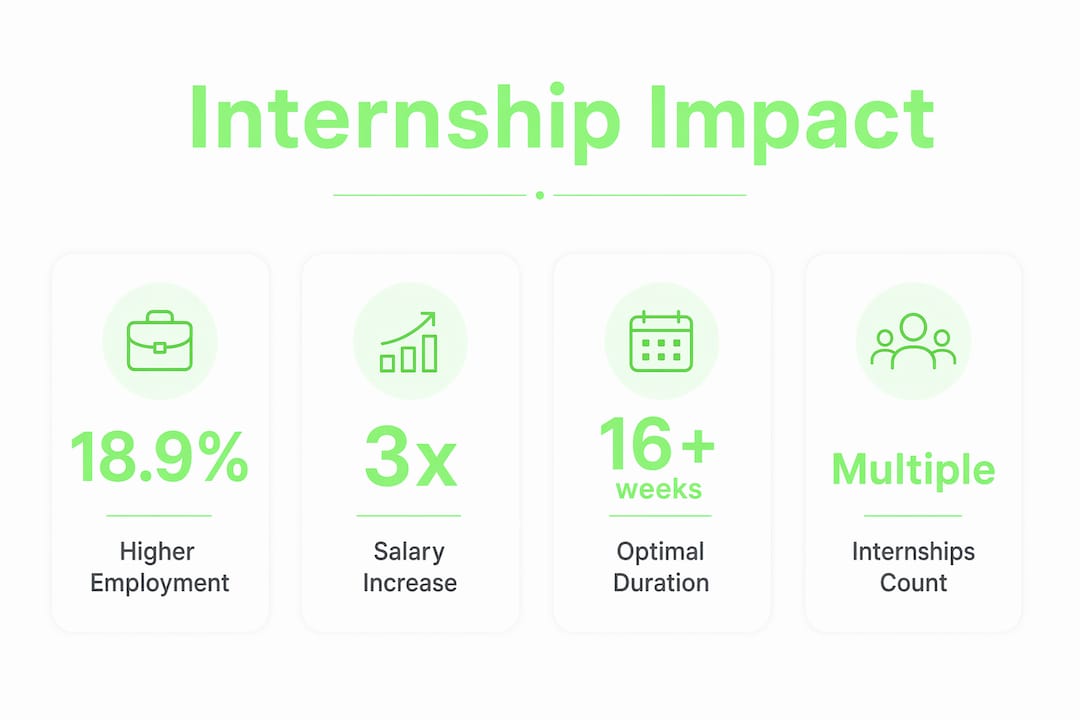
Not all internships are created equal. Duration, quantity, and whether you get paid all shape how much career value you extract.
Duration matters more than you think
A longitudinal study found that graduates with 16-week internships have an 18.9 percentage point higher employment rate five years after graduation compared to those who completed traditional 30-day internships. That gap is enormous. A longer placement gives you time to take on real projects, build deeper relationships, and demonstrate actual impact rather than just showing up and shadowing someone.
More internships compound your advantage
Completing multiple internships does not just add lines to your resume. It multiplies your salary potential. EWU research shows that three completed internships nearly triple the likelihood of earning a starting salary above $80,000 compared to completing just one. The compounding effect is real and measurable.
Paid vs. unpaid: the honest breakdown
Paid internships produce stronger earnings outcomes. Unpaid internships still build career progression and open doors to college-level employment. The University of Wisconsin-Madison Center for Career and Work Transitions found that paid internships yield stronger monetary benefits, while unpaid placements still improve career trajectory meaningfully. If you have to choose, go paid. If the unpaid option is in your target field and the paid one is not, the field alignment often wins long-term.
| Internship type | Employment impact | Earnings impact |
|---|---|---|
| Short-term (under 8 weeks) | Moderate boost | Minimal salary gain |
| Long-term (16+ weeks) | 18.9 pp higher employment rate at 5 years | Significant salary increase |
| Single internship | Doubles job-landing odds | 14% earn $80k+ starting |
| Three or more internships | Compounding career advantage | 28% earn $80k+ starting |
| Paid internship | Strong workforce entry | Higher lifetime earnings |
| Unpaid internship | Career progression improvement | Limited direct earnings boost |
Pro Tip: If you can only do one internship, make it long. A 16-week placement beats two 6-week stints for long-term employment outcomes.
Why do employers value internship experience beyond skills?
Employers are not just looking for what you know. They are looking for signals about who you are at work. Internship experience communicates qualities that a GPA and a transcript simply cannot.
UW-Madison CCWT research confirms that employers treat internships as resume signals for professionalism, reliability, and the ability to navigate office culture. These are unobservable qualities in a traditional hiring process. An internship is proof of concept.
The Strada Education Foundation found that employers treat internships as strategic business investments, not just talent pipelines. They assign interns to real problems. Interns who solve those problems convert to full-time offers at significantly higher rates. That means your internship is simultaneously a job audition and a business contribution.
Here is how employers rank what they look for in intern candidates:
- Demonstrated reliability. Showing up prepared, meeting deadlines, and following through signals that you will do the same as a full-time employee.
- Cultural fit. Employers want to know you can work with their team without friction. Internships test this in real time.
- Problem-solving under real conditions. Classroom projects are controlled. Workplace problems are not. Employers value students who have navigated ambiguity before.
- Professional communication. Writing clear emails, presenting ideas confidently, and knowing when to ask for help are skills employers cannot assess from a transcript.
- Commitment to growth. Interns who seek feedback and improve during their placement signal coachability, which is one of the most valued traits in early-career hires.
How can students maximize the value of their internships?
Getting an internship is step one. Getting the most out of it is the part most students underestimate.
Start by choosing placements that align with your actual career interests and offer real responsibility. An internship where you spend eight weeks filing documents teaches you almost nothing. Look for roles where you will own a project, contribute to a team goal, or solve a defined problem. The volunteering and skill-building principle applies here too: the more you contribute, the more you learn.
Build relationships deliberately. Do not wait for your manager to introduce you around. Ask for informational conversations with people in roles you find interesting. Seek out a mentor within the organization. Research on peer mentorship benefits consistently shows that guided relationships accelerate skill development faster than solo experience. The same holds true inside an internship.
Treat the role as a strategic engagement, not a temporary gig. Identify a real business challenge your team faces and propose a solution. Even if your idea is not adopted, the act of thinking at that level gets noticed. The Strada Education Foundation found that interns who contribute solutions to real problems convert to full-time offers at higher rates.
After the internship ends, follow up. Send a thank-you note within 48 hours. Connect on LinkedIn with every person you worked with. Check in with your manager three months later. Most students disappear after their last day. The ones who stay in touch are the ones who get called when a position opens.
- Select internships with real project ownership, not just observation roles.
- Seek a mentor inside the organization within the first two weeks.
- Identify one business problem and propose a solution before the placement ends.
- Connect with every colleague on LinkedIn before your last day.
- Follow up with your manager 90 days post-internship to stay on their radar.
Key takeaways
Internship experience is the single most effective step college students can take to increase starting salary, accelerate job placement, and build the professional identity that employers actually hire for.
| Point | Details |
|---|---|
| Salary impact is real | Graduates with three internships are nearly three times more likely to earn $80k+ starting. |
| Duration drives outcomes | A 16-week internship produces an 18.9 pp higher employment rate at five years versus a 30-day placement. |
| Paid beats unpaid for earnings | Paid internships yield stronger lifetime earnings; unpaid still builds career progression. |
| Employers read signals | Internships communicate reliability, cultural fit, and professionalism that transcripts cannot show. |
| Identity formation is underrated | Forming a professional identity through internships is a key but overlooked factor in long-term employability. |
What I actually think about internships in 2026
The competition for entry-level roles has gotten brutal. I have watched talented graduates with strong GPAs get passed over because they had zero real-world experience. And I have seen students with average grades land great jobs because they did three internships and knew how to talk about their work.
Here is what most career advice gets wrong: it treats internships as resume decoration. They are not. They are identity-building experiences. The student who completes a 16-week placement at a company they care about comes out knowing what kind of professional they want to be. That clarity shows up in interviews. Hiring managers feel it immediately.
The students who get the most from internships are the ones who go in with a plan. They know what skill they want to develop. They know whose career they want to learn from. They treat the placement like a founder treats a pilot program: test fast, learn faster, and build relationships that outlast the role. That mindset is rare at 20 years old. It is also exactly what separates the students who launch strong careers from the ones who spend two years figuring out what they want.
My honest advice: do not do one internship. Do three. Make at least one of them long. And never, ever ghost the people who gave you a chance.
— Samim
Siift can help you build the career foundation that lasts
The same clarity and confidence that makes a great intern makes a great founder. At Siift, we help ambitious people cut through the noise and build real traction, whether that means validating a business idea or figuring out your next career move with more precision than a generic AI tool can offer. If you are a student or recent graduate thinking about how to build a career with real leverage, explore what Siift does and see how structured thinking about your goals changes everything. The platform guides you step by step, so you spend less time guessing and more time moving forward.
FAQ
What is the importance of internships for college students?
Internships give college students practical skills, professional networks, and career clarity that classroom learning cannot provide. Graduates who intern are over twice as likely to earn a starting salary above $80,000 compared to those without internship experience.
How many internships should a student complete?
Research shows that completing three internships nearly triples the likelihood of earning a starting salary above $80,000 compared to completing just one. Multiple internships compound both salary potential and career confidence.
Are unpaid internships worth doing?
Unpaid internships still improve career progression and open pathways to college-level employment, even though they produce weaker direct earnings benefits than paid placements. If the unpaid role is in your target field, the long-term career alignment often outweighs the short-term pay gap.
How do internship duration and career outcomes connect?
Graduates who complete internships of 16 weeks or longer show an 18.9 percentage point higher employment rate five years after graduation compared to those who completed short 30-day placements. Longer placements allow for deeper project ownership and stronger professional relationships.
What do employers actually look for in internship experience?
Employers use internship experience as a signal for professionalism, reliability, and cultural fit. These are qualities that transcripts and grades cannot communicate, which is why candidates with internship experience consistently outperform those without in hiring decisions.