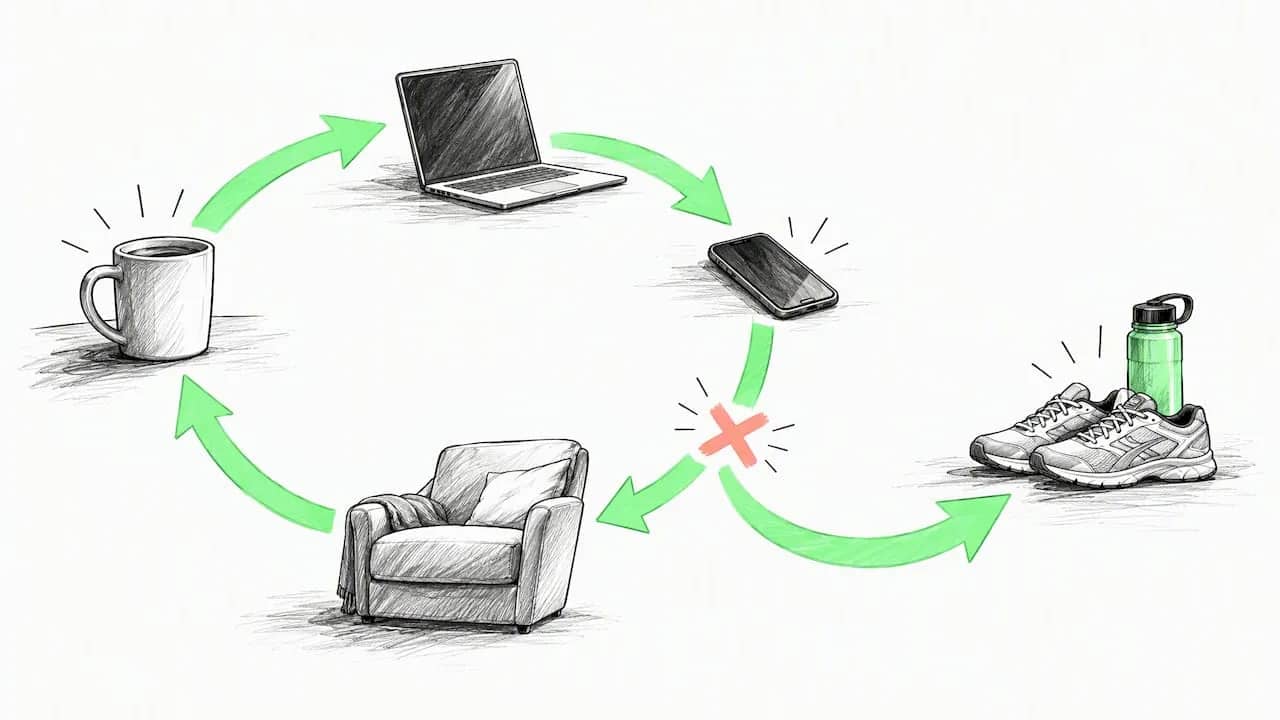

You can’t delete a habit. You can only outcompete it. The most reliable way to unlearn a bad habit is to find the cue that triggers it, plan a specific replacement action for that exact moment, reward the new behavior, and give it far longer than 21 days. Willpower alone is the weakest tool in the box.
This guide walks through how that works, why the usual advice fails, and how to apply it if you’re building something new: a side business after your day job, a startup, or a product inside a big company. Spoiler: the same logic that fixes your 11 p.m. scrolling also fixes your Monday-morning planning chaos.
TL;DR
- Habits run on cues. Find the trigger, then swap the response instead of just trying to “stop.”
- Suppressing a habit by force of will can backfire. Substitution and rewarding the absence of the behavior work better.
- Write an if-then plan: “If [specific cue], then I will [specific action].” Vague intentions don’t count.
- Expect weeks to months, not 21 days. The median in one landmark study was 66 days.
- Big life changes, like launching a side business, are your best window to rewrite routines.
Table of Contents
- Why “just stop” never works
- How long unlearning really takes
- The four-part method
- Change the context, change the habit
- Bad habits that quietly sink new ventures
- Our perspective: you’re unlearning more than habits
- A one-week starter plan
- Where siift fits
- FAQ
- Sources
Why “just stop” never works
Most of us treat a bad habit like a character flaw. It isn’t. A habit is a behavior that has become automatic, triggered by a cue in the environment rather than by conscious will. Your brain built it on purpose, because automatic behaviors save mental effort.
The trouble is the reward loop. According to NIH News in Health, pleasure-based habits are especially sticky: dopamine is there while you do the thing, and when you aren’t doing it, dopamine drives the craving to do it again. That’s not weakness. That’s wiring.
Then there’s the willpower trap. The same NIH piece notes that after resisting a temptation, willpower can be temporarily drained. So the plan “I’ll just resist harder” is a plan that runs out of fuel by about 4 p.m.
The research is less polite still. A 2022 paper titled “Inhibitory control hinders habit change” argues that inhibiting an unwanted behavior, the thing we all instinctively try first, can get in the way of actually changing it. Pushing a habit down does not unplug it.
How long unlearning really takes
You’ve heard it takes 21 days. It doesn’t. In a study of 96 volunteers who picked a behavior and repeated it daily in the same context for 12 weeks, the time to reach 95% of the habit’s final automaticity ranged from 18 to 254 days, with a median of 66 days.
Two things to take from that:
- Plan for roughly two months as a baseline, and for some behaviors, much longer.
- The range is huge. If your friend dropped a habit in three weeks and you’re at week six, you are not failing. You’re on the distribution.
Note what that study measured: forming a new habit. Unlearning an old one is the flip side of the same process. The old response weakens when the new one gets repeated in the same context often enough to take over.
The four-part method
Here’s the practical version, distilled from the research above. It’s boring in the best way.
1. Name the cue
Every habit has a trigger. It’s usually one of five things: a time, a place, an emotion, other people, or the action that came just before. Spend three days just noticing. Don’t change anything yet.
A simple log works. Each time the habit fires, jot down where you were, what time it was, how you felt and what you’d just done. In a pilot trial with office employees, an 8-week program combining stress management and health coaching was designed to help people better control daily stressors and adopt healthier routines. Tracking your own patterns is the unglamorous core of that kind of approach.
The founder version: you’re not logging a vague “I procrastinate.” You’re logging “I open email at 9:05 a.m. because it’s the first thing I do after coffee, and I feel anxious about the pitch deck.”
2. Pick a replacement, not a prohibition
This is where most people go wrong. “Stop checking email first thing” is a prohibition. It leaves a hole in the exact moment the cue shows up, and your brain fills the hole with the old behavior.
A 2026 intensive longitudinal study of habit degradation found that substitution, replacing the habit with a new behavior, was the most frequently chosen strategy. The authors also found that not performing the habit, and rewarding yourself for its absence, were stronger drivers of success than leaning on inhibitory control. (It’s a modest sample of 194 people, so treat it as a strong hint, not gospel.)
So choose a replacement that fits the same cue and delivers a similar payoff:
| Old habit | Typical cue | Replacement that fits the cue |
|---|---|---|
| Doomscrolling at night | Phone on the nightstand | Phone charges in another room; a paperback or a 3-line note on tomorrow’s top task takes its place |
| Opening email first thing | Coffee, anxiety about the day | Write the one task that moves the business forward before opening anything |
| Endless idea tinkering | Feeling stuck on a hard decision | Run one small test, such as five customer messages, before touching the idea again |
| Snacking while working | Mid-afternoon energy dip | Walk around the block, then eat a planned snack |
The replacement doesn’t need to be virtuous. It needs to be easier than the old habit and satisfying enough to repeat.
3. Write an if-then plan
This is the single most useful trick on this page. Psychologists call it an implementation intention: “If [specific situation], then I will [specific action].”
The evidence is encouraging. Experiments on breaking habits with implementation intentions found that planning an alternative response to a critical situation can overrule a habitual one. And a 2019 meta-analysis reported smoking-cessation quit rates of 14.3% for participants using implementation intentions as a standalone intervention, against 3.6% in control groups. Small samples and wide confidence intervals, so don’t bank on those exact numbers for your own life. The direction is the point.
Specificity is everything. A study on physical activity plans looked at exactly how specific people’s plans were and how that related to follow-through. “I’ll eat healthier” has no trigger. “If I’m in the break room at 3 p.m. and feel the urge for the vending machine, then I’ll fill my water bottle and take a five-minute walk” does.
A few templates to steal:
- If I sit down at my desk, then I open my project doc before any inbox or chat tab.
- If I notice myself rewriting the logo for the third time, then I message one potential customer instead.
- If I feel the urge to say yes to a meeting with no agenda, then I reply “Can you send me the agenda first?”
4. Reward the absence
It sounds silly. It works anyway. The 2026 habit degradation study above points to rewarding the non-performance of the habit as a driver of success. Mark an X on a calendar. Tell a friend. Keep a streak. The brain needs to feel that not doing the thing paid off.
If curiosity is your style, try the approach psychiatrist Judson Brewer describes: notice the urge, get curious about what it actually feels like, and watch it pass. In a clinical study he describes in an interview with Psychiatric Times, people with generalized anxiety disorder using his habit-based training saw a 67% reduction in anxiety measures versus 14% with standard care. That’s his own report of his own work, so read it as promising rather than settled, and if anxiety is the habit you’re fighting, a licensed mental health professional is the right person to ask.
Change the context, change the habit
Here’s the part most habit advice skips. Habits are tied to context. A classic piece of research, “Changing circumstances, disrupting habits”, found that when your usual contexts change, habits can’t be cued by the recurring stimuli, and performance depends more on your intentions.
Translation: moving offices, switching jobs, or starting a side business is a rare opening. The old cues are gone. You get to choose new ones before the old autopilot reboots.
If you’re a corporate employee starting a business on the side, you are living this right now. A new schedule, a new workspace (even if it’s the kitchen table), and a new identity are all happening at once. Use them:
- Give the side business its own place and time. Same chair, same hour, same first action. The repetition in a stable context is what builds the new habit.
- Keep the old habit’s cues out of the new space. If you scroll on the couch, don’t build the business on the couch.
- Design flexibility where you can. Researchers studying work schedules found that greater control over when and where you work predicted better sleep and lower work-life conflict. Control over your schedule isn’t a luxury. It’s infrastructure.
Bad habits that quietly sink new ventures
Habits don’t only live in the gym and the pantry. Builders have their own greatest hits. Here are the ones we see most, with a swap for each.
Building before asking. The habit: spend six weeks on a product, then look for buyers. The swap: “If I have a new idea, then I talk to five target customers before I build anything.” Our guide to startup idea validation approach covers what to test first.
Perpetual research. The habit: read one more competitor teardown. The swap: set a stopping rule. Three competitors, one afternoon, then decide.
Decision by mood. The habit: rewrite priorities whenever you feel anxious. The swap: a fixed weekly planning slot, with a written framework. Our post on founder productivity and decision-making frameworks is a good place to start.
Running on stress. The habit: treat exhaustion as proof of commitment. Scholars of entrepreneurship note that founders often can’t escape job-related stress because their finances and identity are so tied to the venture. Sleep and recovery aren’t self-care extras. They protect the decision-making you need to scale. The CDC’s NIOSH notes that most adults need 7 or more hours of quality sleep, and that it matters most during stressful times. We also cover managing stress as an entrepreneur separately.
Going to market on vibes. The habit: post, hope, repeat. The swap: a written plan with a target customer, a channel and a weekly number to check.
Our perspective: you’re unlearning more than habits
We build siift for people turning ideas into businesses, and we watch the same pattern repeat. The hard part is rarely a lack of information. It’s a set of automatic behaviors: chasing the shiny idea, trusting the gut over the evidence, skipping the uncomfortable customer call, asking a chatbot a vague question and accepting a vague answer.
That last one deserves a moment. Generic AI tools are brilliant at sounding confident. Used without structure, they can become a bias amplifier: you ask, they agree, you feel validated, and you’ve learned nothing. We think the better design is the opposite. A tool should work like a good coach, asking for the next specific step, surfacing blind spots, and making it harder to skip the unglamorous parts.

That’s why we built siift as a step-by-step guide through ideation, validation and go-to-market rather than an open text box. The structure is the point. It’s an if-then plan for your whole business: if you have an idea, then validate it; if it holds, then map the market; if the market is there, then plan how to reach it.
No software unlearns anything for you. But a system that puts the right question in front of you at the right moment is a decent replacement for the old cue. And it’s far less tiring than willpower.
— Samim Safaei
A one-week starter plan
Don’t overhaul your life on Monday. Try this.
- Days 1 to 3: Pick one habit. Log every instance with time, place, mood and the preceding action. No fixes yet.
- Day 4: Find the most common cue. Choose a replacement that fits it and is easy to do in under two minutes.
- Day 5: Write your if-then plan on a sticky note. Put it where the cue happens.
- Days 6 and 7: Run the plan. Mark each success. Reward the absence of the old behavior, even with something small.
- Week 2 onward: Keep the context stable. Expect slips. Expect the 66-day median, or longer.
When you slip, don’t restart the whole thing. Look at the cue that beat you and tighten the plan. That’s data, not defeat.
Where siift fits
If the habit you want to unlearn is “starting things without proof they’ll work,” that’s squarely our territory. siift is an AI business operating system that guides you through business ideation, validation and go-to-market planning, step by step.
There’s a Free plan to start with. Paid plans are Discover at $29 per month per user and Focus at $99 per month per user, plus an Enterprise option. See the pricing page for what each includes.
FAQ
How long does it take to unlearn a bad habit?
There’s no fixed number. A study of 96 people forming new habits found it took anywhere from 18 to 254 days to reach peak automaticity, with a median of 66. Plan for a couple of months, and don’t treat a slip as a reset.
Is willpower enough to break a bad habit?
Usually not. Research suggests relying on inhibitory control can hinder habit change. Replacing the behavior with a different action at the same cue, and rewarding yourself for not doing the old one, tends to work better.
What is an if-then plan?
It’s an implementation intention: “If [specific cue], then I will [specific action].” The more specific the situation and the action, the better it works. Experiments show such plans can overrule habitual responses.
Why do old habits come back when my situation changes?
Because habits are tied to cues in your environment. When the context changes, as it does with a new job or schedule, old cues lose their grip for a while. If you return to the old setting, the cues return too, so build new routines in a stable new context.
When should I get professional help?
If the habit involves substance use, an eating disorder, self-harm, or anxiety or depression that affects daily life, talk to a doctor or licensed mental health professional. This guide covers everyday work and lifestyle habits, not clinical conditions.
Sources
- Breaking Bad Habits, NIH News in Health
- Inhibitory control hinders habit change, PMC
- How are habits formed: Modelling habit formation in the real world, European Journal of Social Psychology
- How to form a habit, British Psychological Society
- Determinants and strategies of self-reported habit degradation, PubMed
- Breaking habits with implementation intentions, PubMed
- Implementation intentions meta-analysis, APA PsycNET
- Implementation intentions and physical activity, APA PsycNET
- Changing circumstances, disrupting habits, APA PsycNET
- Stress management and health coaching for office employees, PMC
- Work-time control, sleep and work-life conflict, PMC
- Entrepreneurship and stress, Emerald Insight
- Improve Sleep, NIOSH Science Bulletin, CDC
- Skin and Psych: Habit Loop Science, Psychiatric Times