
Over half of American indie founders now experiment with AI-driven vibe coding, hoping rapid iteration will outpace traditional software development. If you want to build apps faster but feel blocked by complex technical hurdles, this emerging method promises quick results without requiring years of engineering experience. Discover practical strategies to tackle common myths, avoid quality pitfalls, and transform AI-generated code into reliable products for your next startup idea.
Table of Contents
- Defining Vibe Coding and Common Myths
- Types of Vibe Coding Problems for Founders
- From Prototype to Product: Major Pitfalls
- Code Quality, Security, and Maintainability Risks
- Minimizing Issues: Refactoring and Smart Validation
Key Takeaways
| Point | Details |
|---|---|
| Vibe Coding as an Emerging Approach | Vibe coding allows rapid software prototyping using AI-generated code, prioritizing speed over traditional rigorous methodologies. |
| Risks of AI-Generated Code | Founders must validate AI-generated code, as it often requires thorough review and can introduce significant technical debt. |
| Importance of Comprehensive Testing | Extensive testing and architectural validation are essential for ensuring code reliability and security before deployment. |
| Adopting Smart Validation Strategies | Implementing multi-layered validation techniques can transform AI-generated outputs into robust, maintainable software solutions. |
Defining Vibe Coding and Common Myths
Vibe coding represents an emerging software development approach where developers leverage AI tools to generate code through intuition and rapid experimentation. Unlike traditional coding methodologies, this technique allows entrepreneurs to prototype software solutions quickly by relying on AI-generated code insights without deep technical understanding.
At its core, vibe coding challenges conventional software development practices by prioritizing speed and accessibility over meticulous code review. Developers describe project requirements to large language models, which then generate functional code snippets. While proponents argue this democratizes software creation, critics highlight significant potential risks around code reliability, security vulnerabilities, and long-term maintainability.
Common myths surrounding vibe coding often misrepresent its capabilities and limitations. Many founders mistakenly believe AI-generated code is immediately production-ready or equivalent to professionally written software. In reality, these code outputs require substantial human validation and technical expertise to transform into robust, scalable solutions. Understanding these nuances is critical for indie founders looking to leverage AI coding tools effectively.
Pro tip: Always treat AI-generated code as a starting point, not a finished product, and invest time in comprehensive code review and testing before deployment.
Here’s a comparison of traditional coding and vibe coding for startup founders:
| Aspect | Traditional Coding | Vibe Coding with AI |
|---|---|---|
| Required Expertise | Deep technical knowledge | General intuition, minimal coding skills |
| Development Speed | Slower, deliberate process | Rapid prototyping, quick iterations |
| Risk of Technical Debt | Lower with proper reviews | Higher due to overlooked flaws |
| Typical Use Case | Enterprise software, production systems | Early-stage prototypes, MVPs |
Types of Vibe Coding Problems for Founders
Founders engaging in vibe coding frequently encounter significant challenges that can compromise their software development process. Startup technical risks emerge when AI-generated code lacks the nuanced understanding required for robust application development. These challenges manifest across multiple dimensions, creating potential vulnerabilities that can undermine a startup’s technological foundation.
The primary vibe coding problems include quality control issues, debugging complexity, and scalability limitations. Developers often generate code without comprehensive testing, leading to hidden performance bottlenecks and security weaknesses. Automated code generation tools may produce functional snippets that appear correct superficially but contain fundamental architectural flaws that only become apparent during advanced testing or production deployment.
Another critical challenge involves technical debt accumulation. When founders rely heavily on AI-generated code without thorough review, they risk creating software systems with intrinsic structural weaknesses. These systems become increasingly difficult and expensive to modify or scale as the startup grows. Integration challenges also emerge, as AI-generated code might not seamlessly communicate with existing technological infrastructures or follow best practices in software design and architecture.
Pro tip: Implement a rigorous code review process that treats AI-generated code as a draft, requiring comprehensive manual validation and systematic testing before integration.
From Prototype to Product: Major Pitfalls
Transitioning from a prototype to a production-ready product represents a critical challenge for founders using vibe coding approaches. Prototype development risks emerge when rapid development techniques fail to account for long-term software architecture and scalability requirements. The initial excitement of quickly generating functional code can quickly evaporate when confronted with the complex realities of enterprise-grade software development.
Founders frequently encounter substantial roadblocks during this transition, including significant architectural limitations. Automated code generation often produces solutions with deep structural weaknesses, such as tightly coupled components, inefficient data management, and inconsistent programming paradigms. These underlying issues create substantial technical debt that becomes exponentially more challenging and expensive to resolve as the product matures and user demands increase.
The most critical pitfalls include security vulnerabilities, performance bottlenecks, and integration challenges. Vibe coding’s trial-and-error approach typically generates code that looks functional on the surface but lacks the robust error handling, modular design, and comprehensive testing necessary for reliable software. Founders must recognize that AI-generated code represents a starting point, not a finished solution, requiring extensive manual review, refactoring, and systematic validation before considering the product production-ready.
Pro tip: Develop a comprehensive code review strategy that treats AI-generated prototypes as experimental drafts, requiring rigorous manual validation, architectural redesign, and incremental testing before production deployment.
Code Quality, Security, and Maintainability Risks
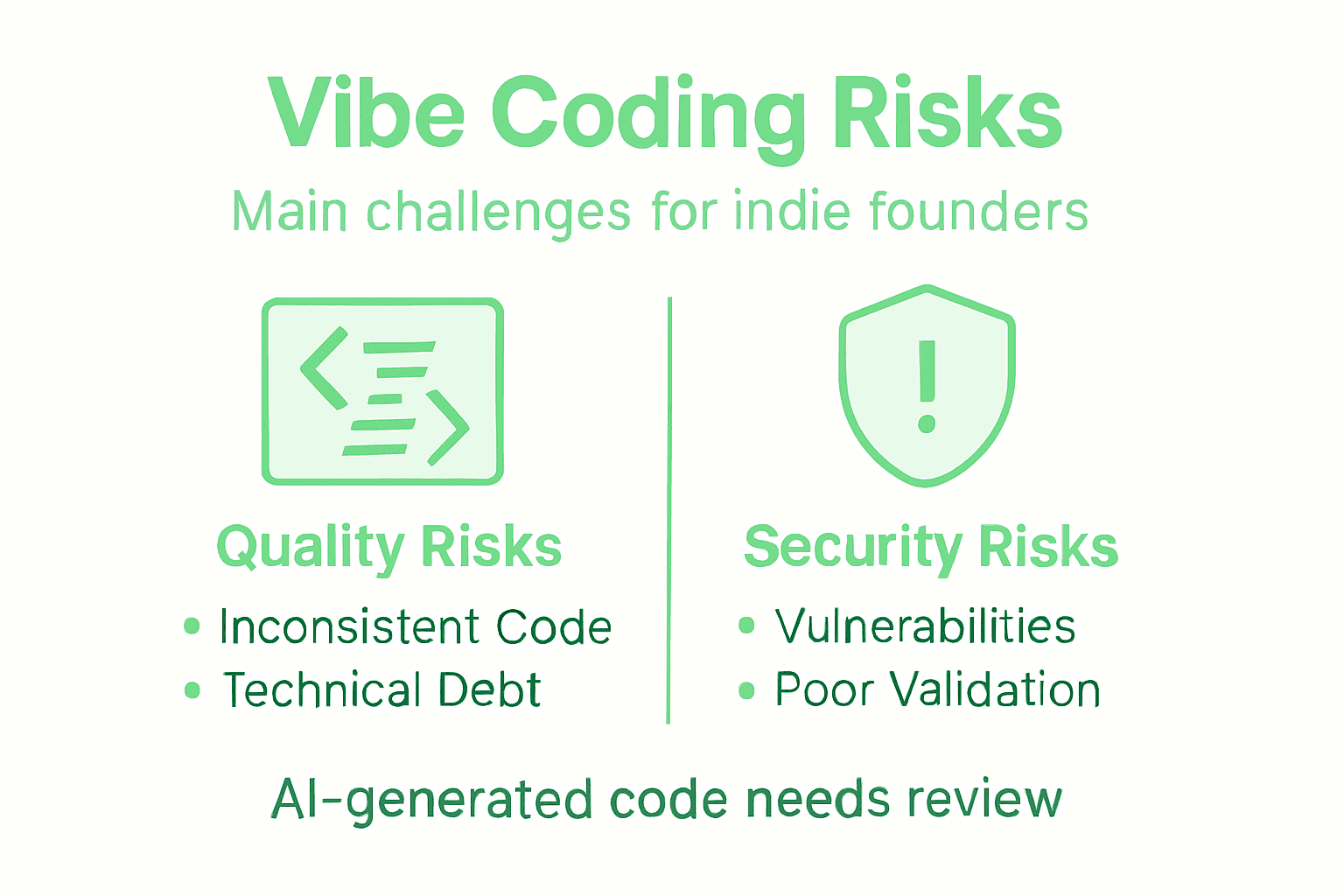
Vibe coding introduces profound challenges in maintaining robust software quality and security standards. Security vulnerabilities in AI-generated code emerge from the fundamental disconnect between rapid generation and comprehensive software engineering principles. The seemingly convenient shortcut of AI-powered code creation masks complex underlying risks that can compromise entire technological infrastructures.

The most critical quality concerns stem from inconsistent coding patterns, lack of systematic documentation, and potential security gaps. Automated code generation frequently produces solutions with inherent structural weaknesses, including outdated library dependencies, inefficient error handling, and non-standard implementation approaches. These technical deficiencies create significant maintainability challenges, making future code updates and system scalability exponentially more difficult and resource-intensive.
Founders must recognize that AI-generated code represents a preliminary draft requiring extensive human expertise and rigorous validation. The evolving developer role now emphasizes strategic curation, policy governance, and meticulous review processes to mitigate risks introduced by algorithmic code generation. This shift demands a proactive approach to identifying potential vulnerabilities, implementing comprehensive testing frameworks, and maintaining strict adherence to industry-standard security protocols.
Pro tip: Implement a multi-layered code review strategy that combines automated scanning tools, manual expert review, and incremental security testing to systematically identify and remediate potential vulnerabilities in AI-generated code.
Minimizing Issues: Refactoring and Smart Validation
Founders seeking to mitigate vibe coding risks must adopt sophisticated validation techniques that transform AI-generated code into robust, maintainable solutions. Formal verification approaches offer promising strategies for systematically improving code quality, bridging the gap between rapid generation and engineering rigor. These methods transform AI-generated code from a rough draft into a reliable, production-ready foundation.
The emerging framework for smart validation involves multiple critical strategies. Developers must implement comprehensive code review processes that go beyond surface-level inspection, integrating automated scanning tools, manual expert review, and incremental testing. This multi-layered approach helps identify potential vulnerabilities, refactor inefficient code structures, and ensure alignment with best software engineering practices. By treating AI-generated code as a collaborative draft requiring iterative refinement, founders can significantly reduce technical debt and security risks.
Advanced validation techniques now emphasize human-in-the-loop methodologies that maintain developer intentionality while leveraging AI’s generative capabilities. This approach requires founders to develop a nuanced understanding of AI code generation, actively curating and refining outputs rather than passively accepting them. The goal is to create a symbiotic relationship between human expertise and artificial intelligence, where technological intuition is balanced with systematic validation and architectural integrity.
Pro tip: Develop a structured refactoring workflow that includes automated code analysis, peer review checkpoints, and incremental testing to systematically transform AI-generated code into production-ready software.
Summary of smart validation strategies for AI-generated code:
| Strategy | Description | Business Benefit |
|---|---|---|
| Automated Code Analysis | Tools scan for errors and risks | Early risk detection |
| Peer Review Checkpoints | Manual review by developers | Improves code reliability |
| Incremental Testing | Gradual functional validation | Ensures performance stability |
| Architectural Refactoring | Redesign flawed structures | Enhances scalability |
Navigate Vibe Coding Risks with Confidence Using Siift.ai
Vibe coding offers indie founders an exciting way to prototype quickly but comes with serious challenges like technical debt, security risks, and difficult transitions from prototype to product. If you are struggling to balance rapid AI-generated development with the need for quality and scalability, you are not alone. Founders must understand how to validate, refactor, and strategically manage these AI-generated outputs to avoid costly pitfalls.
Siift.ai Intelligent Business Canvas helps you do just that by guiding you through the complexities of turning your vibe coding prototypes into viable businesses. With personalized feedback, new insights, and prioritized actions, Siift.ai empowers you to systematically de-risk your founder journey without guesswork or blindspots. Ready to transform your ideas into scalable products with confidence? Explore how our modern founder’s strategy platform can help you overcome vibe coding hurdles today at Siift.ai. Start your smarter build with Siift.ai Intelligent Business Canvas and take control of your founder journey now.
Frequently Asked Questions
What is vibe coding?
Vibe coding is an emerging software development approach where developers use AI tools to generate code based on intuition and rapid experimentation, allowing for quicker prototyping without requiring deep technical knowledge.
What are the main risks associated with vibe coding for indie founders?
The primary risks include code quality issues, security vulnerabilities, technical debt accumulation, and integration challenges, which can arise from relying heavily on AI-generated code without thorough validation and review.
How can founders mitigate the risks of using AI-generated code?
Founders can minimize risks by implementing a rigorous code review process, utilizing automated scanning tools, ensuring incremental testing, and engaging in architectural refactoring to transform AI-generated code into production-ready solutions.
Why is it important to validate AI-generated code before deployment?
Validating AI-generated code is crucial because it allows founders to identify potential vulnerabilities, ensure code quality, and align the software with industry standards, thereby preventing long-term issues related to maintainability and performance.