
What is a value proposition: A clear guide for 2026
Many aspiring entrepreneurs struggle to articulate why customers should choose their product over competitors. This confusion often leads to failed launches and wasted resources. A strong value proposition is the foundation of business success, clearly defining how your offering uniquely solves customer problems and delivers measurable benefits. In 2026, AI tools are revolutionizing how founders craft and validate these critical statements. This guide walks you through creating compelling value propositions that attract customers, validate ideas, and accelerate your path to product-market fit.
Table of Contents
- What Is A Value Proposition: A Clear Guide For 2026
- Understanding What A Value Proposition Is And Why It Matters
- Using The Value Proposition Canvas To Design And Validate Your Offering
- Common Mistakes To Avoid And Expert Tips For Crafting A Winning Value Proposition
- Applying And Testing Your Value Proposition With AI Tools For Startup Success
- How Siift.ai Helps You Craft And Validate Your Value Proposition
Key takeaways
| Point | Details |
|---|---|
| Clear problem-solution fit | Your value proposition must articulate exactly how your product solves specific customer pains better than alternatives. |
| Use proven frameworks | The Value Proposition Canvas aligns product features with customer jobs, pains, and gains for validation. |
| Quantify and test | Include measurable benefits and validate assumptions with 50-200 real users before full launch. |
| Avoid common pitfalls | Skip jargon, focus on outcomes not features, and prioritize top 3 customer pains. |
| Leverage AI acceleration | Modern AI tools help prototype messaging faster and refine propositions based on market feedback. |
Understanding what a value proposition is and why it matters
A value proposition is a clear statement explaining how your product uniquely solves customer problems, delivers specific benefits, and outperforms competitors. It answers three fundamental questions: Who are you serving? What problem do you solve? Why should they choose you?
The core elements include identifying your target audience with precision, communicating clear differentiation from alternatives, demonstrating relevance to customer pains and gains, and providing quantifiable benefits that customers can understand immediately. Without these components, your message becomes generic noise in a crowded market.
Clarity and succinctness matter enormously. Investors and customers make quick decisions. A muddled value proposition signals unclear thinking about your business model. Successful value proposition statements cut through complexity to communicate value in seconds, not minutes.
Many founders confuse features with value. Listing product capabilities tells customers what you built, not why they should care. Vague language like “innovative solution” or “cutting-edge platform” means nothing without concrete outcomes. Millennials and side hustlers benefit most by focusing on relevant pains they personally understand and gains they genuinely want to deliver.
Common misconceptions include:
- Believing longer descriptions sound more professional when brevity wins
- Assuming technical features impress non-technical buyers
- Thinking one value proposition works for all customer segments
- Forgetting to update propositions as markets evolve
Your value proposition should evolve with customer feedback. Early versions rarely survive first contact with real users. The best founders treat their value propositions as hypotheses requiring validation, not final truths. Strong examples show how successful companies refined their messaging through iteration.
For aspiring entrepreneurs, a sharp value proposition validates whether your idea solves a real problem worth paying for. It forces you to articulate customer pains you can actually relieve and gains you can genuinely create. This clarity prevents building products nobody wants, the number one reason startups fail. Understanding value propositions deeply transforms how you approach every business decision from pricing to marketing.
Using the value proposition canvas to design and validate your offering
The Value Proposition Canvas provides a structured framework for aligning what you build with what customers actually need. This tool maps two critical sides: the customer profile showing jobs, pains, and gains, and the value map detailing your products, pain relievers, and gain creators.
The customer profile side captures three elements. Customer jobs describe tasks people want to accomplish, problems they need to solve, or needs they want to satisfy. Pains represent negative outcomes, risks, or obstacles preventing job completion. Gains are positive outcomes, benefits, or desires customers hope to achieve. You must research these through direct customer conversations, not assumptions.

The value map side mirrors this structure. Your products and services list what you offer. Pain relievers explain how your offering reduces or eliminates specific customer pains. Gain creators describe how you produce outcomes and benefits customers want. The canvas works by systematically matching value map elements to customer profile elements.
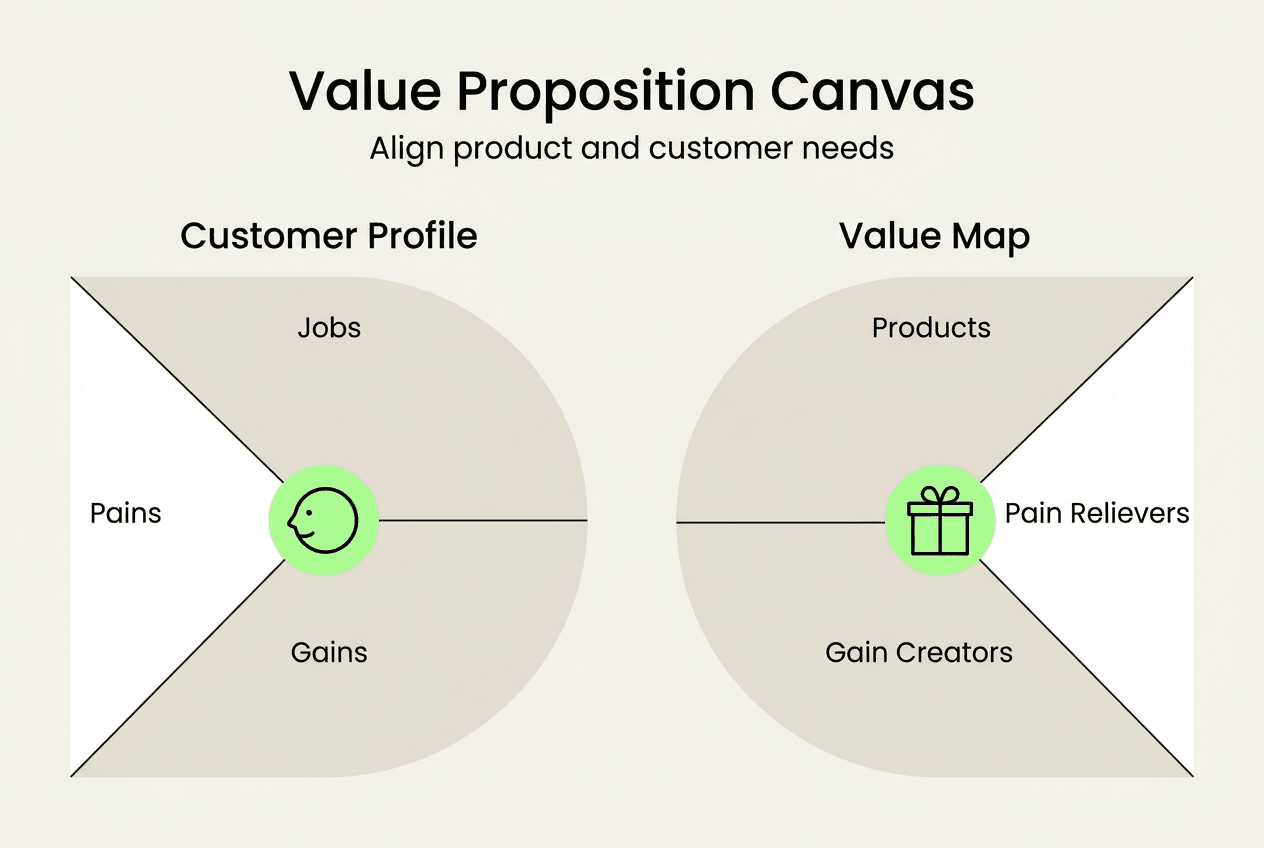
Here’s how to build your canvas effectively:
| Canvas Section | Key Actions | Validation Method |
|---|---|---|
| Customer Jobs | List 5-10 functional, social, emotional jobs | Interview 20-30 target customers |
| Customer Pains | Identify obstacles, risks, negative outcomes | Rank by severity and frequency |
| Customer Gains | Define desired outcomes and benefits | Prioritize must-haves versus nice-to-haves |
| Products/Services | Describe your offering concisely | Create minimal viable product |
| Pain Relievers | Match how you reduce each pain | Test with pilot customers |
| Gain Creators | Show how you deliver each gain | Measure actual outcomes |
Prioritizing matters enormously. Start by identifying the top 3 pains and top 3 gains that matter most to your target customers. Trying to address everything dilutes your focus and weakens your proposition. Concentrated value beats scattered features every time.
Testing assumptions through real user interactions is non-negotiable. Conduct validation interviews with 50-200 people in your target market. Ask open-ended questions about their pains and gains. Listen more than you talk. Watch for patterns in their responses that confirm or contradict your hypotheses.
Pro Tip: Create separate canvases for each distinct customer segment you serve. A value proposition that resonates with enterprise buyers rarely works for individual consumers. Segment-specific canvases reveal opportunities competitors miss.
This framework supports finding product-market fit by forcing alignment between what you build and what customers value. It minimizes risk by surfacing mismatches early when changes cost less. Founders who test their ideas systematically using the canvas avoid expensive pivots later. The canvas transforms abstract concepts into concrete validation steps you can execute immediately.
Common mistakes to avoid and expert tips for crafting a winning value proposition
Most entrepreneurs sabotage their value propositions through predictable mistakes. Recognizing these pitfalls helps you craft statements that actually convert customers and attract investors.
Jargon and vague phrasing kill clarity. Phrases like “synergistic ecosystem” or “paradigm-shifting innovation” sound impressive but communicate nothing. Customers need concrete outcomes they can visualize, not buzzwords that require translation. Replace abstract language with specific results your offering delivers.
Feature-focused messaging misses the mark. Listing capabilities assumes customers understand how features solve their problems. Most don’t make that connection. Instead, lead with outcomes and benefits, then mention features as supporting evidence. Your customer cares about saving 10 hours weekly, not that your software uses machine learning.
- Targeting too broad an audience instead of a specific segment
- Listing 15 benefits when 3 would be stronger
- Using passive voice that obscures who benefits
- Failing to differentiate from competitors clearly
- Never updating the proposition based on feedback
Prioritization separates good propositions from great ones. Identify the 3-5 top pains and gains through customer research, then build your entire message around those priorities. Everything else is noise. This focus makes your proposition memorable and actionable.
Quantifying value transforms abstract promises into credible claims. Instead of “saves time,” specify “reduces reporting time by 40%.” Instead of “increases revenue,” state “generates $50,000 additional annual income.” Include proof through metrics, case studies, or testimonials that validate your claims.
Your value proposition should evolve continuously. Markets shift, competitors emerge, and customer needs change. Schedule quarterly reviews of your proposition against current customer feedback. Successful founders treat value propositions as living documents requiring regular updates, not static statements carved in stone.
Pro Tip: Make your customer the hero of your value proposition story. Position your product as the guide that helps them achieve their goals, not as the star of the show. This subtle shift dramatically increases emotional resonance.
“The best value propositions focus relentlessly on customer outcomes, provide concrete proof of results, and evolve based on real-world feedback rather than founder assumptions.”
AI tools accelerate continuous refinement by analyzing customer language patterns, suggesting outcome-focused phrasing, and testing multiple variations quickly. Modern AI platforms help you iterate faster than manual methods allow. They surface insights from customer conversations that humans might miss, improving your go-to-market fit systematically.
Avoid the trap of perfection paralysis. Your first value proposition will be wrong in some ways. Launch with your best hypothesis, gather feedback, and refine based on actual customer responses. Speed of learning beats theoretical perfection. The best startup advice emphasizes testing and iteration over endless planning.
Applying and testing your value proposition with AI tools for startup success
Transforming your value proposition from concept to validated market message requires systematic application and testing. Here’s a practical five-step method proven to work:
- Find 10-20 lighthouse clients who represent your ideal customer profile and face the pains you solve
- Identify their top 3 pains through in-depth interviews, ranking by severity and willingness to pay
- Define specific outcomes and ROI your solution delivers, quantified in time saved, revenue gained, or costs reduced
- Provide proof through pilot results, case studies, or guaranteed trial periods that demonstrate value
- Test repeatedly with 50-200 target users, tracking which messaging variations drive highest engagement and conversion
This approach works because it grounds your proposition in real customer language and validated outcomes. Lighthouse clients become your proof points and early advocates, accelerating market credibility.
Comparing MVPs reveals why value propositions matter so much:
| Approach | Customer Acquisition | Funding Success | Pivot Rate | | — | — | — | | Clear quantified value proposition | 3x higher pilot conversion | 2.5x more likely to secure funding | 40% fewer major pivots | | Feature-heavy generic messaging | Struggles to gain traction | Faces investor skepticism | 60% require significant changes |
Startups using quantified propositions show measurably better outcomes across all key metrics. They attract pilot customers faster, demonstrate clear ROI to investors, and require fewer expensive pivots because they validated customer value early.
AI tools dramatically accelerate this process. Platforms like Copy.ai generate multiple value proposition variations in minutes, testing different angles and phrasing. They analyze customer feedback at scale, identifying patterns that inform refinement. AI-powered tools help you prototype messaging faster than traditional methods, shortening the validation cycle from months to weeks.
Real user testing with sufficient sample size separates assumptions from reality. Aim for feedback from 50-200 people in your target market, not just friends and family. Use surveys, interviews, and landing page tests to measure which propositions resonate. Track specific metrics like click-through rates, sign-up conversions, and qualitative feedback themes.
Quantified value propositions increase funding potential by providing concrete evidence of market demand and customer willingness to pay. Investors want proof you understand your customers deeply and can articulate value clearly. A sharp proposition signals market validation, reducing perceived risk.
Pilot customer acquisition accelerates when your value proposition speaks directly to urgent pains with measurable relief. Customers buy outcomes, not features. Early validation guides show that founders who quantify value close pilot deals 3x faster than those using generic messaging.
Building startup traction requires consistent application of your value proposition across all customer touchpoints. Your website, pitch deck, sales conversations, and marketing materials must reinforce the same core message. Consistency builds recognition and trust.
2026 benchmarks show successful startups iterate their value propositions 5-8 times before achieving strong product-market fit. Each iteration incorporates customer feedback, market changes, and competitive insights. The fastest path to success combines systematic testing with AI-accelerated refinement.
How siift.ai helps you craft and validate your value proposition
Navigating value proposition development alone feels overwhelming for most aspiring entrepreneurs. siift.ai provides an AI-powered platform specifically designed to guide you through ideation, validation, and go-to-market systematically. The Intelligent Business Canvas offers personalized feedback, actionable insights, and prioritized next steps that de-risk building your business.
The platform helps you validate ideas step-by-step, filtering out biases and blindspots that derail founders. Instead of guessing what customers want, you use essential AI tools to test assumptions quickly and refine your value proposition based on real market signals. This approach accelerates your founder’s journey to product-market fit while minimizing costly mistakes.
Frequently asked questions
What is the difference between a unique selling proposition (USP) and a unique value proposition (UVP)?
A USP highlights specific features or attributes that competitors don’t offer, focusing on product differentiation. A UVP emphasizes the critical benefits customers absolutely need and why your solution is indispensable to them. While USPs answer “what makes us different,” UVPs answer “why does this matter to you.” The distinction matters because customers care more about outcomes they receive than features you possess.
How can AI tools improve creating and testing value propositions?
AI accelerates value proposition development by generating multiple messaging variations quickly, analyzing customer language patterns, and suggesting outcome-focused phrasing that resonates. AI tools enable continuous refinement based on real-time feedback, helping you match changing market needs faster than manual methods. They surface insights from customer conversations that humans might overlook, systematically improving your go-to-market fit. Modern AI platforms reduce the time from initial hypothesis to validated proposition by 60-70%.
What are the key elements to include in a strong value proposition?
Strong value propositions require four essential elements: precise target audience identification, clear communication of differentiation from alternatives, quantifiable customer benefits with specific metrics, and direct focus on addressing top customer pains and gains. Each element must be concrete and verifiable. Vague statements weaken credibility while specific claims build trust. Your proposition should answer who you serve, what problem you solve, why you’re different, and what measurable results customers can expect. Key components work together to create a compelling case for choosing your solution.
Why is testing your value proposition with real users important?
Testing validates assumptions about customer pains, gains, and willingness to pay before you invest heavily in product development. Real user feedback uncovers gaps between what you think customers want and what they actually need. It improves messaging clarity by revealing which phrases resonate and which confuse. Systematic testing increases product-market fit, leading to higher success rates and fewer expensive pivots. Founders who test propositions with 50-200 target users achieve measurably better outcomes than those relying on intuition. Early validation methods prevent building products nobody wants, the primary cause of startup failure.