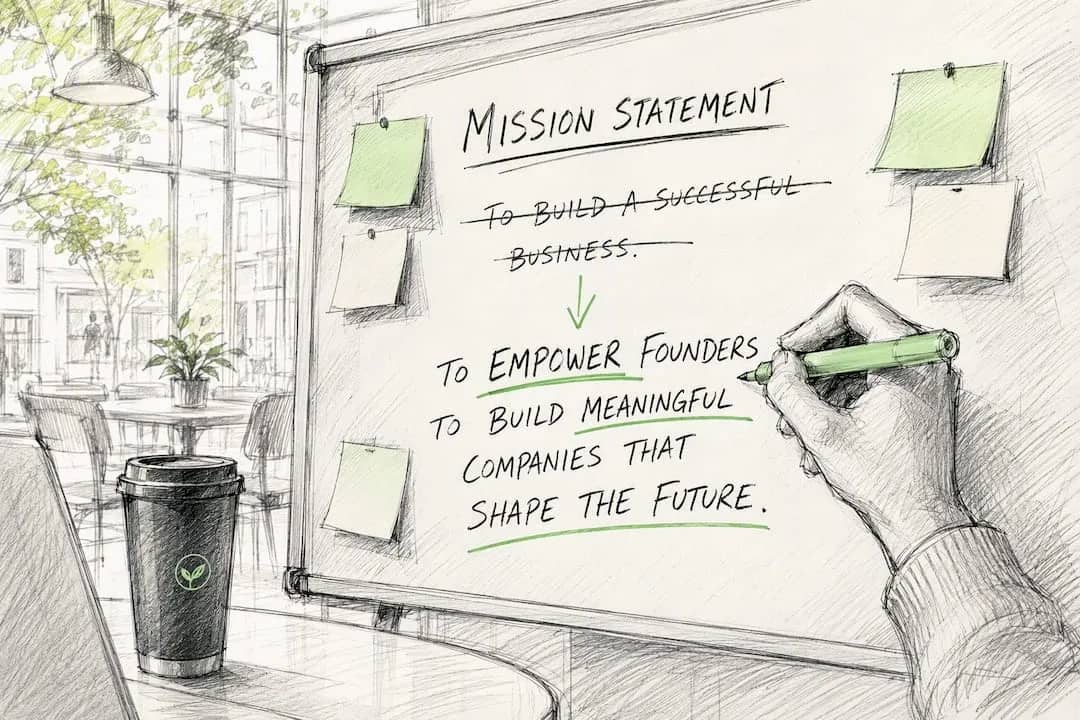
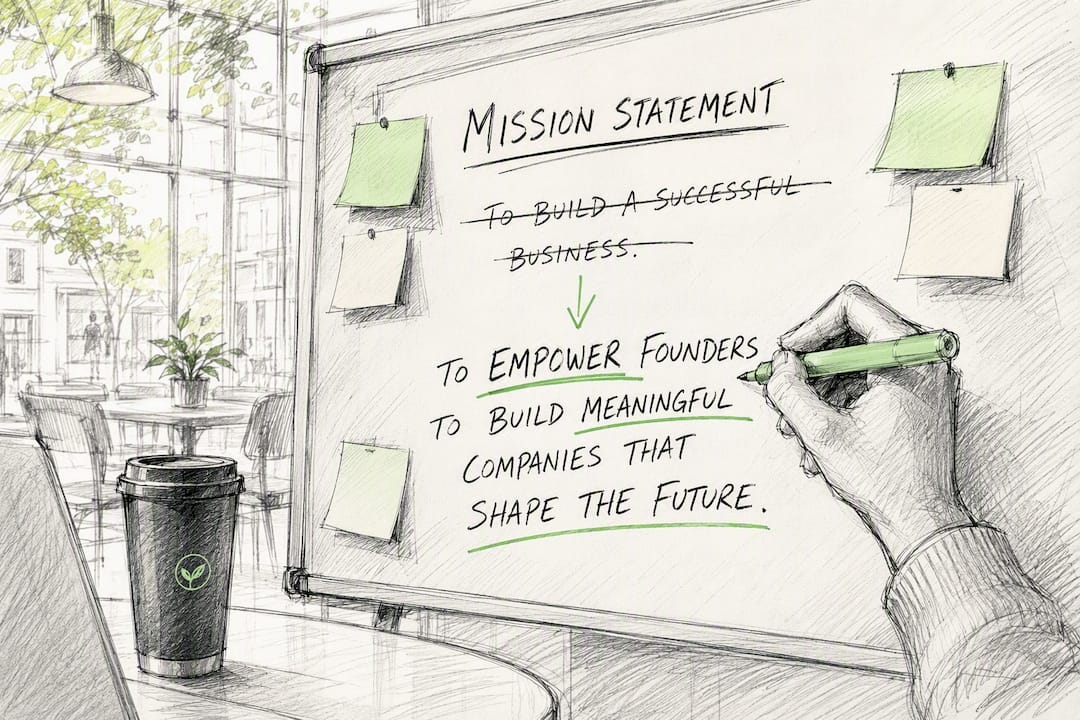
A mission statement is a present-focused sentence or two that defines what you do, for whom, and how, so it can filter your daily decisions instead of just decorating your homepage. IKEA nails this in five words: to create a better everyday life for the many people. Follow the steps below and you’ll walk away with a working draft, not a vague slogan.
TL;DR:
- A mission statement must clearly define the specific audience, the active action, and the impact, with an optional approach that differentiates your business.
- Creating a focused workshop with key stakeholders and outsiders accelerates drafting a memorable, distinctive, and decision-guiding mission statement.
- It should be brief, written in plain language, and tested by outsiders to ensure clarity, memorability, and that no competitor can claim it verbatim.
- Regular review, ideally annually or after major business changes, helps keep the mission aligned with evolving goals and market circumstances.
- A strong mission helps filter decisions, informs hiring, and guides product and budgets, making it a strategic tool rather than just décor.
Table of Contents
- What Is a Mission Statement, and Why Does It Matter for Small Teams?
- What Are the Key Components of an Effective Mission Statement?
- How Do You Run a Mission Statement Workshop in One Meeting?
- What Are Some Mission Statement Templates and Examples?
- How Do You Embed Your Mission Statement Into Daily Operations?
- What Mistakes Weaken a Mission Statement, and How Do You Fix Them?
- How Should You Involve Stakeholders in Writing Your Mission?
- What Tools Help You Gather Feedback While Drafting?
- How Often Should You Revisit and Revise Your Mission Statement?
- A Founder’s Take on Why Most Mission Statements Fail Anyway
- Turn Your Mission Into a Validated Strategy With siift
- Sources
- FAQ
What Is a Mission Statement, and Why Does It Matter for Small Teams?
A mission statement answers three questions in present tense: what you do, who benefits, and how you do it differently. That’s it. It’s not aspirational fluff for a future you haven’t earned yet.
People mix this up with two other things constantly. A vision statement looks forward, describing the world you’re trying to build years from now. A mission statement stays grounded in the present, describing the work happening right now. Values are different again. They’re the behavioral rules that govern how your team acts, not what your business does. The Community Tool Box treats mission and vision as companion exercises. You can brainstorm both in the same session, but they answer different questions.
For a two-person startup or a five-person shop, a sharp mission does real work:
- It filters decisions fast. When a shiny opportunity shows up, you ask if it fits the mission, not if it sounds fun.
- It clarifies hiring. Candidates self-select based on whether the mission resonates.
- It keeps a founder from chasing every idea that lands in their inbox on a Tuesday.
Skip this step and you’re steering by vibes. That works until it doesn’t.
What Are the Key Components of an Effective Mission Statement?
Every solid mission statement, regardless of industry, is built from the same five pieces. Miss one and the statement reads either too vague or too bloated.
- Audience. Name your primary beneficiary specifically. “People” is weaker than “first-time homebuyers” or “independent bakers.”
- Action. Lead with a strong, active verb in present tense: build, create, connect, protect. Avoid passive constructions like “is committed to.”
- Impact. State the change or benefit you create, not the process you use to get there.
- Approach. Add a short differentiator, the “how” that separates you from someone doing roughly the same thing.
- Tone and length. Keep it to a few sentences. Grammarly’s guidance on business writing backs this: use plain language and at least one active verb, and skip the jargon entirely.
You don’t need all five elements crammed into one sentence. A tight audience plus action plus impact often outperforms a statement that tries to say everything.
Pro Tip: Read your draft out loud to someone outside your industry. If they have to ask what you meant, cut the word that confused them, not explain it further.
How Do You Run a Mission Statement Workshop in One Meeting?
You can draft a real mission statement within a short, focused workshop session if you run it like a workshop instead of a brainstorm-until-someone-gets-tired session. Here’s the five-step flow, adapted from a common process recommended by Philanthropy Roundtable, stretched to fit a founder’s timeline.
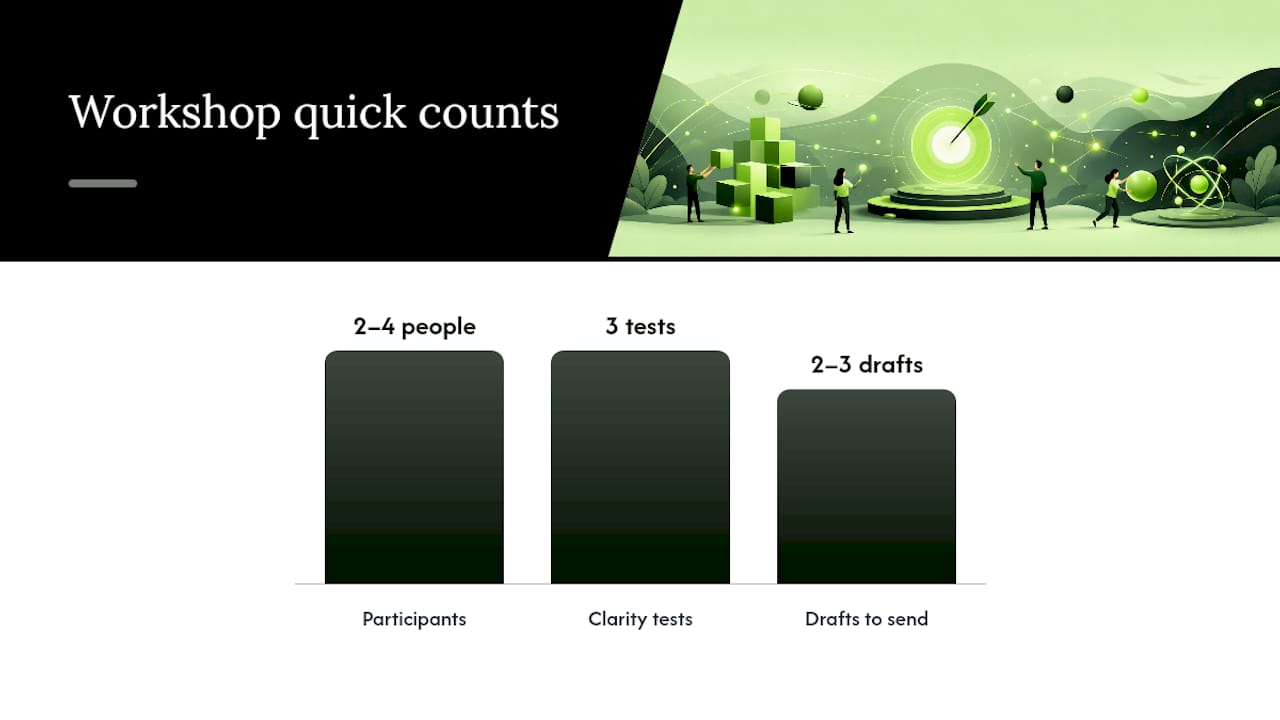
Step 1: Prep in a brief preparation time. Pick two to four people: the founder, one team member, and maybe a trusted advisor or early customer. Send these questions ahead of time so nobody freezes in the room:
- Who exactly are we here for?
- What do we do for them that they can’t easily get elsewhere?
- What would disappear from their world if we shut down tomorrow?
Step 2: Answer the guided prompts together. Go around the room and answer, out loud, in plain language: what you do, who it’s for, how you do it, what changes for them, and what values shape the approach. Write every answer on a whiteboard or shared doc. Don’t edit yet.
Step 3: Draft several variations quickly. Use the raw material from step two to fill in a formula. A reliable one, per Aprio’s guide, is: “We [action] to [benefit] for [audience] by [approach].” Write a version emphasizing audience first, another leading with action, another cutting the approach clause entirely. Speed beats polish here.
Step 4: Run three clarity tests. Pull in someone who wasn’t in the room, ideally a customer or an outsider with no context.
- Can they repeat it back after hearing it once?
- Does it tell them who you serve without you explaining?
- Could a direct competitor claim the exact same sentence?
If the answer to test three is yes, you haven’t found your differentiator yet. Send the top two or three drafts out for quick written feedback too, since a diverse drafting group tends to increase buy-in and catch vague spots the room missed.
Step 5: Finalize and schedule the next look. Pick the winner, get sign-off from whoever owns final say, and put a date on the calendar to revisit it, typically annually or after a major pivot. Don’t let “final” mean “forgotten.”
What Are Some Mission Statement Templates and Examples?
Staring at a blank page is the fastest way to write something forgettable. Start with a formula instead, then swap in your own words.
Three formula patterns to fill in:
- “We [action verb] [audience] to [impact], by [approach].”
- “Our mission is to [action] for [audience] so they can [benefit].”
- “We exist to [impact], because [audience] deserves [value].”
Ten micro-examples across contexts, each concise wording:
- “To create a better everyday life for the many people.” (IKEA, consumer retail)
- “Ideas worth spreading.” (TED, media)
- “Seeking a world where everyone has a decent place to live.” (Habitat for Humanity’s mission focus, housing nonprofit)
- Preventing and relieving suffering in emergencies through trained volunteers and donated resources, reflecting the spirit behind the American Red Cross’s disaster relief work.
- “We help solo consultants turn scattered notes into a client-ready proposal in one afternoon.” (B2B micro-SaaS)
- “We roast small-batch coffee so neighborhood cafes can serve something they’re proud of.” (local business)
- “We connect retired teachers with tutoring families who can’t afford private agencies.” (community nonprofit)
- “I build simple, honest financial tools for freelancers who hate spreadsheets.” (personal/solo brand)
- “We package handmade soap so gift shops can stock something that doesn’t feel mass-produced.” (product business)
- “We give first-time founders a straight answer on whether their idea is worth building.” (startup services)
Blank template to fill in right now: “We [verb] [specific audience] to [impact], by [approach].”
Nonprofit and for-profit missions share the same bones here. NonprofitHub’s comparison of good and bad examples makes the point clearly: the mission describes the work, not the program list or the annual budget target.
How Do You Embed Your Mission Statement Into Daily Operations?
A mission statement that lives only on your “About” page is decoration. To make it functional, test it, place it, and use it.
Three quick clarity tests with outsiders:
- Ask a stranger to repeat it back after one read. If they can’t, it’s too long or too vague.
- Ask whether it tells them who you serve, without extra explanation.
- Ask if a direct competitor could say the exact same thing. If yes, sharpen the approach clause.
Where to actually put it: your website header or about section, your onboarding materials for new hires, and the top of every board or leadership meeting agenda.
Where it should do real work:
- Hiring decisions, screening candidates against whether the mission excites them.
- Budgeting, testing every line item against whether it serves the mission.
- Product decisions, killing features that don’t move the needle on your stated impact.
A useful bar for memorability: if your team can’t recite it, it probably won’t fit on a business card, and if it doesn’t fit on a card, it’s not guiding anyone’s Tuesday morning decisions. Treat the mission as a governance litmus test: run every major decision and budget line past it before it moves forward.
Review timing: revisit annually, or immediately after a pivot, a new product line, or a shift in who you actually serve.
What Mistakes Weaken a Mission Statement, and How Do You Fix Them?
Most weak mission statements share the same handful of problems, and each one has a quick fix.
- Too vague. “We strive to provide excellent service” says nothing. Fix: name the specific audience and the specific impact.
- Jargon-heavy. “Leveraging synergistic solutions” reads like nobody wrote it on purpose. Fix: use the active-voice, plain-language approach Grammarly recommends and read it aloud.
- Too long. A five-sentence mission is a mission statement wearing a trench coat full of other documents. Fix: cap it at a few sentences.
- Lists programs instead of purpose. “We run workshops, host events, and publish a newsletter” is a program list, not a mission. Fix: state the underlying impact those programs serve.
- Interchangeable with a competitor’s. If any rival could paste your mission onto their own site, it’s not doing its job. Fix: sharpen the approach clause until it’s distinctly yours.
| Checklist item | Pass condition |
|---|---|
| Length | One to three sentences |
| Verb | Strong, active, present tense |
| Audience | Named specifically, not generic |
| Distinctiveness | A competitor couldn’t claim it word for word |
| Clarity test | An outsider repeats it back correctly on first read |
Durability doesn’t mean vagueness. IKEA’s mission has held steady for decades precisely because it’s specific enough to mean something and simple enough to survive product-line changes.
How Should You Involve Stakeholders in Writing Your Mission?
The people who should weigh in on your mission aren’t just whoever’s in the office that day. Pull in your co-founders or leadership team first, since they need to actually believe the words before they’ll use them to make decisions. Then loop in a couple of frontline employees, the ones talking to customers daily, because they’ll catch gaps between what leadership thinks the business does and what it actually does.

Early customers deserve a seat too, even an informal one. A five-minute call asking “what do you think we actually do for you” often surfaces language sharper than anything a founder writes alone. If you have a board or advisors, bring them in during step four of the workshop process, the clarity-testing stage, rather than the initial brainstorm. Fresh eyes catch vagueness that insiders miss because insiders already know what the words are supposed to mean.
Skip the trap of writing a mission statement solo and then presenting it as finished. Even a strong draft benefits from one round of outside reaction before it’s locked in. The goal isn’t consensus on every word choice. It’s making sure the people who’ll actually use the mission to make decisions had a hand in shaping it, so the resulting language reflects the real business, not just the founder’s mental model of it.
What Tools Help You Gather Feedback While Drafting?
You don’t need anything fancy here. A shared document with comment access, a quick survey tool like a free Google Form, or even a five-question Slack thread will surface most of what you need. The goal is capturing reactions fast, not building a research operation.
For the workshop itself, a shared whiteboard, physical or digital, works better than a single person typing while others talk. It keeps everyone’s raw language visible and prevents one voice from dominating the phrasing before the group has weighed in.
When you’re testing drafts with outsiders, keep the ask simple: send two or three candidate versions and ask which one they’d repeat back most easily, and why. Open-ended “why” answers matter more than a simple vote, since they tell you which specific words are landing and which are creating confusion.
If you’re also working through the underlying problem your business solves, problem statement examples for entrepreneurs can help you sharpen the language before you fold it into the mission draft. The clearer your problem statement, the less guessing your mission statement has to do.
How Often Should You Revisit and Revise Your Mission Statement?
A mission statement isn’t a tattoo. It’s closer to a lease you renew when the terms still make sense and rewrite when they don’t. Most small teams do well with an annual check, ideally tied to whatever planning cycle you already run, so it’s one more line item rather than a separate event nobody remembers to schedule.
Outside that annual rhythm, a few triggers should prompt an off-cycle review: a major pivot in who you serve, a new product line that changes what “impact” means for your business, or a merger or leadership change that shifts the “how” behind your approach. If your team can no longer recite the mission without checking a document, that’s also a sign it’s drifted too far from daily language and needs a rewrite, not just a reminder email.
Revision doesn’t mean starting over. Often it’s a single clause that needs updating, the approach or audience piece, while the core action and impact hold steady. Keep the previous version on file too. Comparing drafts side by side over a few years is a quick way to see whether your business has actually changed direction or just gotten better at describing what it always did.
A Founder’s Take on Why Most Mission Statements Fail Anyway
Most mission statements fail for a boring reason: nobody tested whether a stranger could repeat them back. Founders write in committee-speak because it feels safer than committing to a specific sentence, and then wonder why the words never come up in a hiring interview or a budget fight.
Here’s what I’d push back on: the idea that a mission statement is a branding exercise you knock out once and file away. It’s closer to a strategic constraint, the same category as a runway number or a target market. At siift, we treat mission clarity as an input to validation, not a decoration on top of it. A mission that names a specific audience and a specific impact makes every downstream decision, what to build, who to hire, which market to enter, faster to make and easier to defend. If you want to see how that connects to concrete go-to-market choices, siift’s step-by-step traction guide walks through how mission-level clarity turns into a real plan.
The founders who get the most out of this exercise aren’t the best writers in the room. They’re the ones willing to cut a sentence they like because it doesn’t survive the stranger test.
— Samim Safaei
Turn Your Mission Into a Validated Strategy With siift
Writing the sentence is the easy part; to ensure your startup is investor-ready, consider using a funding readiness assessment for entrepreneurs as a next step. Knowing whether your mission actually points at a real, fundable business is where most founders get stuck, and where generic AI chat tools run out of useful things to say. siift’s New Business OS takes the mission you just drafted and runs it through the same lens investors use: is there a real audience, a real problem, and a real path to traction? Instead of guessing whether your “who” and “impact” clauses hold up, you get a structured validation process that flags blind spots before you’ve spent months building around a shaky premise.
If your mission points toward a specific market opportunity, siift’s startup idea validation software is the natural next stop, and if you’re ready to turn that validated mission into an actual launch sequence, the go-to-market planning tools pick up right where this workshop leaves off. Start a trial and see whether your mission survives contact with a real market.
Sources
FAQ
What are the three parts of a mission statement?
Most effective mission statements name the audience (who you serve), the action (what you do, in active voice), and the impact (the benefit or change you create). A fourth optional element, your approach, explains how you do it differently.
What is an example of a good mission statement?
IKEA’s “to create a better everyday life for the many people” is widely cited because it’s short, plain, and durable across decades of product changes. TED’s “ideas worth spreading” works the same way at just three words.
What are the five criteria for a successful mission statement?
A strong mission uses plain, active-voice language, stays to a few sentences, names a specific audience, states a clear impact, and passes the “repeat it back” clarity test with an outsider.
How do I write my mission statement?
Run a short workshop: gather two to four people, answer guided prompts about who you serve and how, draft five to ten variations using a formula like “We [action] to [benefit] for [audience] by [approach],” then test the top drafts with outsiders before finalizing. Tools like siift can help validate whether that mission points at a real market opportunity once the wording is set.