

Active listening for leaders is the discipline of full presence, real-time clarification, and honest feedback that surfaces what your team usually keeps to itself. Get this right and you make better calls, faster, because you’re deciding with actual information instead of the polished version people hand up the chain. The rest of this guide breaks down the skills, the traps, and the exact habits that can help you improve your listening.
TL;DR:
- Leaders who focus on clarifying questions and summarizing improve their ability to catch signals before issues escalate or misunderstandings cost resources.
- Adjusting listening techniques to individual communication preferences and cultural norms increases the likelihood of truly understanding quieter or different-background team members.
- Building habits such as pausing after questions and practicing active listening exercises daily can significantly develop leadership skills over time without formal training.
- Using structured meeting formats, like roundtable starts or deliberate silence, encourages deeper engagement and reduces the tendency to default to internal or superficial listening levels.
- Regular self-assessment and direct feedback from team members on feeling heard are essential to measure and sustain improvements in active listening.
Table of Contents
- What Active Listening Actually Means for a Leader
- What Better Listening Actually Delivers
- The core listening skills every leader can benefit from practicing
- Common Obstacles and How Leaders Overcome Them
- The Leader Listening Workout: Exercises You Can Start Today
- Designing Meetings and One-on-Ones Around Real Listening
- How to Track Whether Your Listening Is Actually Improving
- Adapting Your Listening Style to Different People and Cultures
- Why Body Language Says More Than Your Words Do
- Giving Feedback That Builds on What You Heard
- Staying Present During Hard and Emotional Conversations
- Making Active Listening Work Across Screens and Time Zones
- A Practitioner’s View: The Insight Hiding in Plain Sight
- Turning What You Hear Into What You Build
- Sources
- FAQ
What Active Listening Actually Means for a Leader
Most leaders think they’re already good at this. Most leaders are wrong. Active listening isn’t nodding while you plan your response. It’s a two-way loop: you take in what someone says, you paraphrase or clarify to confirm you got it, and you feed that understanding back before you act on it. NIH’s StatPearls resource frames it exactly this way: a feedback and paraphrase cycle that confirms the listener’s comprehension actually matches what the speaker meant, not what the listener assumed they meant.
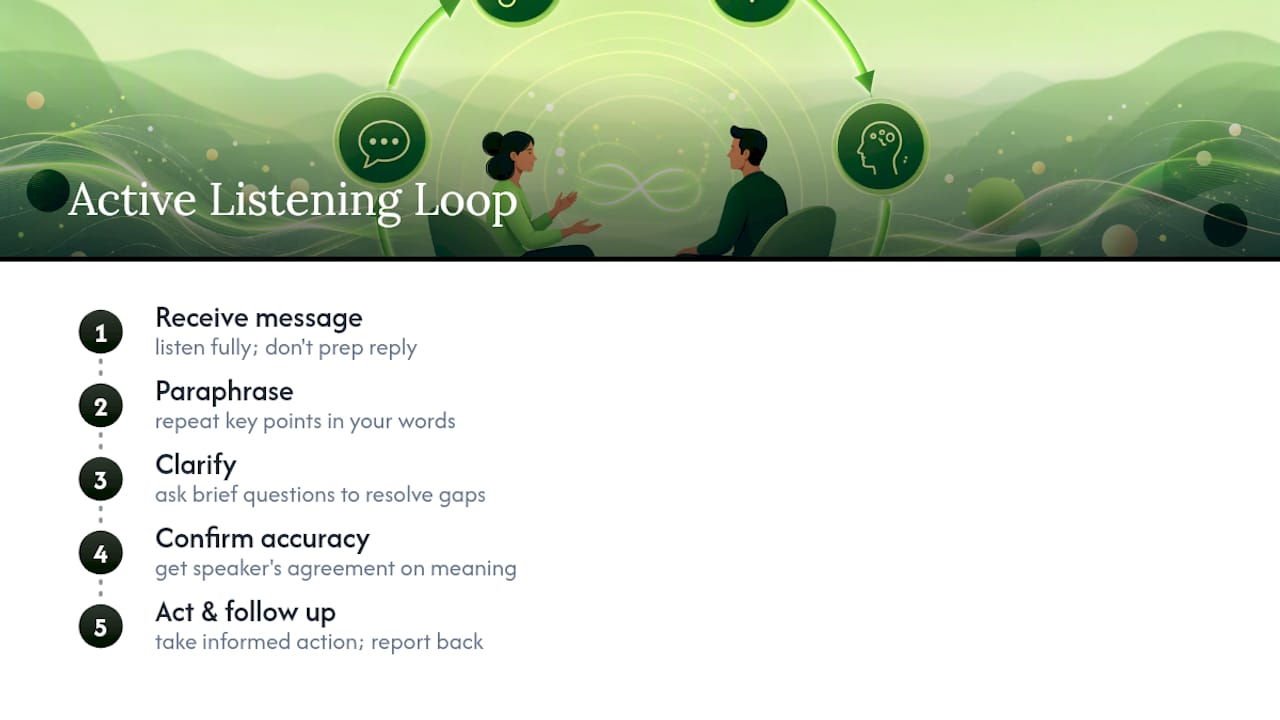
That gap between “what I heard” and “what you meant” is where most leadership mistakes get born. Someone flags a risk in a meeting. You hear the surface complaint, miss the real concern underneath, and move on. Three weeks later, that missed signal is a resignation letter or a blown launch.
Berkeley Executive Education makes the sharper point: active listening isn’t a soft skill you deploy to seem approachable. It’s a strategic shift. It builds the psychological safety that lets people take risks, pitch weird ideas, and admit when something’s broken before it’s a crisis. Teams that don’t feel heard don’t innovate. They comply, then quietly disengage.
So when you hear “active listening,” don’t picture a therapy session. Picture a leader who’s using presence and feedback as an actual data-collection system, one that catches signals before they become expensive.
What Better Listening Actually Delivers
Here’s the honest tally: leaders who listen well get faster problem detection, higher engagement, and fewer expensive misunderstandings.
Fewer misunderstandings sound minor until you calculate what one costs. A misread priority sends a team down the wrong path for a sprint. A misheard customer complaint gets “fixed” in the wrong direction. Active listening catches these before they compound, because clarifying questions surface the gap between assumption and reality while it’s still cheap to correct.
Trust and engagement move together here too. When people feel genuinely heard, they say more of what’s actually true, including the uncomfortable stuff. That’s not a nice cultural side effect. It’s the raw material for better decisions. Forbes Business Council contributors point out that listening only pays off when it’s followed by visible action. If people share feedback and nothing changes, they stop sharing. Follow-through is the proof that the listening was real.
This also connects directly to retention and inclusion. People stay where they feel their input shapes outcomes. Quieter voices, often the ones with the most useful outside perspective, only speak up when the room has demonstrated it’s safe to. That safety is built one paraphrase and one follow-up action at a time, and it compounds into the kind of innovation that never shows up when everyone’s just performing agreement.
The core listening skills every leader can benefit from practicing
The Center for Creative Leadership identifies six skills that separate leaders who genuinely listen from leaders who just wait for their turn to talk. None of these require a personality transplant. They’re behaviors you can start practicing in your next meeting.
- Pay attention. Put the phone away, close the laptop, and actually look at the person talking. Micro-habit: before someone starts speaking, take one breath and set an intention to focus only on them for the next 60 seconds.
- Suspend judgment. Resist forming a verdict before someone finishes their thought. Micro-habit: silently ask yourself, “What am I assuming right now?” and set it aside until they’re done.
- Reflect. Mirror back the emotional tone, not just the content. Micro-habit: after someone shares a concern, say, “That sounds frustrating” before jumping to logistics.
- Clarify. Ask a question instead of guessing at meaning. Micro-habit: use “When you say X, do you mean…?” at least once per conversation.
- Summarize. Restate the core point in your own words before responding. Micro-habit: end with, “So what I’m hearing is…” and let them correct you.
- Share. Once you’ve confirmed understanding, offer your own perspective, but only after the first five steps.
Layer in the Three Levels of Listening as a quick diagnostic: Level 1 is internal listening, where you’re mostly tracking your own reaction. Level 2 is focused listening, fully on the other person. Level 3 is global listening, where you’re also reading the room, the energy, and what’s unsaid. Most leaders default to Level 1 without noticing. Try tracking which level you’re actually operating at during your next three one-on-ones.
Pick one skill to practice. Clarifying questions are an effective way to improve because they are low-effort and immediately noticeable to the other person.
Common Obstacles and How Leaders Overcome Them
Two traps derail listening more than anything else, and both feel like helping in the moment.
The first is the advice trap. Someone brings you a problem, and your brain immediately starts building a solution instead of finishing the listening. You cut them off with “Here’s what I’d do,” and you’ve just told them their input was a formality. The second is confirmation bias: you hear what confirms what you already believe and quietly filter out what doesn’t. Stanford’s research on active listening names this as one of the biggest invisible barriers, especially in disagreements, because it lets you feel like you listened while actually just waiting to rebut.
A few tactics fix both traps:
- Set an intention before the conversation starts: “I’m here to understand, not to solve.”
- Physically remove the device. Not silence it. Remove it.
- Use a deliberate three-second pause before responding. Silence feels awkward for about a week, then it becomes your best tool.
- Ask “And what else?” before offering any opinion. It’s a small question that keeps people talking past their first, safest answer.
Pro Tip: Before you respond to any problem someone brings you, ask yourself one question: “Am I trying to understand, or am I trying to fix?” If the honest answer is “fix,” ask one more clarifying question first.
The Leader Listening Workout: Exercises You Can Start Today
Building this skill works the same way strength training does: short, repeated reps beat one long session. Cleveland Clinic’s guidance on active listening backs this up, pointing to small, daily habits over workshops as the more reliable path to change.
Run these on a rotation:
- The 10-second reset. Before any conversation that matters, take 10 seconds to clear your head of whatever you were just doing. Context-switching kills presence.
- The 60-second silent listen. Pick one meeting this week where you say nothing for the first 60 seconds someone else is talking. Just absorb.
- The three-second pause. After someone finishes a sentence, wait three full seconds before you respond. It feels long. It isn’t.
- Paired roleplay. Grab a colleague and practice reflecting and summarizing on a real (low-stakes) topic. Trade roles. Notice how often your summary misses the actual point.
- The meeting round. Go around the table and let every person speak once before anyone responds to anyone. This alone surfaces opinions that groupthink usually buries.
- The closing question. End meetings with “What haven’t we heard yet?” It’s uncomfortable the first time. It’s gold by the third.
None of these require a training budget or an offsite. They require you deciding, this week, to do them.
Designing Meetings and One-on-Ones Around Real Listening
Listening scales through design, not willpower. If you rely on remembering to listen well in the moment, you’ll fail under pressure. Build the structure instead.
- Open group meetings with a round: everyone gets 30 seconds uninterrupted before discussion opens.
- Assign a rotating “devil’s advocate” role so dissent has explicit permission.
- Build in deliberate silence after asking a question. Most leaders fill silence within two seconds; force yourself to wait five.
For one-on-ones, a simple repeatable script works better than winging it: start with “What’s on your mind that we haven’t talked about?”, follow with a clarifying question, then close with “What do you need from me?” That last question is the one most leaders skip, and it’s the one that turns listening into visible follow-through. HBR’s research on how leaders shape conversations points to the same pattern: leaders who model this behavior consistently see it replicate down through their teams, because people copy what their manager does, not what the handbook says. If you manage distributed teams, pairing this script with a clear remote communication approach keeps the habit from getting lost in the shuffle of async updates. For feedback specifically, pairing clarification with delivery that people can actually accept matters just as much as the listening itself.
How to Track Whether Your Listening Is Actually Improving
You can’t improve what you don’t measure, and “I think I’m a good listener” is not a metric.
Run a monthly self-assessment against three questions: Did I stay present without checking my phone? Did my paraphrase get confirmed as accurate, or did I get corrected? Did I take a visible follow-up action on at least one thing someone told me? That third question matters most. CCL’s own communication research points to simple diagnostic tools, self-assessments and feedback prompts, as the practical way leaders actually catch drift in their own habits.
Beyond self-review, ask your direct reports directly, ideally through a quick, anonymous one-question pulse: “Do you feel heard in our one-on-ones?” Track it over a quarter. You’ll notice movement well before any formal review cycle catches it.
A few workable metrics to watch:
- Paraphrase accuracy rate: how often your summary gets confirmed versus corrected.
- Follow-up action rate: how many things people raise actually result in a visible next step.
- Felt-heard score: a simple 1 to 5 pulse question, tracked monthly.
Audit one meeting a month against these. It takes ten minutes and tells you more than any annual engagement survey.
Adapting Your Listening Style to Different People and Cultures
The same listening technique doesn’t land the same way with every person on your team, and treating it like a one-size script is where a lot of well-intentioned leaders trip up.
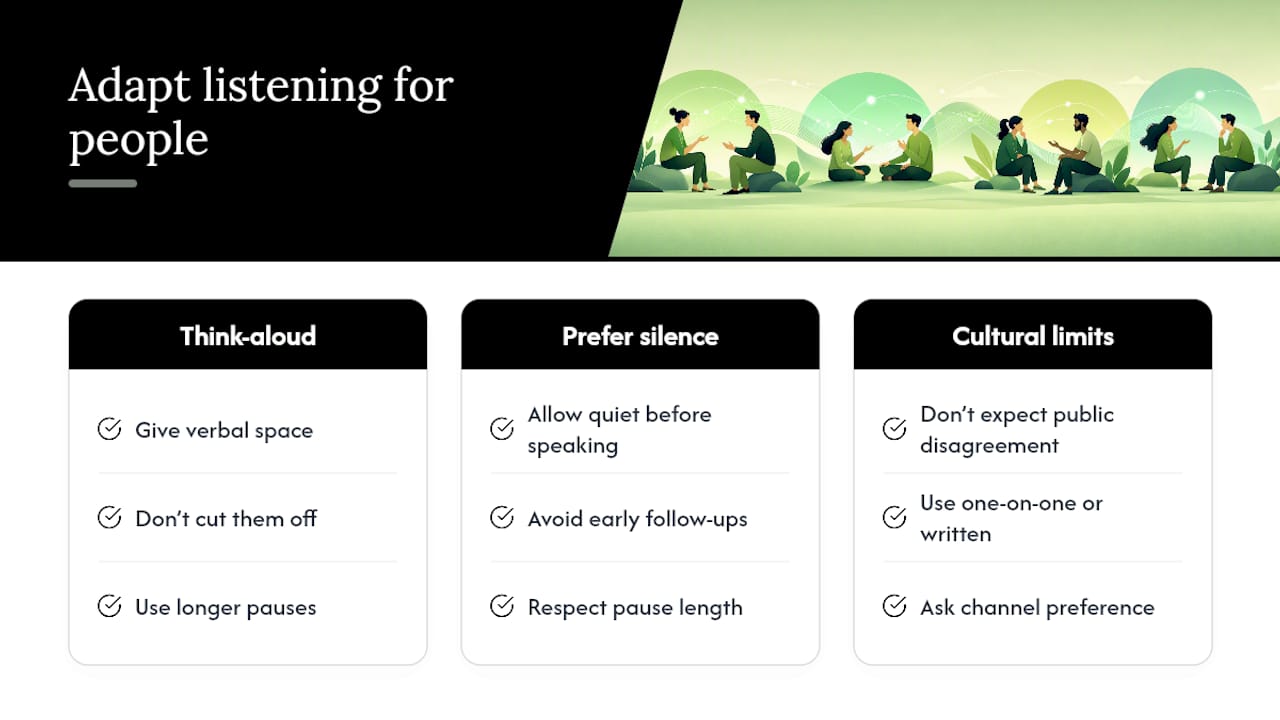
Some direct reports process out loud and need room to think through a problem verbally before landing on the real issue. Cut them off early and you’ll never hear the actual concern. Others need silence and space before they’ll say anything at all, and filling that silence with a follow-up question too soon reads as pressure, not interest. Watch which type you’re dealing with and adjust your pause length accordingly.
Cultural context adds another layer. In some workplace cultures, direct disagreement with a leader in a group setting is simply not going to happen, regardless of how safe you think you’ve made the room. That doesn’t mean the concern isn’t there. It means you need a different channel, a one-on-one, a written follow-up, an anonymous prompt, to actually surface it. Hierarchy norms, communication directness, and comfort with silence all vary by background, and assuming your default style works universally is a fast way to miss what quieter team members are actually telling you.
The fix isn’t mastering every cultural nuance perfectly. It’s staying curious about how someone prefers to communicate and asking them directly rather than guessing: “Do you prefer I follow up on this in writing or in person?” That one question does more for cross-cultural listening than any amount of research.
Why Body Language Says More Than Your Words Do
Active listening isn’t just what comes out of your mouth. Half of it is what your body’s doing while someone else talks, and people read that signal whether you mean to send it or not.
Eye contact, an open posture, and a slight forward lean all signal genuine engagement. Crossed arms, a glance at your watch, or typing while someone’s mid-sentence tell them exactly how much you’re actually absorbing, no matter what you say afterward. Nodding at the right moments, without turning it into a nervous tic, confirms you’re tracking without interrupting their flow.
Facial expression matters just as much. A flat, unreadable face during a hard conversation reads as disinterest even when you’re internally paying close attention. Letting your expression genuinely shift, a slight frown at bad news, a raised eyebrow at something surprising, tells the other person their words are landing somewhere real.
Mirroring tone matters too. If someone brings you a serious problem in a low, careful voice and you respond with a breezy, upbeat tone, the mismatch undercuts every word of reassurance you offer. Match their energy first, then guide the conversation where it needs to go.
Giving Feedback That Builds on What You Heard
Listening well sets up the feedback that follows. Skip the listening step and your feedback lands as an opinion imposed from outside. Do the listening first and that same feedback lands as a shared conclusion.
Start with what you heard before you offer what you think. “You mentioned the deadline felt unrealistic given the current scope. Here’s what I’m seeing on my end…” This single move changes the entire tone of a feedback conversation, because it proves you were tracking their perspective before adding yours.
Keep feedback specific and behavioral rather than characterizing. “The report missed the Q3 numbers” is useful. “You’re not detail oriented” is not, and it invites defensiveness instead of correction. Specific feedback also tends to trace directly back to something you clarified in the listening phase, which reinforces that the two are connected, not separate leadership tasks.
Close every piece of feedback with a question, not a directive: “Does that match what you were seeing?” This reopens the loop instead of closing it, and it’s often where the real information shows up, the part they were reluctant to say until you gave them another opening.
Staying Present During Hard and Emotional Conversations
Difficult conversations are where active listening either proves itself or falls apart completely, because your instinct under tension is to defend, explain, or fix, not to listen.
Name the emotion in the room before addressing the content. “This is clearly a frustrating situation” does more to lower the temperature than any explanation you could offer, because it tells the other person you registered how they feel before you started managing the facts. Skipping straight to solutions when someone’s upset almost always reads as dismissive, even when your intentions are good.
Resist the urge to defend yourself mid-conversation. If someone raises a criticism that stings, your job in that moment is still to understand it fully before you respond to it. Suspending judgment gets harder exactly when emotions run high, which is precisely when confirmation bias does its worst work, filtering out anything that doesn’t match your version of events.
Take a real pause if you need one. “Let me sit with that for a minute before I respond” is a legitimate, professional thing to say, and it beats reacting from a defensive place. Suspending judgment under pressure is harder than it sounds precisely because tension makes your brain want resolution immediately. Give it the pause anyway.
Making Active Listening Work Across Screens and Time Zones
Remote leadership strips away half of what makes listening feel natural, no shared room, no easy eye contact, and a video call that everyone’s slightly tired of by the fourth meeting of the day.
Video, used deliberately, still beats audio-only for anything sensitive. Seeing a raised eyebrow or a hesitant pause carries information a voice call misses entirely. For anything emotionally loaded or ambiguous, default to camera-on rather than a quick call or a wall of chat messages.
Async tools have their place too, but they need structure to support real listening rather than just message volume. A written prompt like “What’s one thing on your mind that we haven’t discussed?” dropped into a team channel weekly gives quieter voices a lower-pressure way to speak up than a live meeting ever will. Recorded video updates, watched fully rather than skimmed, preserve tone and body language that text strips out completely.
The trap with digital tools is mistaking responsiveness for listening. Answering a Slack message in ninety seconds isn’t the same as understanding it. Build in a deliberate pause before you reply to anything substantive, even in writing, the same three-second rule that works in person works just as well typed out.
A Practitioner’s View: The Insight Hiding in Plain Sight
The best leadership decisions rarely start with a spreadsheet. They start with someone on the team mentioning, almost as an aside, that a customer keeps asking for something the roadmap doesn’t cover. Miss it, and you keep building the wrong thing confidently. Catch it, because you were actually listening instead of running the meeting on autopilot, and you’ve got the seed of a pivot that could save a quarter of wasted work.
The gap between hearing that comment and acting on it is where most organizations lose the thread. Someone says something valuable, it gets nodded at, and it evaporates by the next agenda item. Turning that raw signal into a validated decision takes more than good intentions. It takes a way to capture what you heard and actually test it before betting resources on it.
— Samim Safaei
Turning What You Hear Into What You Build
Here’s the honest gap: you can become a genuinely great listener and still lose the signal, because a sharp insight from a one-on-one or a customer call means nothing if it dies in a notes app nobody reopens. siift’s New Business OS exists for exactly that handoff. It takes the qualitative stuff you pick up through real listening, a hesitant comment, a repeated complaint, an offhand idea, and runs it through a structured validation process so you know whether it’s worth building before you spend a single sprint on it.
You’re not choosing between listening well and building smart. Good listening is just the input. siift is what turns that input into a validated next step instead of a good idea that quietly dies in your notes app. If you’re sitting on insights you haven’t acted on yet, that’s exactly where to start.
Sources
- Active Listening Techniques: Best Practices for Leaders | CCL
- Active listening (StatPearls/NLM)
- The art of active listening | Berkeley Executive Education
- Six steps to active listening | Stanford Report
FAQ
What is active listening in a leader?
Active listening in a leader means giving full attention to what someone says, then confirming understanding through paraphrasing and clarifying questions before responding or acting, rather than just waiting for a turn to talk.
What are the three R’s of active listening?
Definitions vary across sources, but a common version centers on receive, reflect, and respond, taking in what’s said, mirroring it back to confirm understanding, and only then offering a reaction.
What are the five keys of active listening?
Common frameworks vary, but they typically include paying attention, withholding judgment, reflecting, clarifying, and summarizing, the core behaviors CCL identifies as foundational to strong leadership listening.
What are the four listening skills leaders need to master?
Most frameworks point to paying attention, suspending judgment, clarifying, and summarizing as the highest-leverage skills, since these four catch the most misunderstandings before they turn into costly mistakes.
How do I know if I’m actually improving as a listener?
Track paraphrase accuracy, whether people confirm or correct your summaries, and your follow-up action rate on things people raise. A simple monthly pulse question like “Do you feel heard?” tracked over a quarter shows real movement.