

TL;DR:
- Humility in leadership involves recognizing one’s limits, crediting others, and remaining open to correction. It promotes innovation, stronger relationships, and greater team adaptability by fostering ownership and trust. Embedding humility requires deliberate structural practices like managing meeting protocols and normalizing mistakes to build resilient, innovative teams.
Humility in leadership is defined as the active practice of acknowledging your limits, crediting others, and staying open to being wrong. It is not a soft skill. Research from Psychology Today published in february 2026 shows that humble leaders drive innovation by activating employees’ felt responsibility for constructive change. London Business School identifies humility as the mechanism that unlocks collective intelligence in volatile environments. Frontiers journal links it directly to stronger mentoring relationships and employee career adaptability. If you lead a team and you want it to grow faster than you can personally manage, humble leadership qualities are not optional. They are the architecture.
How does humility in leadership fuel team innovation?
Leader humility directly facilitates innovative behavior by making employees feel ownership over their work. When a leader admits uncertainty, it signals that the team’s ideas matter. That signal activates what researchers call “felt responsibility for constructive change,” which is the internal drive to improve things rather than wait for permission.
Two specific behaviors produce this effect at zero cost. First, specific praise tied to a concrete contribution tells an employee their effort was seen and valued. Second, connecting individual tasks to the organization’s broader mission makes the work feel meaningful, not mechanical. Both behaviors increase work meaningfulness, which researchers identify as a direct precursor to sustained creative output.
Practical ways to invite ownership into your team culture:
- Ask “What would you change about this?” before offering your own opinion.
- Credit contributions by name in meetings and written updates.
- Share decisions that were reversed because of team input.
- Invite dissenting views explicitly, not just theoretically.
- Acknowledge when a team member’s idea outperformed your own.
Pro Tip: Before your next team meeting, write down one specific contribution each person made in the past week. Reference it by name during the meeting. This takes three minutes of prep and produces a disproportionate lift in engagement and creative risk-taking.
“Humble leaders don’t just tolerate input. They architect conditions where input becomes the norm.” — Psychology Today, 2026
The importance of humility in leaders shows up most clearly in innovation metrics. Teams led by humble managers generate more ideas, test more hypotheses, and recover faster from failed experiments. That is not a personality outcome. It is a structural one.
How does humility improve relationships and career adaptability?
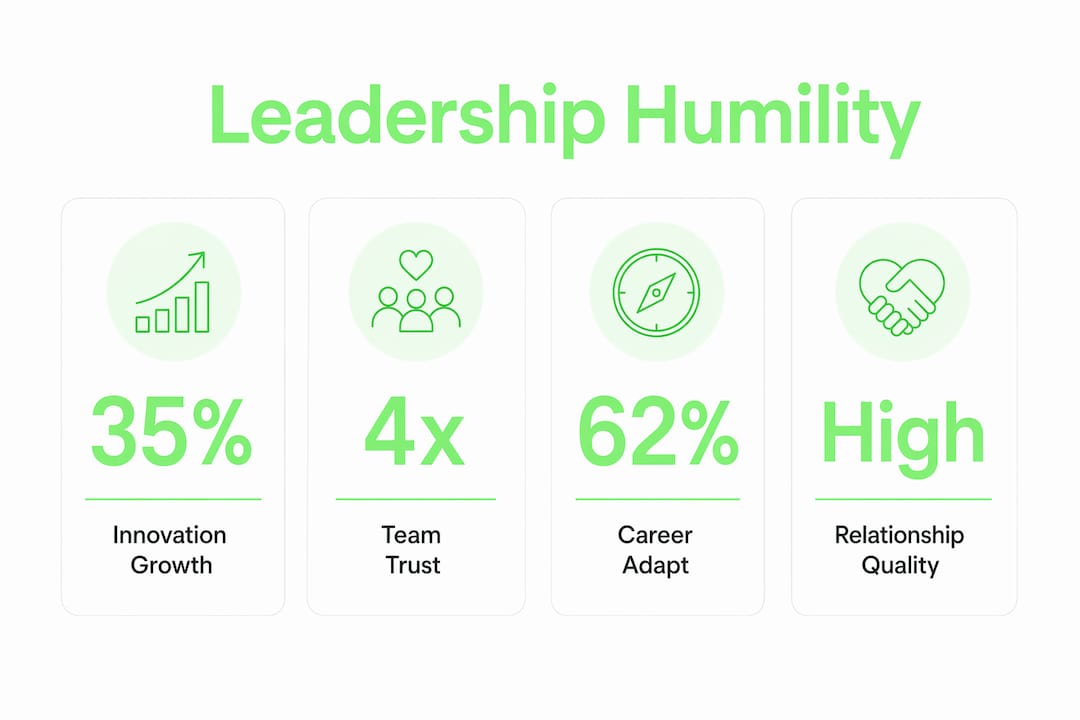
A may 2026 study published in Frontiers journal maps a clear pathway: leader humility produces high-quality leader-member exchange (LMX), which activates mentoring behavior, which builds employee career adaptability. Each link in that chain is statistically significant. The finding matters because career adaptability is what keeps your team competitive when markets shift.
LMX is the academic term for the quality of the relationship between a leader and each individual team member. High LMX means trust, respect, and mutual investment. Low LMX means transactional compliance. Humble leadership qualities consistently produce high LMX because they signal that the leader values the person, not just their output.
| Leadership style | Mentoring behavior | Career adaptability outcome |
|---|---|---|
| Humble leadership | High. Leaders actively invest in employee growth. | Strong. Employees navigate change with confidence. |
| Authoritative leadership | Low. Direction flows one way. | Weak. Employees wait for instructions during disruption. |
| Passive leadership | Absent. No investment in development. | Negligible. Employees feel unsupported and stagnate. |
Mentoring is the bridge between relationship quality and real-world adaptability. When a leader shares hard-won lessons, admits past mistakes, and connects employees to new opportunities, those employees build the mental flexibility to handle career pivots. The mentoring behaviors linked to humble leaders are not formal programs. They are daily habits of transparency and investment.
What are the common misconceptions about humility in executive roles?
The most persistent myth about humility in executive roles is that it signals weakness. It does not. It signals self-awareness, which is a prerequisite for good judgment. The confusion arises because humility looks like deference from the outside, but it functions as precision from the inside. A humble leader is not unsure of their direction. They are sure enough to question it.
Authority and expertise can erode humility over time. Past success creates cognitive shortcuts that feel like wisdom but are often just confirmation bias. The longer a leader has been right, the harder it becomes to stay genuinely open. Chief Executive magazine describes humility as a discipline of continual self-questioning, not a trait you either have or lack.
Common misconceptions leaders carry into senior roles:
- “Admitting I don’t know something undermines my authority.” (It builds it.)
- “My team needs certainty from me, not questions.” (They need direction and honesty, not theater.)
- “Humility means I defer to consensus.” (It means I weigh dissent seriously before deciding.)
Pro Tip: When you catch yourself dismissing an idea quickly, pause and ask: “Am I rejecting this because it’s wrong, or because it challenges something I’ve already decided?” That one question is the practice.
Confidence and humility are not opposites. Confidence provides the direction and decisiveness your team needs to move. Humility keeps you from mistaking speed for accuracy. The leaders who combine both are the ones who build teams that trust them through uncertainty, not just through success.
How can leaders structure humility into their governance and culture?
Humble leadership does not happen by accident. It requires deliberate design at the structural level. London Business School research recommends that leaders set governance frameworks that reduce ego influence before it enters the room. That means controlling the conditions of decision-making, not just the decisions themselves.
Specific structural practices that embed humility into team culture:
- Set meeting agendas that require junior team members to present first. This prevents senior voices from anchoring the discussion before others have spoken.
- Establish speaking order in brainstorms so that the most senior person speaks last, not first.
- Create a regular “what we got wrong” segment in team retrospectives. Normalize learning from failure as a leadership behavior, not an admission of incompetence.
- Write terms of reference for key decisions that require documented dissent before a final call is made.
- Share your own pivot points publicly. When you tell your team about a time you changed your mind because of new evidence, you model the behavior you want from them.
Normalizing shared mistakes transforms a team’s relationship with risk. When leaders model learning publicly, experimentation becomes safe. Blame cultures collapse when the person at the top is the first to say “I was wrong, and here’s what I learned.” That is not vulnerability theater. It is how you build a learning organization.
The psychological safety that humble leadership creates is the same condition that Google’s Project Aristotle identified as the single strongest predictor of high-performing teams. You cannot mandate safety. You can only model it. And the fastest way to model it is to lead with humility, structurally and consistently.

Founders building early teams can apply these same principles. A startup pivot guide built on humble leadership principles shows how admitting a wrong direction early saves months of wasted effort. The willingness to question your own assumptions is not a weakness in a founder. It is the core competency.
Key takeaways
Humble leadership is the most reliable path to building teams that innovate, adapt, and trust their leaders through uncertainty.
| Point | Details |
|---|---|
| Humility drives innovation | Humble leaders activate employees’ felt responsibility for change, producing more ideas and faster iteration. |
| LMX and mentoring improve adaptability | High-quality leader-member relationships built on humility lead directly to stronger mentoring and career resilience. |
| Humility requires structural design | Setting speaking order, agendas, and mistake-sharing norms embeds humility into culture, not just personality. |
| Confidence complements humility | Pairing humility with clear direction prevents it from reading as indecision or weakness. |
| Authority erodes humility over time | Leaders must treat humility as a daily discipline of self-questioning, not a fixed trait. |
Why I think we’ve been teaching leadership humility backwards
I’ve watched a lot of leadership development programs treat humility as a module. Forty-five minutes on active listening, a worksheet on blind spots, and a certificate. Then everyone goes back to their calendar full of back-to-back decisions and the humility evaporates by Thursday.
The problem is that we frame humility as a behavior to perform rather than a condition to design for. The leaders I’ve seen sustain it over years are not the ones who try harder to be humble. They are the ones who built their environment to make ego harder to sustain. They changed who speaks first in meetings. They published their own mistakes in team updates. They asked their direct reports to rate their openness quarterly and shared the results with the group.
That is a fundamentally different approach. It treats humility as an ongoing leadership discipline rather than a character trait you either have or need to fake. And it works because it removes the reliance on willpower, which is the first thing to go under pressure.
The other thing I’d push back on is the idea that humble leadership is a soft alternative to strong leadership. The research from London Business School and Frontiers in 2026 shows the opposite. Humble leaders build teams that are more adaptive, more innovative, and more resilient. That is not soft. That is the whole game. If you want to unlock what drives innovation in your team, start by questioning your own assumptions out loud. It costs nothing and signals everything.
— Samim
Building the leadership foundation your team deserves
Leadership and humility are inseparable in high-performing organizations, and the evidence from 2026 research makes that case clearly. If you are building a team or a company from the ground up, the structural habits you set now will define your culture for years. Siift is built for founders and leaders who want to operate with clarity and confidence at every stage of growth. From validating your first idea to scaling a team that can execute without you in every room, Siift gives you the frameworks to build right from the start. Visit Siift and see how the platform helps you build a business that does not depend on one person always having the right answer.
FAQ
What is humility in leadership?
Humility in leadership is the practice of acknowledging your limits, crediting others’ contributions, and staying open to being wrong. Research shows it directly increases team innovation and employee career adaptability.
Can leaders be humble and still be decisive?
Yes. Confidence and humility work together. Confidence provides direction and trust, while humility keeps leaders open to dissenting views and new evidence before a final decision is made.
How does humble leadership affect team innovation?
Humble leaders activate employees’ felt responsibility for constructive change, which drives creative output. Specific recognition and connecting work to broader goals are two proven, zero-cost ways to produce this effect.
What is the biggest challenge of humility in executive roles?
Authority and past success erode humility over time. Chief Executive magazine identifies humility as a discipline of continual self-questioning, not a fixed trait, which means it requires active daily practice to maintain.
How do you build humility into a team’s culture structurally?
London Business School recommends setting governance frameworks that reduce ego influence, including controlling speaking order in meetings, requiring documented dissent before key decisions, and normalizing public sharing of mistakes and pivots.