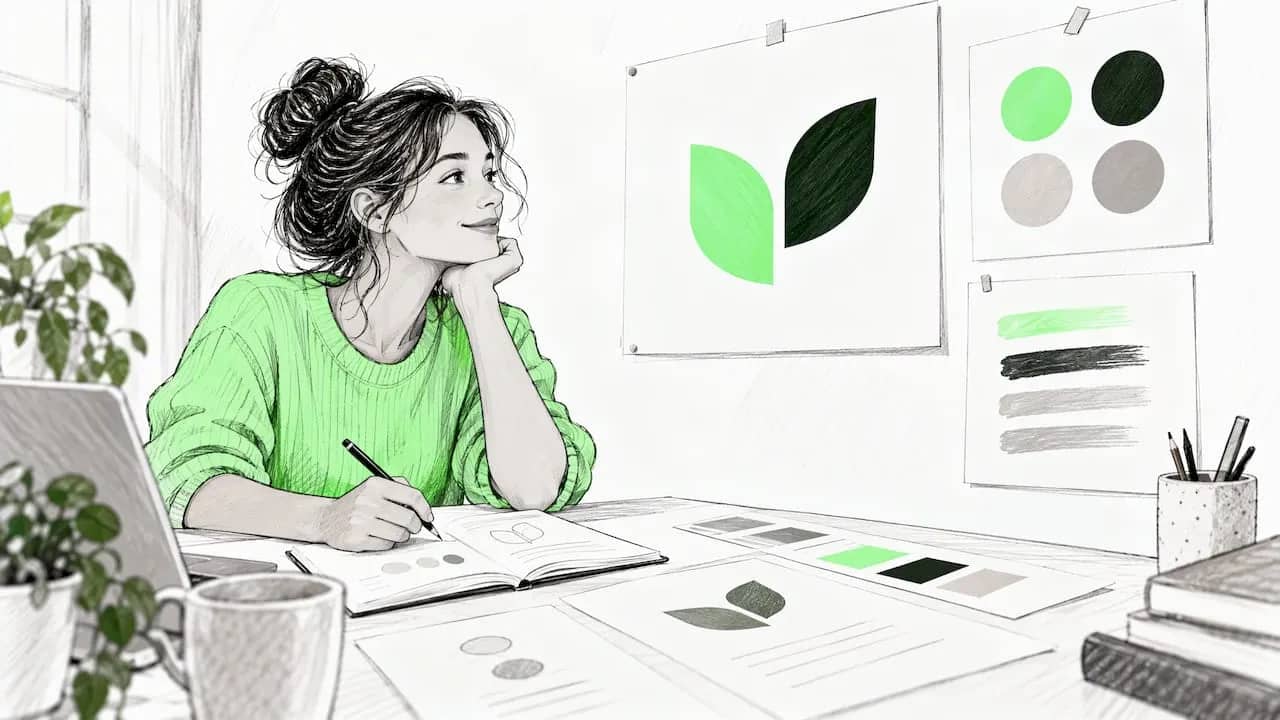

Building your own brand comes down to five decisions, made in the right order: who you serve, what you stand for, what you’re called, how you sound, and how you look. Most people start with the logo and finish with a nagging feeling that something’s off. We’d flip that. Do the thinking first, and the design takes an afternoon.
This guide is for anyone starting something of their own, especially if you’re doing it on the side of a day job and nobody handed you a playbook. It covers the business brand and the personal brand behind it, because for a solo builder they’re usually the same thing.
TL;DR
- A brand is a promise to a specific audience, not a logo. Pick the audience and the promise before you touch a design tool.
- Your personal brand works best as an honest amplification of real strengths, not a character you invent.
- Check your name against US trademark realities before you fall in love with it. Descriptive names are weak names.
- If you have an employer, write down what’s safe, what needs review and what’s off limits before you post a word.
- Treat brand research as a loop, not a one-off task. AI can speed it up, but you still make the calls.
Table of Contents
- What a brand actually is (and isn’t)
- Step 1: Pick your audience before your aesthetic
- Step 2: Find your spike
- Step 3: Be yourself, edited
- Step 4: Choose a name that survives contact with the law
- Step 5: Give your brand a voice and a look
- Step 6: Choose channels you’ll actually keep up
- If you have a day job: the brand agreement you need
- Where AI helps (and where it doesn’t)
- Our perspective: brand is the output of validation
- Turning your brand into a plan with siift
- A 14-day brand sprint
- FAQ
- Sources
What a brand actually is (and isn’t)
A brand is how a business, product or person is perceived in the market, and the rules that keep that perception consistent. Shopify’s guide frames it as what differentiates you from others in your industry, plus a set of brand guidelines that dictate how you’re presented.
That definition has two halves, and beginners tend to do only one. The perception half (what do people think of when they hear your name?) is the real asset. The guidelines half (colors, tone, logo rules) is just how you protect it.
For a personal brand, Ahrefs puts it plainly: it’s how people perceive you and what you’re known for, built from your skills, experience and values. Notice what’s missing. Nobody said “followers.”
Step 1: Pick your audience before your aesthetic
Every brand decision downstream gets easier once you can finish this sentence: “I help [specific person] get [specific result] without [specific pain].”
If that feels premature because you haven’t validated the idea yet, good instinct. A brand built on an untested assumption is just expensive decoration. Market research isn’t a one-time setup step either: the U.S. Small Business Administration treats market research and competitive analysis as part of planning your business, and the work doesn’t end at launch.
A quick audience sprint, about two hours:
- Write down the three people you’d most like as customers. Real humans, not “millennials.”
- For each, note the problem they’d pay to solve and what they do today instead.
- List five competitors or substitutes. Include “a spreadsheet” and “doing nothing.”
- Circle the gap nobody’s filling well. That’s where your brand lives.
If you want a faster route through the research, an AI platform for startup idea validation can structure this for you. More on that below.
Step 2: Find your spike
Here’s where most brands go beige. Trying to appeal to everyone reads as having nothing to say.
Maven co-founder Wes Kao argues that the way to stand out is a ‘spiky point of view’: a stance grounded in real expertise that also admits its own limits. It isn’t a contrarian hot take. It builds a reputation for rigor, not noise.
Try writing three statements in the form “Most people say X. In my experience, Y, except when Z.” The “except when” is what makes it credible. Keep the one that makes you slightly nervous and that you could defend for ten minutes.
Some examples of the shape (invented for illustration):
- “Most advice says post daily. For a side business with five spare hours a week, one strong piece a week beats seven weak ones, unless you’re selling to a platform-native audience.”
- “Most people name the company first. Name the problem first.”
Step 3: Be yourself, edited
There’s an anxiety that personal branding means manufacturing a shinier you. It doesn’t. Career experts at Hays say it’s about highlighting authentic strengths, with consistent expression across your visual, written and verbal spheres, adjusted by situation much like you’d choose different clothes for different occasions, without losing your core self.
A practical audit, borrowing from the same Hays guidance:
- Google yourself. What comes up?
- Check every social profile for consistency and professionalism.
- Remove or update anything that doesn’t reflect your best self.
- Write your brand message in two sentences.
Then run the “clothes test.” Would the you in your LinkedIn headline recognize the you in your newsletter? If not, you have a costume problem, not a branding problem.
Research suggests authenticity pays commercially, too. Shopify’s 2024 research found that 79% of shoppers are more likely to buy from brands whose values align with their own. Values only align if you’ve actually stated some.
Step 4: Choose a name that survives contact with the law
This is the step where “vibe-first” branding gets expensive. Founders pick a name that sounds great, buy the domain, print the stickers, and then discover it can’t be protected.
In US trademark practice, generic designators like Co., Inc. or LLC are merely descriptive. In one USPTO office action, an examiner required a disclaimer for “CANDLE CO.” on candles, because the words describe the goods and the type of business. A descriptive name gives you a weaker mark and fewer rights to enforce.

So skip the literal. A name like “Candle Company” for a candle company is easy to remember and hard to own. Coined, suggestive or unexpected words tend to make stronger marks.
Before you commit:
- Search the USPTO trademark database for similar names in your category. Similar sounds and meanings matter, not just exact matches.
- Check the domain and the main social handles.
- Say it out loud to three people and ask them to spell it.
- If the stakes are real, consult a trademark attorney before filing. Filing fees are paid per class and a refused application doesn’t give them back, so a search first is cheap insurance. One practitioner’s overview puts the fee at $250 to $350 per class, but check the current USPTO fee schedule before you budget.
This is general information, not legal advice. A trademark attorney is the right professional for anything specific to your name.
Step 5: Give your brand a voice and a look
Now the fun part, and it’ll go faster than you expect because you’ve done the hard thinking.
Voice
Pick three adjectives and one “never.” For example: plain, warm, a little dry; never corporate. Write five sample sentences in that voice: a homepage headline, a welcome email, a customer apology, a product description, a social post. If they sound like different people, tighten the adjectives.
Visuals
You need only the basics to start:
| Element | Good enough for launch | Revisit when |
|---|---|---|
| Logo | A clean wordmark in one typeface | You have paying customers and a clear niche |
| Colors | One primary, one accent, one neutral | You add a product line |
| Typography | Two fonts max | You hire a designer |
| Photography | Real photos of you or your work | You have budget for a shoot |
Consistency beats polish. A modest identity used everywhere looks more professional than a gorgeous one used on Tuesdays.
Story
Your origin story should be true, short and about the customer more than you. “I spent nine years in operations watching small teams drown in spreadsheets” works. A heroic montage doesn’t.
Step 6: Choose channels you’ll actually keep up
Pick one place where your customers already spend time, and one owned asset (a website and an email list). Everything else is optional.
- Writing-led brand: a newsletter or blog, with LinkedIn for distribution.
- Visual product: Instagram or Pinterest, with short video.
- Expert services: LinkedIn plus talks, podcasts and guest posts.
If you’re in tech and want to see how AI changes the content side of this, there’s a useful walkthrough on building a brand online with AI-driven strategies. And our own breakdown of AI tools for startup marketing covers what’s worth paying for.
For a deeper walkthrough on personal positioning, see our step-by-step guide to building an online personal brand.
If you have a day job: the brand agreement you need
Many first-time founders build on nights and weekends. That’s smart, and it brings a risk nobody mentions in branding guides: your employer.
One suggestion from a guide on employee personal brands is a short, mutual, written agreement. It sorts topics into green (safe), amber (needs review) and red (off limits), and covers definitions of trade secrets, internal roadmaps, client data and code. Even if your company has no such document, you can draft your own version and ask your manager or HR to confirm it.
A simple version for your side business:
- Green: your general expertise, public industry commentary, your own product.
- Amber: anything touching your employer’s industry, clients or tools. Ask first.
- Red: confidential information, employer time and equipment, anything that competes with your employer.
The last point isn’t hypothetical. SHRM reporting describes an employee given a written warning after making side-business calls on a work phone during work time. Employment terms and state law vary, so for anything unclear, read your contract and talk to an employment attorney.
There’s also a human side. Research on employee ambassadors on social media describes an authenticity paradox: constant tension between self-branding demands and being genuine. You can sidestep much of it by keeping your side brand clearly separate from your employer’s.
Where AI helps (and where it doesn’t)
AI is excellent at the grunt work of branding: summarizing competitors, clustering customer language, drafting name options, stress-testing your positioning. The SBA notes that AI-powered workflows can help turn research findings into practical deliverables like pitch decks, one-pagers or strategic plans, and a repeatable workflow is the goal.
It’s not great at taste, nerve or knowing your customer’s face. Those stay with you. Generic chatbots also forget your context between sessions, so you end up re-explaining your business every time. That’s where a structured tool earns its keep. For tech-minded builders, there’s a good primer on applying AI to market research and brand strategy.
Our perspective: brand is the output of validation
We talk to a lot of first-time founders, and the pattern is consistent. They spend three weeks on a logo and three hours on whether anyone wants the thing. Then they wonder why a beautiful brand doesn’t convert.
We think the order matters. Brand is what you get when you’ve validated a problem, understood your competitors, and chosen a position you can defend. Skip that, and you’re decorating a guess. Do it, and the name, voice and story almost write themselves, because they’re drawn from evidence about real customers instead of vibes.
That belief shaped how we built siift: a step-by-step AI business operating system that walks you through ideation, validation and go-to-market in sequence, keeps your business context in one place, and is designed to filter out the biases and blind spots that trip up first-timers. You shouldn’t need an MBA or an agency retainer to make good decisions. You need structure, honest feedback and a bit of momentum.
— Samim Safaei
Turning your brand into a plan with siift
If you’d like help making these decisions in order, siift’s startup idea validation tools guide you through audience, competitors and positioning, and our go-to-market planning software turns that into a launch plan. There’s a free plan, plus Discover at $29 per month per user and Focus at $99 per month per user. See the pricing page for details on each, including Enterprise.
A 14-day brand sprint
| Days | Task | Output |
|---|---|---|
| 1-2 | Audience sprint | One-sentence customer and problem |
| 3-4 | Competitor and substitute review | Gap you can own |
| 5 | Spiky point of view | One defensible stance |
| 6 | Name shortlist and trademark search | Three vetted names |
| 7 | Employer check (if employed) | Green, amber, red list |
| 8-9 | Voice and story | Three adjectives, one origin story |
| 10-11 | Visual basics | Wordmark, palette, two fonts |
| 12-13 | Website and email capture | One-page site live |
| 14 | First public post | Your stance, in your voice |
Ship it ugly-but-consistent, then improve with real feedback. A brand is a living thing, and nobody ever got it right in a notebook.
FAQ
How much does it cost to build your own brand?
You can start for close to nothing: a domain, a simple site builder and free design tools. The costs that matter are the ones you can’t undo, like a name you have to change later or a trademark application refused after you’ve paid the fee. Spend your first dollars on research and a name check, not on a logo.
What’s the difference between a personal brand and a business brand?
A business brand is how a company is perceived. A personal brand is how you are perceived, based on your skills, experience and values. For a solo founder they overlap heavily, but giving the business its own name makes it easier to grow, hire or sell later.
Can I build a brand while working a full-time job?
Yes, and many people do. Check your employment agreement for outside-work and conflict-of-interest clauses, keep side work off employer time and equipment, and agree a clear green, amber and red list for what you’ll talk about publicly. For anything ambiguous, consult an employment attorney.
Do I need to trademark my brand name right away?
Not necessarily on day one, but search before you commit, because descriptive names are harder to protect. Registering later is possible, yet a forced rebrand after you’ve built an audience is the costly scenario. A trademark attorney can advise on timing for your situation.
Sources
- How To Build a Brand From Scratch, Shopify
- Personal Brand: What It Really Is and How to Build One, Ahrefs
- Build Your Own Personal Brand, Hays
- Market research and competitive analysis, U.S. Small Business Administration
- USPTO Non-Final Action 99195374
- How to Trademark Your Business Name and Protect It Federally
- The Employer’s In-Depth Guide to Enabling Employee Personal Brands
- What to Do About Moonlighting Workers, SHRM
- Fear of being replaced: The dark side of employee ambassadorship on social media