Design thinking for innovation is a human-centered, iterative method teams use to uncover unmet needs and learn fast which ideas actually create value, using cycles of research, ideation, and testing instead of guesswork. It’s built for messy, ill-defined problems where the “right” answer isn’t obvious yet. Once you’ve got the concept down, the real question is which stage model fits your team and timeline.
TL;DR:
- Small teams can complete a one-day design thinking sprint by focusing on a single user problem, with clear roles assigned for faster results.
- Rapid research methods like short interviews and contextual inquiry effectively uncover user needs, while affinity mapping and journey maps synthesize insights.
- Using structured ideation tools such as brainwriting and SCAMPER prevents dominant voices and sparks creative variation before prototyping.
- Early prototyping with paper sketches or wireframes allows quick testing, and capturing user feedback helps validate or invalidate concepts efficiently.
- Scaling design thinking across organizations requires cross-functional squads, leadership support for small tests, and tracking metrics like learning velocity and idea adoption.
Table of Contents
- What Design Thinking Is and Which Stage Models Actually Work
- Tools for Every Stage: Research, Ideation, and Prototyping
- How to Run a One-Day Design Thinking Sprint
- Scaling Design Thinking Across Teams and Leadership
- What the Research Actually Shows
- Where AI Fits Into the Design Thinking Process
- Editorial Perspective: Why Most Teams Skip the Hard Part
- Sources
- FAQ
What Design Thinking Is and Which Stage Models Actually Work
McKinsey defines design thinking as a systemic, customer-focused problem-solving approach that helps organizations respond to fast-moving markets by centering real user needs instead of internal assumptions. That’s the whole game: stop guessing, start learning from actual humans.
Three models dominate practice. The d.school’s five-stage framework, Empathize, Define, Ideate, Prototype, Test, is the most widely taught and works well for teams new to the method. Harvard Business School’s four-stage version, Clarify, Ideate, Develop, Implement, compresses the front end and suits leaders who want fewer handoffs. The Double Diamond adds a fourth “D” (Discover, Define, Develop, Deliver) and is popular in product organizations already running agile sprints.
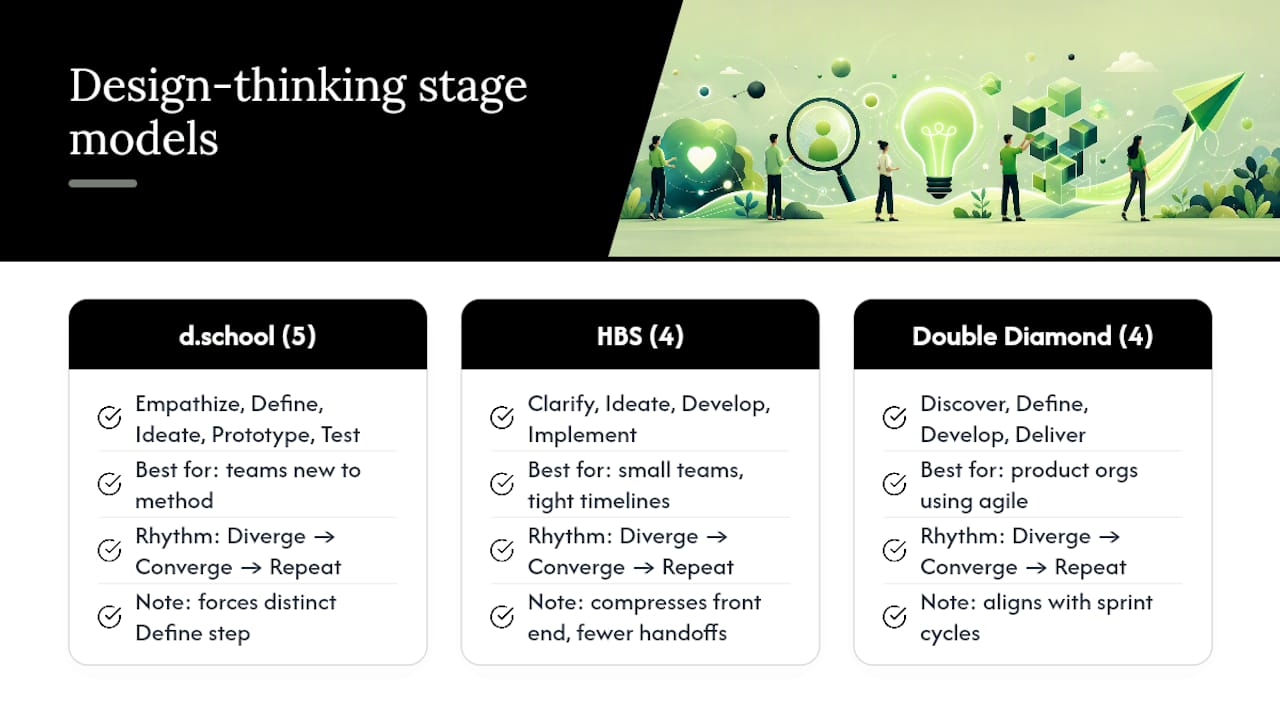
All three share the same rhythm: diverge to generate options, converge to narrow them down, repeat. Pick based on your constraints. Small teams with tight timelines do better with HBS’s leaner model. Larger cross-functional groups benefit from the d.school’s extra structure, since it forces a distinct definition step before anyone starts ideating.
Tools for Every Stage: Research, Ideation, and Prototyping
Each stage has its own toolkit, and mixing them up wastes time. Here’s what actually gets used in practice, not what looks good in a slide deck:
- Empathy research: short-form user interviews (20 to 30 minutes), contextual inquiry (watching someone use a product in their real environment), and “five whys” probing to get past surface complaints.
- Synthesis: affinity mapping to cluster raw notes into themes, customer journey maps to spot friction points, and “How Might We” statements to reframe problems as opportunities.
- Ideation: brainwriting (silent, individual idea generation before group discussion) prevents the loudest voice from dominating. SCAMPER (Substitute, Combine, Adapt, Modify, Put to other use, Eliminate, Reverse) forces structured variations on an existing idea. Worst-Idea exercises break creative gridlock by removing the fear of a bad suggestion.
- Prototyping: paper sketches for early concepts, clickable wireframes for flows, and “Wizard of Oz” prototypes (a human faking the backend) for testing service ideas before writing code.
- Testing: run five-user usability sessions, capture friction points verbatim, and convert every finding into one of three buckets: validated, invalidated, or needs more data.
Creative problem-solving methods sharpen the ideation phase specifically by giving teams structured ways to separate divergent thinking from convergent decision-making, rather than blending the two and getting mediocre results from both.
How to Run a One-Day Design Thinking Sprint
You don’t need a week-long offsite. A single focused day, or two half-days if attention spans are shorter, gets you from problem to tested prototype.
Pre-work: identify one specific user problem in advance, recruit three to five target users for testing, and assign four roles: a facilitator (keeps time, not the boss), a researcher (owns interviews and synthesis), a decision owner (breaks ties), and a prototyper (builds fast, cares about polish later).
- 9:00 to 10:30, Empathize: run three to four rapid interviews or review existing customer feedback. Output: raw notes, no interpretation yet.
- 10:30 to 11:30, Define: affinity map the notes, write one clear problem statement. Output: a single “How Might We” question the team agrees on.
- 11:30 to 1:00, Ideate: brainwriting followed by SCAMPER on the top three concepts. Output: one concept selected for prototyping.
- 1:00 to 3:00, Prototype: build the lowest-fidelity version that tests the core assumption. Output: a testable artifact, not a finished product.
- 3:00 to 4:30, Test: run it past your recruited users, capture reactions live. Output: a validated/invalidated list with next steps.
Document everything in a single shared doc, one page, so decisions aren’t buried in slide decks nobody reopens.
Pro Tip: Assign someone to write down dissenting opinions before the group votes on a direction. Groupthink kills more good ideas than bad facilitation ever will.
Pro Tip: Set a hard stop for ideation, even mid-sentence. Constraint breeds better decisions than “just five more minutes” ever does.
For a deeper walkthrough of facilitation techniques and session templates, siift’s practical team guide to the design thinking process covers the exercises above in more detail.
Scaling Design Thinking Across Teams and Leadership
A one-off workshop feels great and changes nothing if it doesn’t survive contact with the org chart. Scaling it means building cross-functional squads, usually product development, design, and one commercial voice, so ideas get pressure-tested against feasibility and revenue from day one, not after the fact.
Leadership’s job is protecting the experiment budget: the time and permission for teams to run small, cheap tests without needing a business case for every one. Skip that, and design thinking becomes a workshop people did once, not a habit.
Track it with real metrics, not vanity ones: learning velocity (how many assumptions tested per sprint), the ratio of validated to invalidated assumptions, adoption rate of the resulting concept internally, and, eventually, revenue tied to shipped ideas. Design thinking isn’t a replacement for Agile or Lean, it’s the front end that feeds them better inputs. Agile handles the build cadence; design thinking makes sure you’re building the right thing before the sprint backlog fills up with guesses.
For culture-change specifics on embedding this in a small organization, siift’s guide on what actually drives innovation digs into the leadership behaviors that make or break adoption.
What the Research Actually Shows
Academic reviews find design thinking promotes user focus and reduces cognitive bias in decision-making, and can drive measurable innovation outcomes when it’s embedded into culture rather than run as an isolated workshop.
Design-led organizations that lean on rapid prototyping and iteration consistently report stronger customer value and better business outcomes than teams that skip straight to building.
That’s the practical takeaway: teams that test early and often build things people actually want, instead of things that seemed clever in a meeting room. The catch is context. A framework that works at a 500-person product org doesn’t automatically transfer to a three-person startup team with no research budget. Scale the method to your resources, don’t force your resources to match the method.
Where AI Fits Into the Design Thinking Process
AI is a synthesis machine, not a judgment machine. It can chew through fifty interview transcripts and surface patterns faster than any human team, which is genuinely useful. But it can’t sit in a room with a frustrated user and catch the hesitation in their voice that reveals the real problem. Use AI to compress the grunt work of synthesis. Keep humans on empathy, framing, and the call on what to build next.
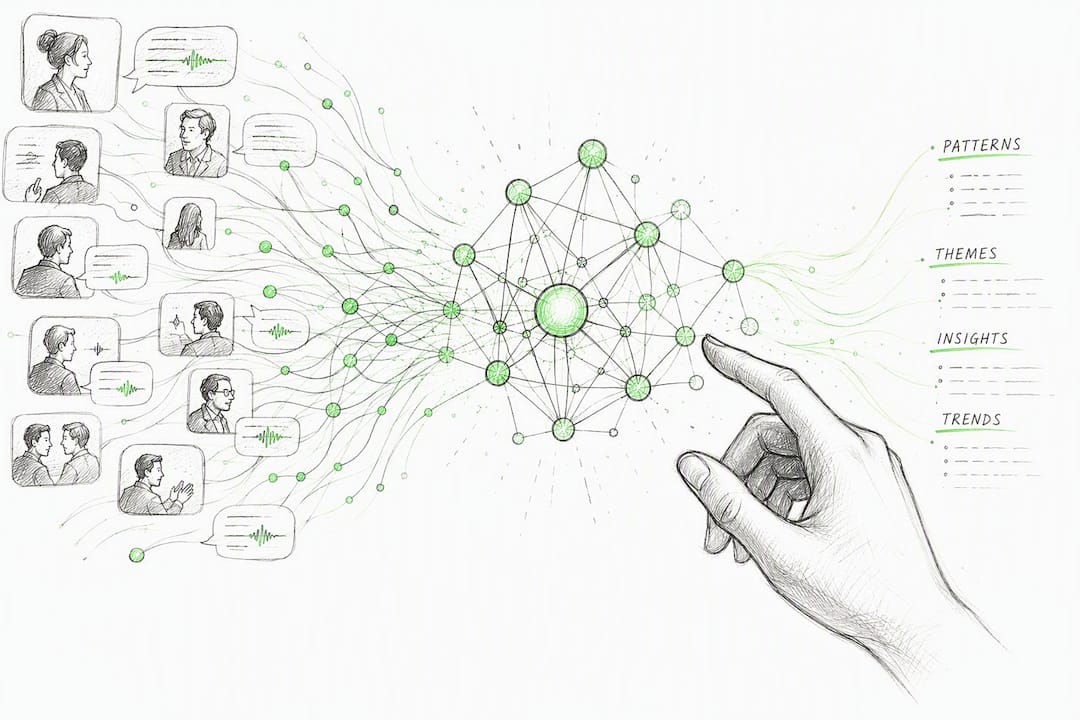
At siift, we built our platform around that split: AI handles pattern recognition and validation logic, you keep the judgment calls. If you want a tool-assisted way to move from insight to go-to-market plan, our go-to-market planning software picks up right where your design thinking sprint leaves off, or start free at App.
Editorial Perspective: Why Most Teams Skip the Hard Part
Most design thinking failures aren’t a methodology problem, they’re a discipline problem. Teams love ideation because it feels creative and low-risk. They dread empathy research and rigorous testing because those phases surface uncomfortable truths about their pet idea. The Emerald review’s finding on reduced cognitive bias only holds if you actually do the unglamorous research work instead of skipping to the fun part.
The IDEO framing of this as a rhythm rather than a checklist is the piece most business teams miss entirely. They run it once, linearly, call it done, and wonder why nothing changed. Real practitioners loop back constantly. That looping is the method, not a detour from it.
— Samim Safaei
Sources
- What is design thinking? | McKinsey
- The 5 Stages in the Design Thinking Process | IxDF
- Design thinking for innovation: context factors, process, and outcomes | Emerald
FAQ
What Is Design Thinking for Innovation?
It’s a human-centered, iterative problem-solving method that combines research, ideation, and rapid testing to help teams identify unmet user needs and validate which ideas will create real value, rather than relying on assumptions.
What Are the Five Stages of Design Thinking?
The d.school’s model runs Empathize, Define, Ideate, Prototype, and Test, though teams often loop back between stages rather than moving through them in a straight line.
What Are the Four D’s of Design Thinking?
The Double Diamond framework uses Discover, Define, Develop, and Deliver, while HBS’s related four-stage model uses Clarify, Ideate, Develop, and Implement. Both separate problem framing from solution-building.
How Long Does a Design Thinking Sprint Take?
A focused sprint can run in a single day or two half-days, covering empathy research, problem definition, ideation, prototyping, and testing with real users in that compressed window.
How Does Design Thinking Differ From Agile or Lean?
Design thinking focuses on discovering the right problem and validating ideas before building, while Agile and Lean focus on how to build and ship efficiently once direction is set. The two work best together, not as substitutes.