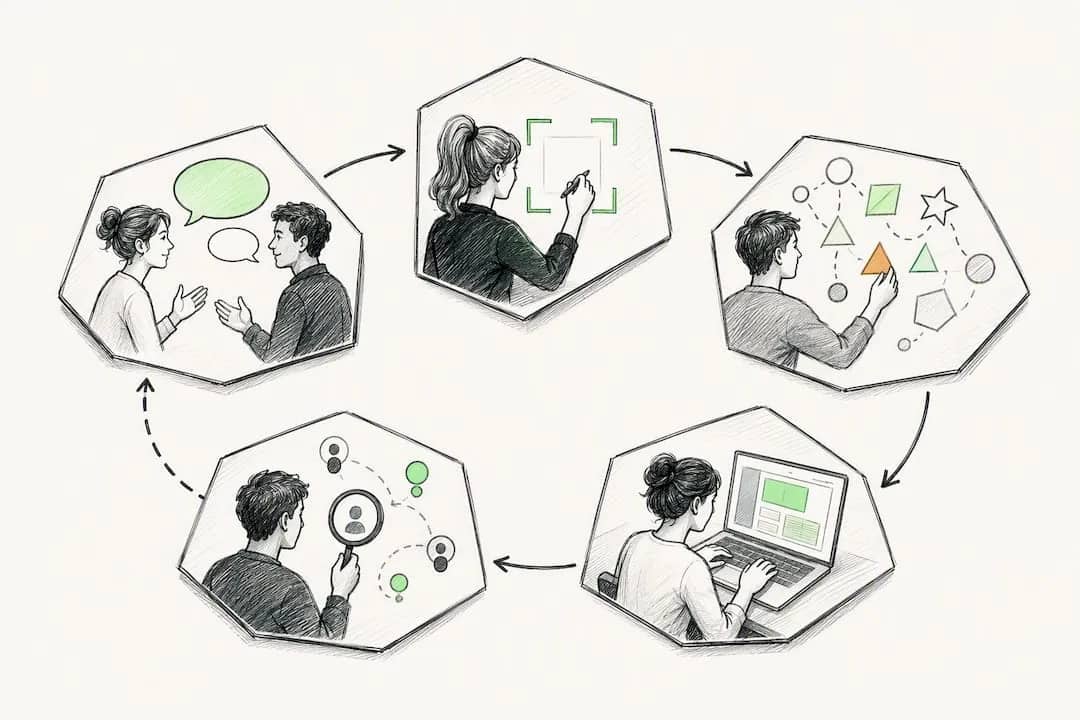
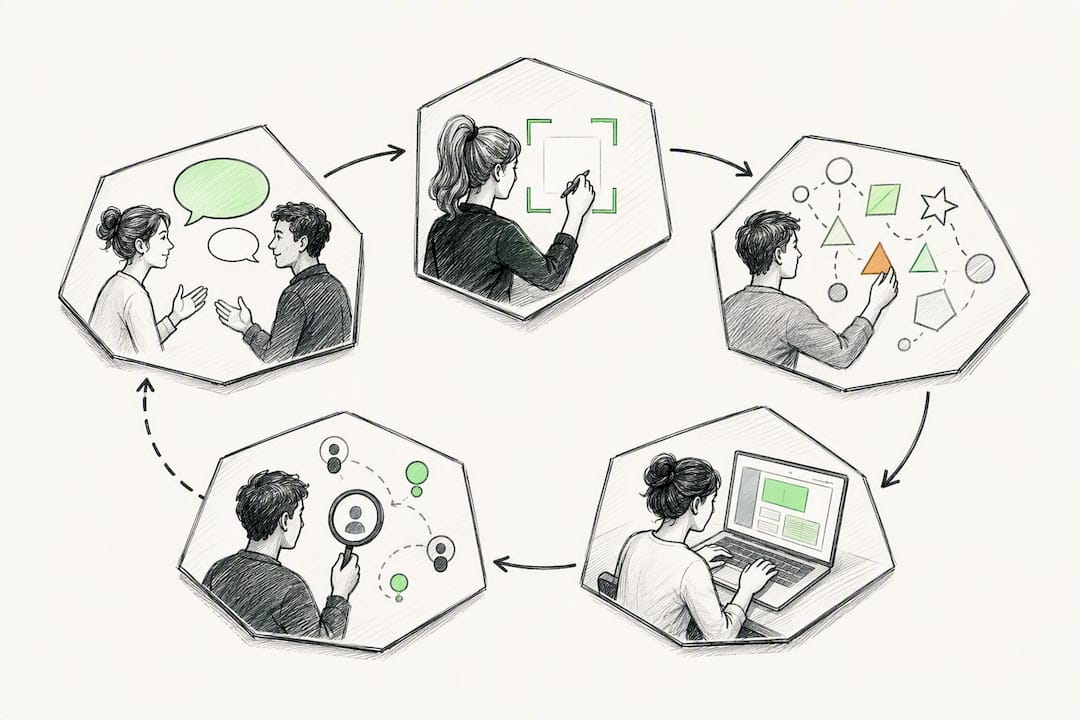
Design thinking is a human-centered, iterative problem-solving methodology built on three pillars: desirability, feasibility, and viability. Most teams practice it through five stages, roughly Empathize, Define, Ideate, Prototype, and Test, cycling back and forth instead of marching straight through. The payoff isn’t a prettier product. It’s a validated one, built with far less guesswork and far less wasted runway than founders normally burn chasing a hunch.
TL;DR:
- Most teams practice design thinking iteratively, cycling back through stages like Empathize and Test to continuously refine solutions.
- The process is most valuable when problem clarity is low, requiring genuine user insights to identify real needs before building.
- Rapid, small-scale research and prototype cycles help validate ideas early, reducing costly missteps and ensuring solutions align with user pain points.
- Overreliance on a strict, linear view of stages often leads to skipping research or testing, risking solutions based on assumptions rather than evidence.
- Tools like siift can streamline synthesis and validation in later stages, especially for solo founders managing multiple tasks and stakeholder alignment.
Table of Contents
- What Is Design Thinking, and Why Does It Matter?
- What Are the Stages of the Design Thinking Process?
- What Are the Core Principles Behind Design Thinking?
- How Do You Actually Run Each Stage?
- Where Does Design Thinking Actually Get Used?
- What Do People Get Wrong About Design Thinking?
- How Do You Start Practicing Design Thinking This Week?
- When Should You Trust Design Thinking, and When Should You Push Past It?
- Where a Tool Like siift Fits Into Your Design-Thinking Practice
- Sources
- FAQ
What Is Design Thinking, and Why Does It Matter?
Here’s the short version: design thinking is a way of solving problems that starts with people, not features. You watch how someone actually struggles with something, define the real problem underneath their complaints, generate a pile of possible fixes, build a rough version fast, and put it in front of real humans before you spend another dollar polishing it. Then you do it again. And again.
That loop matters because most founders don’t fail from lack of effort. They fail from building the wrong thing extremely well. Design thinking is the antidote to that specific disease.
The modern version of this methodology traces back to Tim Brown’s 2008 Harvard Business Review piece and IDEO’s popularization of designer methods for corporate innovation, though the underlying cognitive approach goes back decades further. Stanford’s d.school took those ideas and turned them into a teachable framework, and that’s largely why you now see the five-stage model taught in MBA programs, startup accelerators, and product teams worldwide.
Why does any of this matter for someone building a business right now? A few concrete reasons:
- It derisks decisions before they’re expensive. You learn a solution won’t work while it’s still a sketch, not after you’ve shipped it.
- It forces alignment. Teams that run empathy interviews together stop arguing from opinion and start arguing from evidence.
- It produces more usable innovation. McKinsey frames it as a systemic, customer-focused approach that creates competitive advantage by aligning organizations around real user needs, not internal assumptions.
Pro Tip: If your team can’t articulate the specific person and specific pain point behind a feature you’re about to build, you’re not doing design thinking yet. You’re doing decoration.
What Are the Stages of the Design Thinking Process?
The canonical model, popularized by d.school and formalized in materials like MIT’s breakdown, runs through five stages. Here’s what each one actually asks you to do:
- Empathize. Talk to real users. Watch them use things. Resist the urge to explain or defend your idea while they talk.
- Define. Take what you heard and boil it down to a specific problem statement, often phrased as a point of view: “A busy parent needs a faster way to X because Y.”
- Ideate. Generate a wide range of possible solutions before judging any of them. Quantity first, quality second.
- Prototype. Build the cheapest, fastest version of an idea that lets someone react to it. Cardboard, clickable mockups, a landing page, whatever proves the concept.
- Test. Put the prototype in front of real users and watch what happens. Then loop back to whichever earlier stage the results point you toward.
That’s the version most people learn first, but it’s not the only one. The Interaction Design Foundation teaches the same five stages with heavier emphasis on iteration and constant rebalancing between desirability, feasibility, and viability. Nielsen Norman Group compresses the whole thing into three higher-level buckets: Understand, Explore, and Materialize, which is a useful mental shortcut when five stages feel like too much ceremony. And IDEO’s own process stretches to seven phases, including framing a question, gathering inspiration, generating ideas, and sharing the story, because they’ve found that storytelling itself is part of getting an idea adopted inside an organization.
None of these models disagree with each other. They’re different resolutions of the same photograph.
The part that trips people up isn’t the number of stages. It’s the assumption that you move through them in order and never look back. In practice, seasoned teams loop constantly. A prototype test in week three might send you straight back to Empathize because you realize you interviewed the wrong users. That’s not failure. That’s the process working as intended, and experienced practitioners expect exactly this kind of regression rather than treating it as a detour.
What Are the Core Principles Behind Design Thinking?
Every decision in a design-thinking process gets filtered through three questions, often called the three pillars:
- Desirability. Do people actually want this? Not “would they use it if it existed” but “do they feel the pain sharply enough to change behavior.”
- Feasibility. Can you actually build it with the technology, team, and time you have?
- Viability. Does it make business sense? Will it generate revenue that exceeds what it costs to build and maintain?
A solution only survives when all three overlap. A beautifully desirable idea that’s technically impossible is a science project. A feasible, viable feature nobody wants is a graveyard entry in your product backlog.
Beyond the three pillars, a handful of supporting principles keep the whole method honest:
- Empathy over assumption. You don’t guess what users want. You watch and ask.
- Co-creation. Users and stakeholders help shape solutions, not just react to finished ones.
- Fast learning cycles. Speed of feedback matters more than polish of output, especially early.
These principles show up constantly in prioritization arguments. When a team debates whether to spend two weeks on a feature, the real question isn’t “can we build it.” It’s “have we confirmed desirability, and does it still hold up on feasibility and viability once we do.”
Pro Tip: Score your top three ideas against desirability, feasibility, and viability on a simple 1 to 5 scale before you build anything. The idea with the highest combined score almost never matches your gut favorite, and that gap is exactly the bias you’re trying to filter out.
How Do You Actually Run Each Stage?
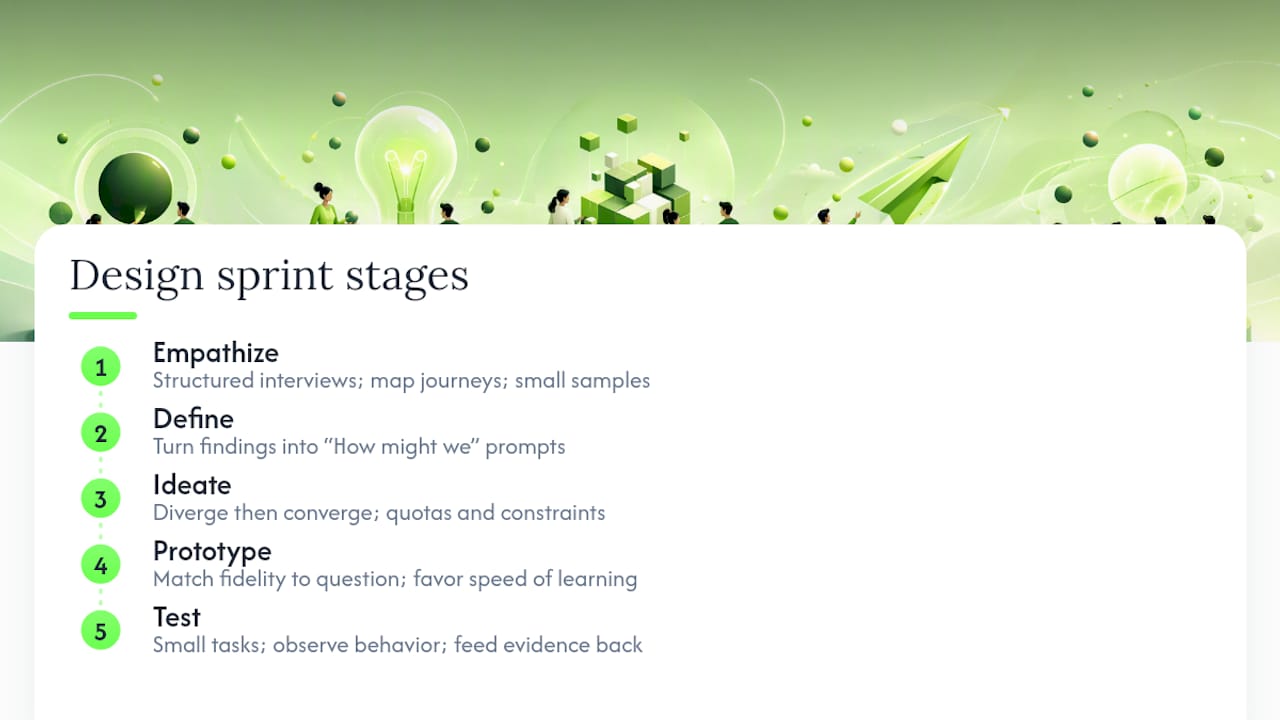
Theory is easy. Execution is where most teams stall. Here’s what works at each stage.
Research (Empathize). Structured interviews beat casual conversations. Ask open-ended questions, watch for what people do rather than what they say they’d do, and map their journey step by step to spot where friction actually lives. You don’t need a huge sample. A small number of interviews per user segment typically surfaces the same patterns repeatedly, a signal you’ve heard enough to move forward.
Framing (Define). This is where most failures start, quietly. A vague problem statement produces a vague solution. Use a “How might we…” prompt to turn a finding into a workable challenge, and build point-of-view statements that name a specific user, their need, and the insight behind it. MIT Sloan’s guidance is blunt about this: teams that skip careful framing and jump straight to building waste entire cycles solving the wrong problem.
Ideation. Separate divergent thinking (generate lots of ideas, defer judgment) from convergent thinking (narrow down to the most testable ones). Techniques like brainstorming with a hard idea quota, “worst possible idea” exercises to loosen inhibition, or forcing constraints (“solve this with zero budget”) all push past the first, obvious answer, which is rarely the best one.
Prototyping. Match fidelity to the question you’re asking. A paper sketch answers “does this concept make sense.” A clickable mockup answers “can someone navigate this.” A working demo answers “will someone actually pay for this.” Higher fidelity costs more time, so MIT Sloan frames the goal as speed of learning, not polish: try, fail, and learn fast rather than perfecting something nobody’s validated yet.
Testing. Run small, structured tests. Give a user a task, watch them attempt it without guiding them, and record where they hesitate or give up. Capture evidence, not opinions, meaning what they did, not just what they said afterward. Feed that evidence directly back into whichever stage it points to.
A note on ideation and iteration together: this whole flow is essentially product iteration at a granular level, and the faster you can cycle through it, the faster you find something worth scaling.
Where Does Design Thinking Actually Get Used?
It’s easy to picture design thinking as something that only applies to physical products, a chair, an app icon, a kiosk. That’s a narrow read of what it actually does.
- Product design. A team redesigning onboarding might interview churned users, discover the real problem is confusion in week one rather than pricing, and prototype a simplified setup flow before writing a line of code.
- Service redesign. A healthcare provider maps a patient’s entire journey, from booking to follow-up, and finds the biggest source of frustration isn’t the appointment itself but the confusing paperwork beforehand.
- Business-model testing. A founder testing a subscription model builds a fake pricing page, drives a small amount of traffic to it, and measures actual signup intent before building any backend infrastructure.
Success in each case gets measured differently than a typical launch metric. You’re looking for validated learning (did the evidence confirm or kill the assumption), adoption in early tests, and reduced rework downstream because the team didn’t have to rebuild something they got wrong the first time. That last point is where the real ROI lives. Human-centered design decisions compound: fewer wrong turns early means dramatically less wasted engineering time later. Design quality itself has become a competitive factor too, with most buyers now judging a business partly by the quality of its digital presence before they ever evaluate the product underneath.
What Do People Get Wrong About Design Thinking?
The single biggest misconception is treating design thinking as a straight line. Empathize, then Define, then Ideate, then Prototype, then Test, done. Real practice never works that way. You’ll bounce back to Empathize after a failed prototype test more often than you’ll move forward smoothly, and that’s a feature of the method, not a bug in your execution.
A second, more expensive mistake: skipping research or testing because you’re confident you already understand the problem. Confidence isn’t evidence. Nielsen Norman Group makes this point directly: teams that skip the Understand phase end up building solutions for imaginary problems, ones that exist in a whiteboard session but nowhere in the real market.
A third pitfall is what you might call superficial adoption, running a single workshop with sticky notes and calling it “doing design thinking” without ever changing how decisions actually get made afterward. IDEO’s own framing treats the methodology as closer to a culture than a checklist, one that requires genuine curiosity and tolerance for early failure. Without that culture, the sticky notes are theater.
- Don’t treat the five stages as a one-way pipeline.
- Don’t let confidence substitute for a real interview or a real test.
- Don’t mistake a single workshop for a lasting practice.
Pro Tip: If your team’s design-thinking process has never sent you backward, you’re probably not testing hard enough. Backward motion is the whole point.
How Do You Start Practicing Design Thinking This Week?
You don’t need a consultant or a six-week program to start. You need a weekend and a willingness to be told your idea is wrong.
A short research sprint (2 to 3 days):
- Identify 5 to 8 people who represent your target user segment.
- Write four open-ended questions, starting with prompts like “Walk me through the last time you…” or “What’s the most frustrating part of…”.
- Interview each person for 20 to 30 minutes, taking notes on what they do, not just what they claim.
- Synthesize by clustering repeated themes on a whiteboard, physical or digital, and circle the pattern that shows up in most conversations.
A rapid prototyping exercise: Pick your top idea from that synthesis and build the lowest fidelity version that still tests the core assumption. A paper sketch, a three-screen clickable mockup, or a single landing page with a signup form all count. Resist the urge to add polish. The goal is a fast answer, not a demo you’re proud of.
A one-day workshop agenda:
| Time | Activity |
|---|---|
| Morning | Share research findings, write POV statements |
| Midday | “How might we” brainstorm, generate 20+ ideas |
| Afternoon | Vote and narrow to 2 to 3 ideas, sketch prototypes |
| End of day | Plan how and when to test with real users |
Success criteria for that day isn’t a finished product. It’s a clear next test and a specific hypothesis you’re willing to be wrong about.
Capturing learnings: Keep a running log, even a simple spreadsheet, of what you assumed, what you tested, and what you actually learned. This is the part most solo founders skip, and it’s the part that turns one sprint into a compounding practice instead of a one-off exercise. If you want a more detailed sprint template with agendas and role assignments, a full team guide walks through the process stage by stage.
When Should You Trust Design Thinking, and When Should You Push Past It?
Design thinking earns its reputation when the problem is genuinely unclear, when you don’t yet know what users actually need, not just what they say they want. That’s its home turf. Where it gets overused is later in a company’s life, when teams keep running empathy interviews and ideation workshops on problems that already have a known answer, mostly because the process feels productive and safe.
The gap I see most often: teams treat qualitative insight from five interviews as if it settles a business question. It doesn’t. Desirability tells you people care. It doesn’t tell you they’ll pay, or that the economics work at scale. That’s where design thinking needs a partner, not a replacement, in the form of harder business validation: pricing tests, unit economics, market sizing, competitive positioning. The methodology finds the right problem. Business validation confirms whether solving it actually builds a company.
AI-assisted tools now compress a lot of this cycle, turning what used to be weeks of synthesis and drafting into hours, but only when a human still owns the judgment calls about what’s actually true. Speed without discipline just gets you to the wrong answer faster.
— Samim Safaei
Where a Tool Like siift Fits Into Your Design-Thinking Practice
Everything above works with sticky notes, a whiteboard, and a willingness to talk to strangers. But once you’re past the workshop stage and trying to turn validated learning into an actual go-to-market plan, manual synthesis starts to buckle under its own weight, especially for a solo founder juggling ideation, market research, and stakeholder alignment at once.
That’s the gap a specialized New Business OS is built for. Such platforms guide you step by step through ideation and validation, structuring the messy output of interviews and prototypes into a coherent, evidence-backed strategy instead of a pile of sticky notes nobody revisits. If you’re still running everything by hand and it’s working, keep going. But if you’re feeling the friction of context-switching between research notes, prioritization calls, and go-to-market planning, siift’s idea validation platform is built to carry that load systematically. Start a trial and see whether your next round of testing moves faster with a system tracking the evidence for you.
Sources
- Design thinking explained — MIT Professional Education
- Design thinking explained — MIT Sloan
- Design thinking — Nielsen Norman Group
- What is design thinking? — McKinsey
FAQ
How Many Stages Does Design Thinking Have?
Most models use five stages, Empathize, Define, Ideate, Prototype, and Test, though variants range from three high-level phases to IDEO’s seven-phase breakdown.
How Long Should a Design Thinking Sprint Take?
A basic research and prototyping sprint can run a few days for a small team, though full workshop cycles often stretch to about a week when you include testing and synthesis.
Is Design Thinking the Same as UX Design?
No. UX design focuses specifically on how users interact with digital interfaces, while design thinking is a broader problem-solving methodology that can apply to products, services, or entire business models.
How Do You Measure Whether Design Thinking Worked?
Look for validated learning (assumptions confirmed or killed with evidence), reduced rework in later development, and adoption signals from early prototype tests rather than only final launch metrics.
Do You Need a Big Team to Practice Design Thinking?
No. A solo founder can run a scaled-down version, a handful of interviews, a rough prototype, and a small test, and tools like siift’s ideation platform can help structure that process without a full team.