
TL;DR:
- Investing in UX design boosts business value by improving conversion rates and reducing support costs. Early UX research and continuous testing provide higher ROI and prevent costly fixes after launch. UX connects product function with customer satisfaction, driving growth and brand loyalty.
UX design is defined as the discipline of crafting products that are intuitive, efficient, and satisfying to use, and it directly drives revenue, retention, and brand loyalty. Brands like Figma and Grammarly built their growth on user-centered design principles, not just clever marketing. The importance of UX design shows up in your bottom line faster than most founders expect. If your product frustrates users, they leave. And they rarely come back.
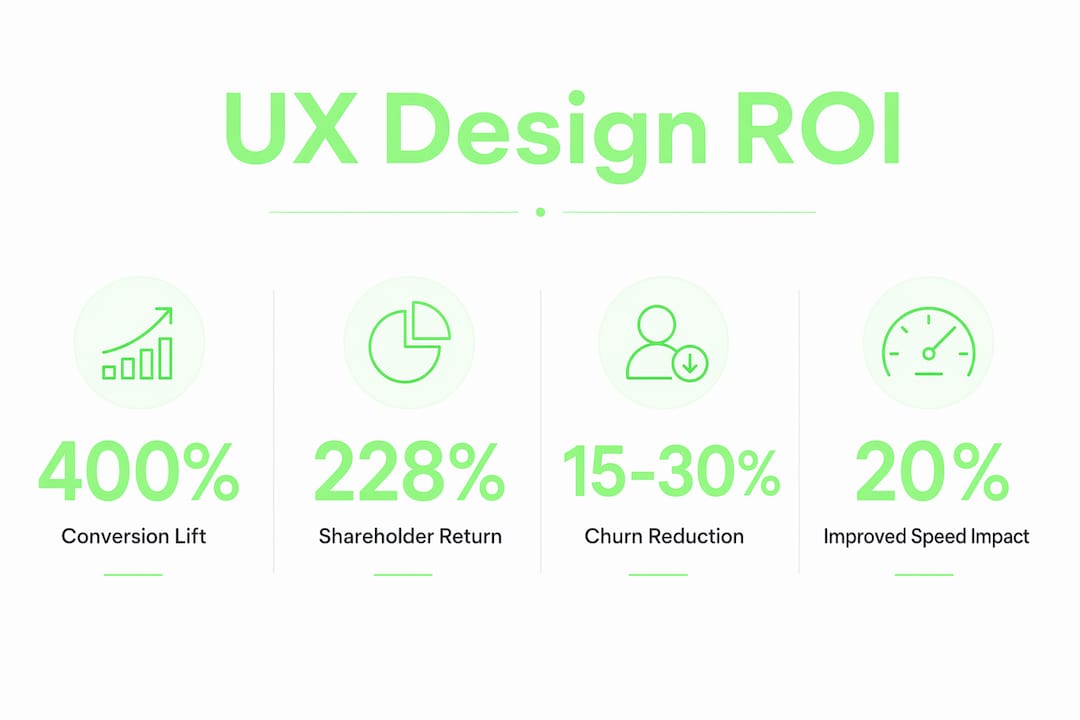
Investing in UX can improve conversion rates by up to 400%, while design-led companies see 228% higher shareholder returns than their peers. That is not a rounding error. That is a structural competitive advantage. For entrepreneurs building products in 2026, UX is not a nice-to-have polish layer. It is the engine underneath everything.

What measurable business benefits come from UX design?
The business case for user experience is built on hard numbers, not intuition. Every $1 invested in UX can return up to $100 in business value. That ratio gets attention in any boardroom.
Here is where the returns show up most clearly:
- Conversion rates: Average UX improvements lift conversions 10–200%. Top-tier optimization reaches 400%.
- Churn reduction: SaaS companies report a 15–30% reduction in 90-day churn after focused UX investments.
- Support costs: Intuitive product design cuts support ticket volume by 40–60%, freeing up budget and team capacity.
- Retention: 88% of users won’t return after a bad experience. One frustrating session is often the last.
Performance speed is its own category of UX impact. A one-second delay in page load time reduces conversions by 20%. A three-second load time causes a 32% increase in bounce rate. Users form their first impression of a product within 50 milliseconds. That is faster than a blink.
Pro Tip: Before investing in new features, audit your product’s load time and core task completion rate. Fixing speed and friction issues almost always delivers faster ROI than building something new.
The churn number deserves special attention for founders in SaaS. A 15–30% churn reduction from UX improvements compounds over time. Retained users spend more, refer others, and cost less to serve. UX is not just a design budget line. It is a revenue protection strategy.
Is UX design a strategic growth multiplier or just aesthetics?
Most founders initially treat UX as the visual layer on top of a working product. That framing costs them. UX is the strategic intelligence that connects engineering, product goals, and customer support, translating user data into business value. It is not decoration. It is infrastructure.
McKinsey data shows design-led companies see 32% higher revenue growth than their peers. The mechanism is not mysterious. When users can accomplish their goals without friction, they buy more, stay longer, and tell others. When they cannot, they churn silently and leave a one-star review on their way out.
“Business leaders should treat UX as a research-driven, revenue-generating discipline rather than a cosmetic preference.”
The myth that UX is purely visual persists because good UX feels invisible. Nobody notices a checkout flow that works perfectly. They only notice when it breaks. This is the paradox of great user-centered design: its success is measured by what does not happen. No support tickets. No rage-clicks. No abandoned carts.
Firms embedding UX into their operating models grow faster than those treating it as a project phase. The difference is cultural. Companies that run continuous user research, test assumptions before building, and measure usability alongside revenue metrics build products that compound. Those that skip UX until launch day spend twice as much fixing what they should have caught early.
70% of online businesses fail partly because of usability problems. That statistic should make every founder pause. The product may work technically. But if users cannot figure it out, it does not matter.
How do you get high ROI from your UX investment?
Getting real returns from UX requires process, not just good taste. The biggest lever is timing. Fixing design flaws before development is up to 10 times cheaper than fixing them during development, and up to 100 times cheaper than post-launch fixes. Early UX research is cheap insurance against expensive rework.
Here is a practical sequence for embedding UX into your product cycle:
- Run user research before wireframing. Talk to real users. Map their actual workflows, not your assumptions about them. Tools like Figma help teams visualize and test concepts before a single line of code is written.
- Define your UX metrics upfront. Google’s HEART framework (Happiness, Engagement, Adoption, Retention, Task Success) gives teams a structured way to measure user experience alongside business KPIs. The System Usability Scale (SUS) provides a standardized score for benchmarking usability over time.
- Run iterative usability tests. Test with five users per round. You will catch 85% of usability issues. Fix them. Test again. This cycle prevents the expensive surprise of a broken launch.
- Track the downstream metrics. Conversion rate, support ticket volume, session length, and 90-day retention all reflect UX quality. If support tickets spike after a product update, that is a UX signal, not just a customer service problem.
- Build UX review into your product iteration cycle. UX is not a one-time audit. It is a continuous feedback loop between users, data, and design decisions.
Pro Tip: The famous $1:$100 ROI ratio for UX is a useful motivator, but it is not a precise forecast. Build your own business case using your baseline conversion rate, churn rate, and support costs. Real numbers from your own product are always more persuasive than industry averages.
The companies that get the most from UX investment are not the ones with the biggest design budgets. They are the ones that validate ideas early and treat user feedback as a primary data source, not an afterthought.
UX design vs. UI design: what is the real difference?
UX and UI are not interchangeable terms, and confusing them leads to misallocated budgets. UX (user experience design) focuses on how a product works, how users move through it, and whether it solves their problem efficiently. UI (user interface design) focuses on how a product looks, including typography, color, layout, and visual hierarchy.
| Dimension | UX design | UI design |
|---|---|---|
| Primary focus | Function, flow, usability | Visual presentation, aesthetics |
| Core tools | User research, wireframes, journey maps | Style guides, mockups, design systems |
| Success metric | Task completion rate, retention, churn | Visual consistency, brand alignment |
| Business impact | Conversion, support costs, revenue growth | Brand perception, first impressions |
| Works without the other? | No. Poor UI undermines good UX. | No. Beautiful UI on a broken flow still fails. |
The key insight: great UI without solid UX fails to meet business goals. A product can look stunning and still drive users away if the navigation is confusing or the core task takes too many steps. Conversely, a well-structured UX with weak UI creates friction at the perception layer, undermining trust before the user even engages.
The strongest products integrate both. Figma, for example, succeeds because its interface is visually clean and its core workflows are deeply thought through. Neither dimension carries the product alone.
Key takeaways
UX design is a measurable business discipline that directly drives conversion, retention, and revenue growth when embedded early and measured rigorously.
| Point | Details |
|---|---|
| UX drives measurable ROI | Every $1 in UX investment can return up to $100 in business value through conversion and retention gains. |
| Speed is a UX metric | A one-second page load delay cuts conversions by 20%; performance is not a technical issue, it is a UX issue. |
| Fix UX early | Catching design flaws before development is up to 100 times cheaper than fixing them post-launch. |
| UX is not UI | UX governs function and flow; UI governs visuals. Both matter, but UX drives the core business metrics. |
| Embed UX into operations | Companies that run continuous user research and iterative testing grow faster than those that treat UX as a one-time project. |
Why I think most founders underestimate UX until it’s too late
I have watched founders pour six months and serious capital into building a product, only to discover at launch that users cannot complete the core task without help. It is one of the most avoidable and most common mistakes in early-stage building. The product works. The UX does not. And by that point, the cost to fix it is brutal.
The shift I see happening in 2026 is encouraging. More founders are treating UX as a research function, not a design function. They are running usability tests before writing code, measuring task completion rates alongside revenue, and using frameworks like Google HEART to hold their product to a real standard. That is maturity. That is what separates products that compound from products that plateau.
The uncomfortable truth is that good UX is invisible. Nobody tweets about a checkout flow that worked perfectly. But bad UX? That gets a Reddit thread, a churn spike, and a support queue that never empties. The failure is always loud. The success is quiet. That asymmetry is exactly why you have to measure it deliberately, because you will not feel it until it is gone.
My advice to any founder: embed UX thinking from day one. Not because it is trendy, but because the data is unambiguous. Design-led companies grow faster, retain more, and spend less on damage control. That is not a design argument. That is a business argument.
— Samim
How Siift helps founders build with UX clarity from the start
Siift is built for founders who want to move fast without building the wrong thing. The platform guides you through ideation, validation, and go-to-market with a structured, data-backed process that surfaces user insights before you commit to a build. That is UX thinking baked into your business strategy from the first decision, not bolted on after launch. Siift filters out the blindspots and assumptions that cause founders to ship products users cannot or will not use. If you are serious about building something that converts, retains, and grows, start with Siift and build on a foundation that is validated from the ground up.
FAQ
What is UX design and why does it matter for business?
UX design is the practice of creating products that are intuitive, efficient, and satisfying to use. It matters because design-led companies see up to 228% higher shareholder returns and 32% higher revenue growth than peers who deprioritize it.
How does UX design improve conversion rates?
UX improvements lift conversion rates by an average of 10–200%, with top-tier optimization reaching 400%. Reducing friction in key user flows, like onboarding or checkout, is the primary driver of those gains.
What is the difference between UX and UI design?
UX design focuses on how a product works and whether users can accomplish their goals efficiently. UI design focuses on visual presentation. Both are necessary, but UX drives the core business metrics like retention and conversion.
How early should founders invest in UX design?
As early as possible. Fixing design flaws before development is up to 10 times cheaper than during development and up to 100 times cheaper than post-launch. Early user research is the highest-leverage UX investment a founder can make.
How do you measure the ROI of UX design?
Track conversion rate, 90-day churn, support ticket volume, and task completion rate before and after UX changes. Frameworks like Google HEART and the System Usability Scale (SUS) provide structured benchmarks for measuring UX quality over time.