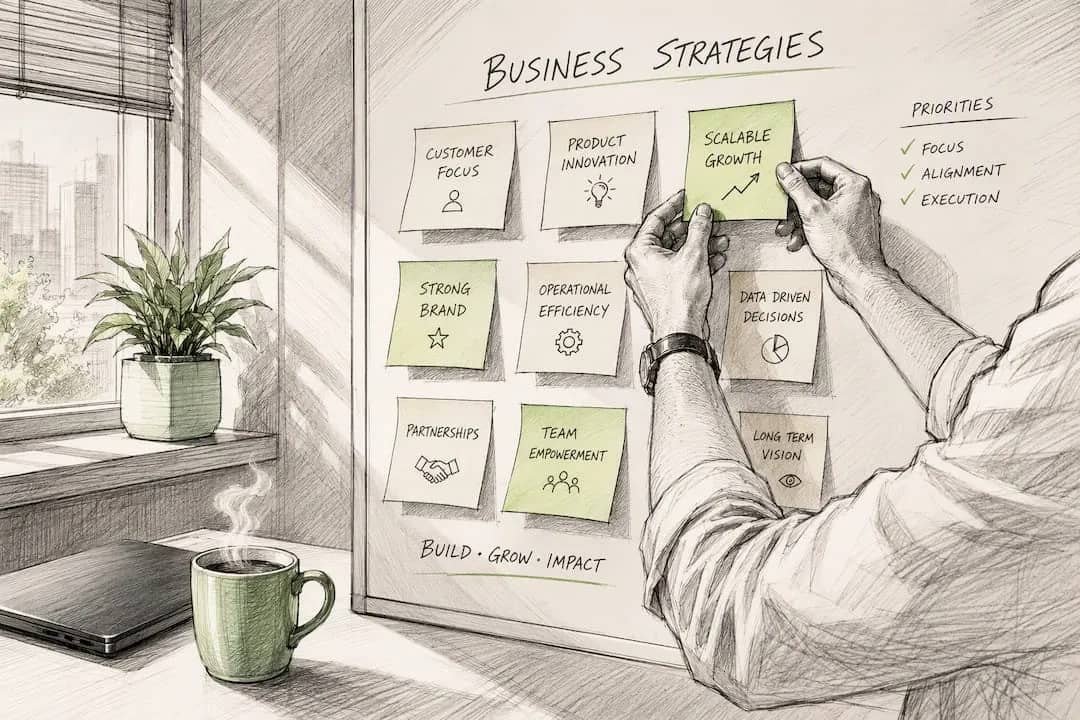
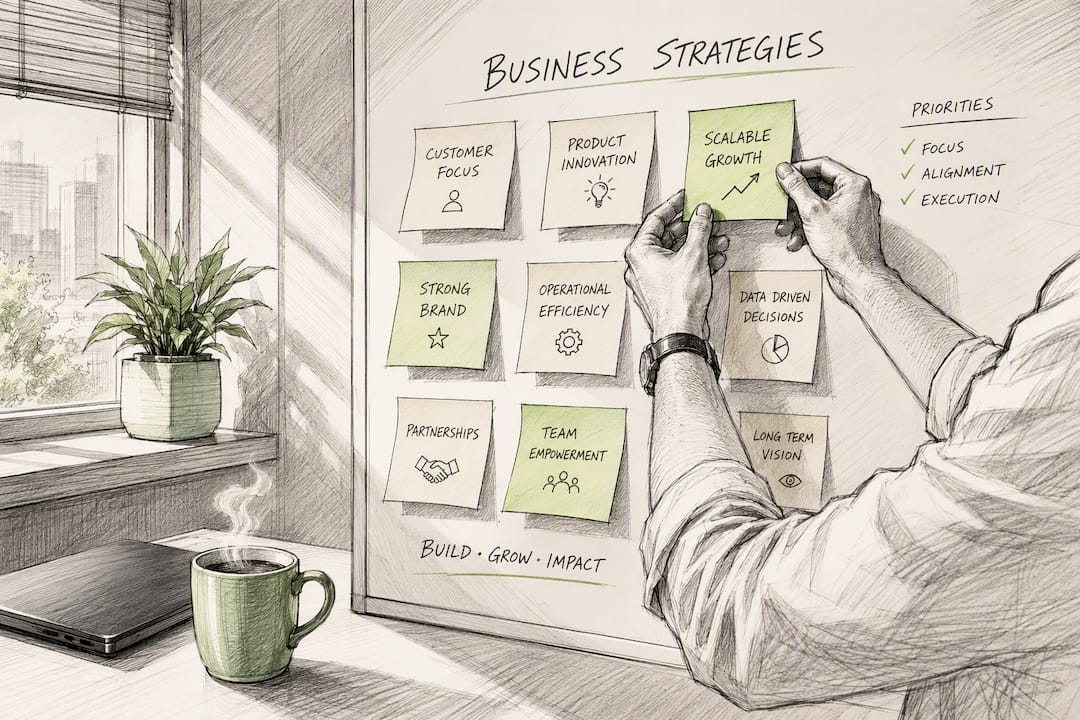
Start by picking a fight, not a format. Before you touch a template, write one sentence naming the exact problem you’re solving and one sentence naming who feels it most. That’s your first customer segment. Everything else in the proposal, whether it’s for investors, co-founders, or pilot customers, should be built to test whether that problem and that customer are real. Keep it concise, testable, and ready to change the moment you get evidence.
TL;DR:
- Validating demand through customer interviews, landing pages, and pilot offerings is essential before building the full product to ensure accurate assumptions.
- Focus on narrowing your market, testing only your riskiest assumption, and setting clear milestones to prove demand, pricing, and delivery capabilities.
- Tailor proposals for each audience by emphasizing market size and financials for investors, mutual benefits for partners, and outcomes for customers, avoiding generic pitches.
- Use structured evidence and specific metrics in each section to avoid inflated market sizes and unproven projections that can undermine credibility.
- Prepare concise, evidence-backed proposals and validation tests to accelerate early growth without wasting time on unnecessary features or assumptions.
Table of Contents
- The First Week of Building a Business Proposal, Hour by Hour
- Steps to Create a Proposal That Survives Scrutiny
- Which Business Proposal Format Fits Your Stage?
- How Do You Validate Demand Before You Build?
- What Financial Numbers Does a Proposal Need?
- Pitch Deck or Business Plan: Which One Do You Send?
- Why Trust This Proposal Framework?
- How to Write Proposal Language That Actually Persuades
- The Mistakes That Sink an Otherwise Good Proposal
- How Should You Structure the Proposal for Impact?
- How Do You Use Competitor Analysis to Strengthen Your Case?
- What’s the Fastest Way to Validate Assumptions With Data?
- Tailoring the Same Proposal for Investors, Partners, and Customers
- A Founder’s Note on the Mistake That Costs the Most Time
- Build Your Validated Proposal Faster With siift
- Sources
- FAQ
The First Week of Building a Business Proposal, Hour by Hour
You don’t need a month of planning to get moving. You need a sequence.
- Hour one: Write your problem statement in two sentences and name a single customer hypothesis (who, specifically, has this problem worst).
- Day one: Draft a lean executive summary and a one-line value proposition. Don’t polish it. Get the logic on paper.
- Week one: Run 5 to 15 customer discovery calls and launch a simple signup test to see if strangers will raise their hand.
- Month one: Assemble a 10 to 15 slide investor pitch and a modular plan you can chop into an appendix or a one-pager depending on who’s asking.
Each stage produces evidence the next stage needs. Skip the calls and your deck is just a good story with no proof behind it.
Steps to Create a Proposal That Survives Scrutiny
Here’s the actual blueprint, section by section, with the minimum evidence you need before moving to the next one.
Define the problem with numbers, not vibes. Vague pain points (“businesses struggle with X”) get ignored by investors and customers alike. Name who has the problem, how often it hits them, and what it costs them in time or money. “Freelance bookkeepers lose 6 hours a week reconciling three disconnected tools” is fundable. “Small businesses need better accounting” is not.
Pick a narrow beachhead, not a broad market. Choose one customer type you can describe in a sentence and state the specific hypothesis you’re testing about them. HBS Online’s validation framework starts exactly here: write your hypotheses down before you research anything, so you know what you’re actually trying to prove or kill. HBS Online’s five-step validation process moves from hypothesis to market sizing to interviews to product tests, in that order, for a reason. Skipping ahead to “build” wastes the most time.
Scope an MVP around your riskiest assumption. For most first-time founders, that’s demand or willingness to pay, not whether the tech works. First Round Review’s guide to testing a business idea recommends isolating one assumption per experiment so you’re not muddying the signal.
- Ask: what single belief, if wrong, kills the whole business?
- Design the smallest possible test for that belief alone.
- Ignore every other feature until that test returns real data.
Size the market from the bottom up. Skip the “$50 billion TAM” slide. Investors have seen a thousand of those and trust none of them. Instead, multiply your realistic price point by a believable number of reachable customers in year one, then show how that scales. Use SBA’s guidance on choosing NAICS or industry categories to ground your numbers in something checkable, rather than a napkin guess.
Pick one or two go-to-market channels and name the test. Don’t list six channels you’ll “explore.” Commit to the one or two most likely to reach your beachhead customer, and define what success looks like in 30 days: a signup rate, a reply rate, a booked demo count.
Define traction before and after launch. Pre-launch traction might be waitlist signups or paid pilot commitments. Post-launch, it’s retention, repeat usage, or revenue. Say explicitly what counts as proof at each stage so nobody, including you, moves the goalposts later.
State your funding request as a milestone unlock, not a lump sum. How much you need, how many months of runway it buys, and what specific milestone that runway is meant to produce (a certain number of paying customers, a completed pilot, a hired engineer). Vague asks read as unprepared asks.
Pro Tip: Write your funding request last, after every other section. You can’t credibly justify a number until you know exactly what it needs to accomplish.
Which Business Proposal Format Fits Your Stage?
The right format depends entirely on who’s reading it and why.
- Lean one-pager: Best for early discovery and internal alignment among co-founders. One page forces clarity you can’t fake.
- 12 to 18 page startup plan: What investors and lenders want for due diligence, or what a bank wants for a loan application. LivePlan recommends keeping even these plans to 10 to 20 pages, prioritizing unit economics and a living roadmap over long prose.
- 10 to 15 slide pitch deck: For investor meetings. Each slide covers one idea: problem, solution, market size, business model, traction, team, ask.
- Modular plan structure: Write your plan in labeled, self-contained sections so you can pull slides for a deck or attach sections as an appendix without rewriting anything.
How Do You Validate Demand Before You Build?
Proof beats projections every time an investor reads a proposal. Here’s how to get proof fast, in order of speed and cost.
- Run structured customer interviews. Ask about past behavior, not hypothetical willingness (“Tell me about the last time you tried to solve this” beats “Would you buy this?”). Fifteen sharp interviews reveal more than fifty vague ones, per First Round Review’s testing framework.
- Build a landing page and drive real traffic to it. A signup conversion rate, even from a small paid campaign, tells you more in a week than a month of guessing. Watch for consistency across traffic sources, not just a single spike.
- Run a concierge MVP. Deliver the outcome manually, by hand, for a handful of pilot customers, and charge something for it. If nobody will pay $50 for the manual version, they won’t pay for the automated one either.
- Isolate the atomic unit of value. Find the single smallest thing a customer needs to experience to know if your idea works, and test only that.
Pro Tip: Charge something, even a token amount, in every pilot test. Free “yes” answers are the least reliable signal in startup validation.
siift’s platform can walk you through building these validation steps systematically instead of ad hoc.
What Financial Numbers Does a Proposal Need?
Investors don’t expect precision. They expect logic they can poke holes in and watch survive.
- A 12-month cash runway showing exactly when you run out of money without more funding.
- A high-level 3-year forecast, directional, not decimal-point accurate.
- Unit economics: customer acquisition cost, lifetime value, gross margin, and payback period, each with a one-line explanation of how you estimated it.
- A sensitivity table showing what happens to your runway if sales come in at half your projection.
LivePlan’s research on business plan credibility notes that investors respond better to believable, bottom-up unit economics than to inflated top-line numbers.
Tie your funding request directly to milestones: “$150,000 buys nine months of runway to reach 200 paying pilot customers,” not “$150,000 to grow the business.”
Pitch Deck or Business Plan: Which One Do You Send?
Match the document to the moment. A first investor meeting wants a pitch deck: compact, opportunity-first, 10 to 15 slides. Shopify’s guide to investment proposals draws this line clearly: decks sell the opportunity, plans support the diligence that follows.
- Send a deck for first meetings and quick partner conversations.
- Send the full plan once someone asks for financial detail or operational depth.
- Pull deck slides straight from your plan’s section headers, then write a one-page summary for anyone who wants the short version.
- After a deck lands well, be ready to attach a financial model, customer references, and any pilot data you’ve collected.
Why Trust This Proposal Framework?
This guide draws on how siift’s New Business OS helps founders move from idea to validated plan systematically, pairing structured frameworks with real-time market research instead of guesswork… Founders use siift during ideation, validation, and go-to-market planning to assemble evidence-backed proposals faster than piecing one together from scratch.
How to Write Proposal Language That Actually Persuades
The words you choose matter almost as much as the numbers behind them, because every stakeholder reads for a different signal.
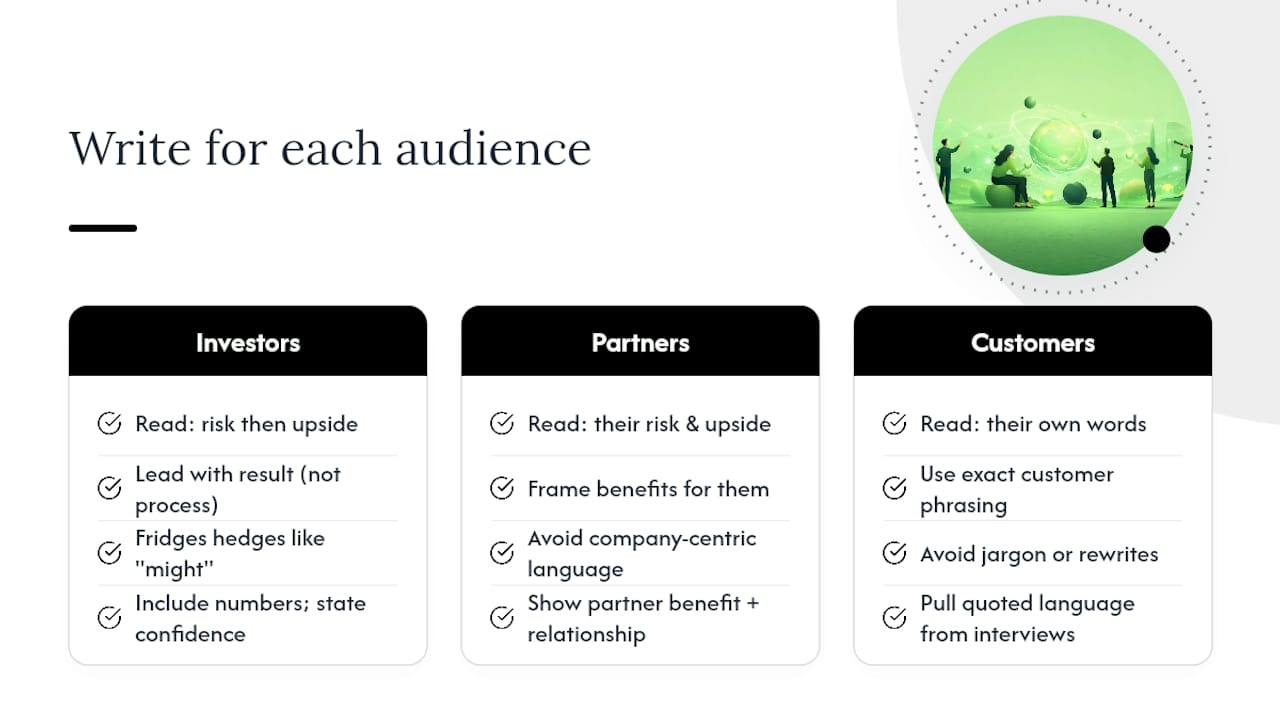
Investors scan for risk and upside in that order. Lead sentences with the result, not the process: “We reduced onboarding time by half” beats “We implemented a new onboarding process.” Cut hedge words like “might” and “hopefully.” If you’re not confident enough to state something plainly, don’t include it yet, test it first.
Partners want to know what’s in it for them, specifically. Swap company-centric language (“our platform enables”) for partner-centric framing (“your customers get X, and you keep the relationship”). Partners don’t care about your roadmap. They care about their own risk and their own upside.
Customers respond to their own words, not your jargon. Pull the exact phrases people used in your discovery interviews and put them in your value proposition. If five people described the problem as “I keep losing track of,” don’t rewrite that into “inefficient workflow management.” You’ll lose the resonance that made the interview useful in the first place.
Across every audience, cut adjectives and add numbers. “Significant improvement” tells nobody anything. When you don’t have the number yet, say so plainly rather than dressing up a guess in confident language, that’s a credibility problem for later.
One structural rule holds everywhere: open every section with your conclusion, then back it up. Nobody reading a proposal wants the buildup. They want the answer, followed by the reason to believe it.
The Mistakes That Sink an Otherwise Good Proposal
Most weak proposals aren’t wrong about the idea. They’re wrong about the execution of the document.
Leading with the solution instead of the problem. If your first paragraph describes your product before it describes the pain it solves, you’ve lost the reader’s context before you’ve earned their attention.
Inflating the market size to look impressive. A slide claiming “$50 billion TAM” with no bottom-up math is a red flag to any investor who’s read more than five decks. It signals you haven’t done the harder, more useful math.
Skipping validation and jumping straight to projections. Financial forecasts with no evidence behind the assumptions read as fiction, however carefully formatted the spreadsheet is.
Writing one document for every audience. A plan built for a bank loan application rarely persuades an equity investor, and a pitch deck rarely satisfies a due diligence checklist. Tailor the document to who’s reading it.
Treating the plan as a one-time deliverable. The proposal you send in month one should look different by month four, once you’ve run real tests. A plan that never changes is a plan nobody’s actually using to make decisions.
Burying the ask. If a reader has to hunt for how much you want and what it buys, you’ve made the easiest part of the pitch unnecessarily hard.
Overwriting instead of editing. Long paragraphs of context before the point rarely help. State the claim, then support it. If a sentence doesn’t change a decision, cut it.
How Should You Structure the Proposal for Impact?
Order matters as much as content. Front-load the sections that answer an investor’s fastest question: is this a real problem, and can this team solve it profitably?
Lead with a tight executive summary that states the problem, the solution, and the ask in under a page. Follow with the problem and market section, then your solution and traction evidence, in that order, before you ever mention the team or the financial detail. Save the appendix, financial model, and supporting data for readers who ask for more.
Within each section, follow the same micro-structure: state the conclusion first, then the evidence. A reader skimming your market section should be able to grasp your entire argument from the first sentence of each paragraph alone. That’s not dumbing it down, that’s respecting how people actually read proposals: fast, and looking for reasons to say no.
Keep visual hierarchy consistent. If your deck uses one big number per slide, don’t suddenly cram five bullet points onto slide seven. Consistency signals discipline, and discipline is exactly what an investor is trying to gauge about you personally, not just your business.
How Do You Use Competitor Analysis to Strengthen Your Case?
A proposal with no competitors mentioned reads as either naive or dishonest. Every real market has alternatives, even if the alternative is “doing nothing” or “using a spreadsheet.”
Name two or three direct or adjacent competitors and describe, specifically, what they do well and where they fall short for your beachhead customer. Vague dismissals (“they’re outdated”) don’t hold up. Specific gaps (“their platform requires a 6-week onboarding process; our concierge test onboarded pilot customers in under a day”) do.
Use the competitive section to sharpen your own positioning, not just to check a box. If you can’t articulate why a customer would switch from an existing option to yours, that’s a signal to go back and run another round of interviews before you finalize the proposal.
What’s the Fastest Way to Validate Assumptions With Data?
Every assumption in your proposal falls into one of three buckets: demand, price, or delivery. Test each one separately, because bundling them muddies your results.
For demand, track signups, waitlist joins, or interview requests against a specific target you set in advance, not after you see the number. For price, run actual pricing tests, ask pilot customers to pay something real, however small. For delivery, track how consistently you can produce the outcome you’re promising once real customers start using it.

Set your success threshold before you run the test, not after. Deciding “we’ll call it a win if we get 20 signups” only works if you commit to that number before traffic starts, otherwise you’ll rationalize whatever number shows up.
Tailoring the Same Proposal for Investors, Partners, and Customers
The core facts stay the same. The framing changes completely depending on who’s reading.
For investors, lead with market size, unit economics, and the funding ask. They’re evaluating a financial bet, so speak their language: return, risk, timeline to milestone.
For partners, lead with mutual benefit and integration logic. Partners are evaluating a relationship, not a financial return, so show them exactly what changes for their business and their customers.
For customers, skip the business mechanics entirely and lead with the outcome. Nobody signing up for a pilot cares about your funding round; they care whether your product solves their specific problem faster or cheaper than what they’re doing now.
Build one master document with all the evidence, then cut a tailored version for each audience. Reusing one generic pitch across all three groups is the fastest way to get ignored by all three.
A Founder’s Note on the Mistake That Costs the Most Time
The most common trap isn’t a bad idea. It’s building the full product before testing the riskiest assumption, usually demand or willingness to pay. Fix it in the next 72 hours: run five customer conversations and ask what they’re doing today instead of your solution. Small, measurable experiments beat a polished plan built on guesses every time.
— Samim Safaei
Build Your Validated Proposal Faster With siift
Writing the proposal is the easy part. Validating the assumptions behind it, without spending three months guessing, is where most founders stall. siift’s New Business OS is built specifically to close that gap: it walks you through problem definition, market sizing, and go-to-market planning step by step, then turns your validated inputs into pitch-ready deliverables, instead of a folder of half-finished Google Docs.
Founders using siift typically go from a raw idea to a structured, evidence-backed go-to-market plan in a fraction of the time it takes to piece one together manually. If you’re also lining up your funding request, tools like Nexus Growth Services can help you get lender-ready on the financing side while siift handles the strategy and validation.
Ready to see what a validated proposal looks like for your idea? Start your validation sprint with siift and turn guesswork into a plan you can actually defend.
Sources
- Plan your business - Small Business Administration
- How to determine market validation - HBS Online (blog)
- How to test a business idea — First Round Review
- How to write an investment proposal — Shopify
FAQ
What Is the First Step in Starting a Business Proposal?
Write a two-sentence problem statement and name your first customer segment before drafting any other section. Everything else in the proposal builds on that foundation.
How Long Should a Business Proposal Be?
A lean one-pager works for early discovery, while a full startup plan typically runs 12 to 18 pages; LivePlan recommends staying within 10 to 20 pages even for investor-facing versions.
What’s the Difference Between a Pitch Deck and a Business Plan?
A pitch deck is 10 to 15 slides focused on the opportunity and the ask, while a business plan provides the operational and financial detail investors need for due diligence, according to Shopify’s investment proposal guide.
How Do I Validate My Business Idea Before Writing the Full Proposal?
Run structured customer interviews, launch a landing page test, and consider a concierge MVP to test willingness to pay, following the validation sequence HBS Online outlines. Tools like siift can guide you through this process step by step.
What Financial Details Do Investors Expect in a Business Proposal?
Investors expect a 12-month cash runway, a high-level 3-year forecast, and honest unit economics like customer acquisition cost and lifetime value, tied directly to a specific funding request and milestone.