

Getting reliable business validation and mileage management handled in one platform is a unicorn hunt when most legacy tools expect you to split between generic expense trackers and separate business model validation kits. Existing mileage apps often fumble on integrations with accounting, leave founders stuck with manual data entry, or skip guided validation for early stage businesses entirely. This comparison lines up five alternatives so you can pick a business validation solution that also handles tax-grade mileage tracking and fits your team’s size, workflow, and appetite for AI guidance without hopping apps every quarter.
Table of Contents
- Siift.ai
- Everlance
- TripLog
- CompanyMileage
- Mileage Quest
- Comparative Analysis: Mileage and Validation Tools
Siift.ai
At a Glance
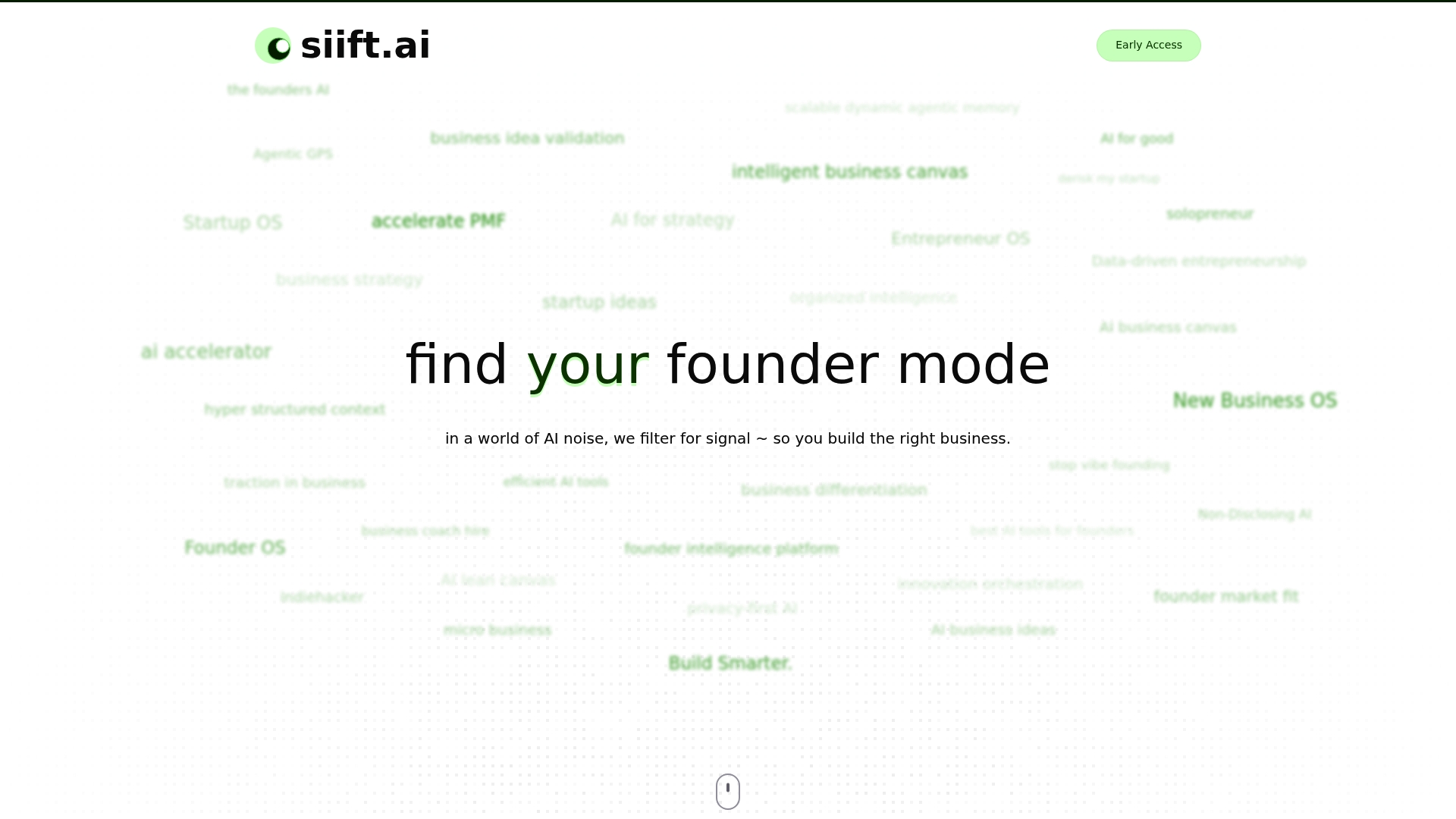
Siift.ai is running a New Business OS in Early Access and may be invite-only right now. The vendor advertises that the platform accelerates traction and scale more efficiently than generic tools like Claude or Openclaw, a marketing claim worth testing in pilots.
Core Features
Siift combines AI-driven validation, guided strategy, and founder-focused tooling for early-stage ventures.
- Agentic AI interactions that suggest next steps rather than just answering prompts.
- Intelligent business canvas and lean canvas templates for mapping assumptions to experiments.
- Founder intelligence platform that captures founder context and previous decisions.
- AI-powered business validation tools to prioritize riskiest assumptions.
- Guided, AI-native interactions for plan execution and derisking.
Siift is not a back-office solution, not a consultancy, not a crypto or web3 service, and it does not provide HR, Legal, Finance, accounting, bookkeeping, or banking.
Key Differentiator
Siift’s core edge is proactive, AI-native guidance designed specifically for founders who need stepwise validation rather than generic advice. That founder-centric approach pairs suggestion flows with a validation canvas so the system nudges you through hypothesis, test design, and interpretation.
Pros
- Focused on early-stage clarity. The workflow forces you to pick the riskiest assumption and design a test rather than wander in ideation.
- Tailored for small teams and solo founders. Templates and prompts assume one or two people running experiments, so outputs match limited bandwidth work.
- Includes conversational nudges called convo-grams that push practical next steps instead of broad recommendations.
- Privacy-minded design. The product data emphasizes a privacy-first posture, which matters when you’re sharing sensitive early IP.
- Recognized in major media outlets, which helps with initial credibility when you evaluate it for your stack.
Cons
- Not built for scaling enterprises or complex multi-team collaboration; larger orgs will likely outgrow its single-founder workflows.
Who It’s For
Solo founders, micro-business owners, indiehackers, and early-stage SaaS entrepreneurs who need a compact, AI-guided system to test ideas and build a validated strategy. If you run a small team and want to move from idea to repeatable experiments, this is directly aimed at you.
Unique Value Proposition
The platform’s stepwise, AI-native guidance turns a business canvas into executable tests and short experiments. Rather than leaving strategy abstract, Siift translates hypotheses into prioritized experiments and follow-ups so you spend less time guessing and more time learning.
Real World Use Case
A solo founder with a prototype runs a three-week validation sprint inside Siift. The app helps map the lean canvas, suggests a two-week customer interview plan, and captures results. The founder finishes with a prioritized roadmap and cleaner investor narrative.
Pricing
Pricing is not specified. The product data states Siift is in Early Access and may be free or invite-only for now. Expect a gated rollout and sign-up or waitlist model before public tiers appear.
Website: https://siift.ai
Everlance
At a Glance
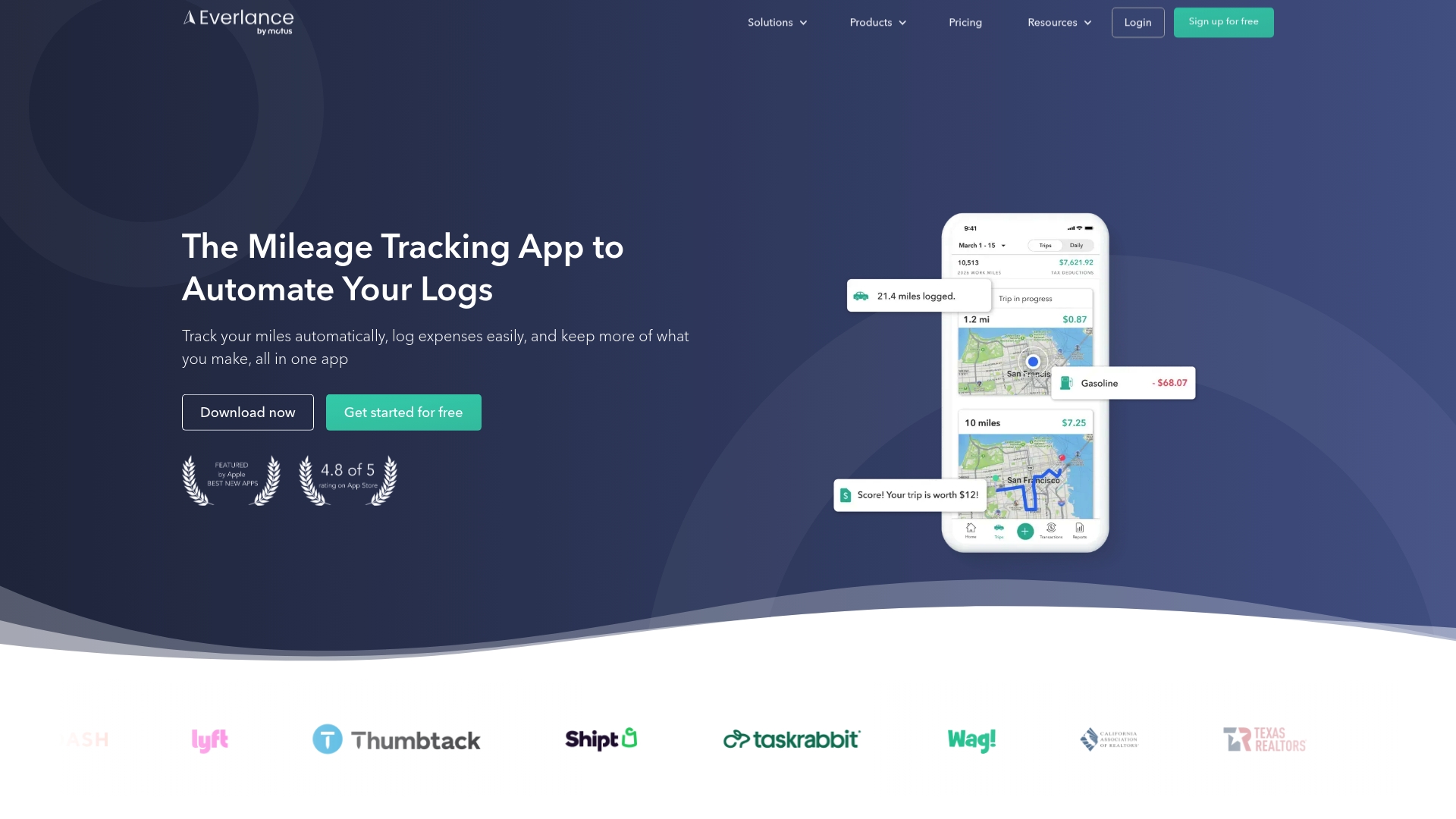
Everlance publishes IRS-compliant mileage logs and offers mileage reimbursement management with real-time GPS tracking for organizations. The app pairs automatic trip detection with expense capture, making it a focused solution for mileage-heavy teams and solo drivers.
Unlike Siift, Everlance concentrates on accurate trip capture and tax-ready reporting rather than business ideation or go-to-market planning.
Core Features
- Automatic mileage logs that attempt to detect and record trips without manual start and stop.
- Expense tracking with receipt capture including photo uploads and basic expense categorization.
- IRS-compliant reports for deduction and audit support plus mileage reimbursement workflows and bank or card linking.
Key Differentiator
Everlance’s angle is its emphasis on automatic mileage detection combined with expense management and IRS-ready exports. That combination targets people who need defensible tax records and quick reimbursement rather than a broader finance platform.
Pros
- The app’s automatic mileage detection reduces manual entries when it works, which saves time for gig workers and frequent drivers.
- Receipt photo capture makes filing expenses less tedious and pairs well with the expense categorization engine.
- Bank and credit card linking cuts down on manual imports and speeds up reconciliation between card charges and logged trips.
- Built-in mileage reimbursement features let small fleets manage driver paybacks without stitching together spreadsheets.
- The interface is modern and approachable, which helps less technical users adopt it quickly.
Cons
- Automatic trip detection is inconsistent for some users and can miss trips entirely, creating extra cleanup work.
- Several users report difficulties exporting data cleanly for tax prep, making manual reconciliation necessary in some cases.
- Recent subscription increases make the paid plans less attractive for cost-conscious sole proprietors.
- Receipt management feels lightweight compared with dedicated expense platforms.
When It May Not Fit
If you rely on flawless passive tracking for hourly billing or strict audit trails, Everlance’s detection glitches and export quirks make it a risky single-source solution. Teams that need advanced receipt workflow or enterprise-grade export fidelity should look elsewhere.
Notable Integrations
- Credit card accounts for automatic expense imports.
- Bank account linking to match charges against trips and expenses.
Who It’s For
Self-employed drivers, gig economy workers, and small business owners who log frequent miles and need tax-ready records. Also suitable for small teams that want a lightweight reimbursement workflow without adopting full fleet telematics.
Real World Use Case
A gig driver uses Everlance to auto-record rides, snap receipts after client purchases, and generate an IRS-compliant mileage report at year end. The result is fewer manual logs and a document set that the driver can hand to an accountant.
Pricing
Everlance offers a free basic tier with limited features. Paid plans start at $69.99/year, with monthly billing options and higher tiers that unlock reimbursement, advanced reporting, and expanded integrations.
Website: https://everlance.com
TripLog
At a Glance
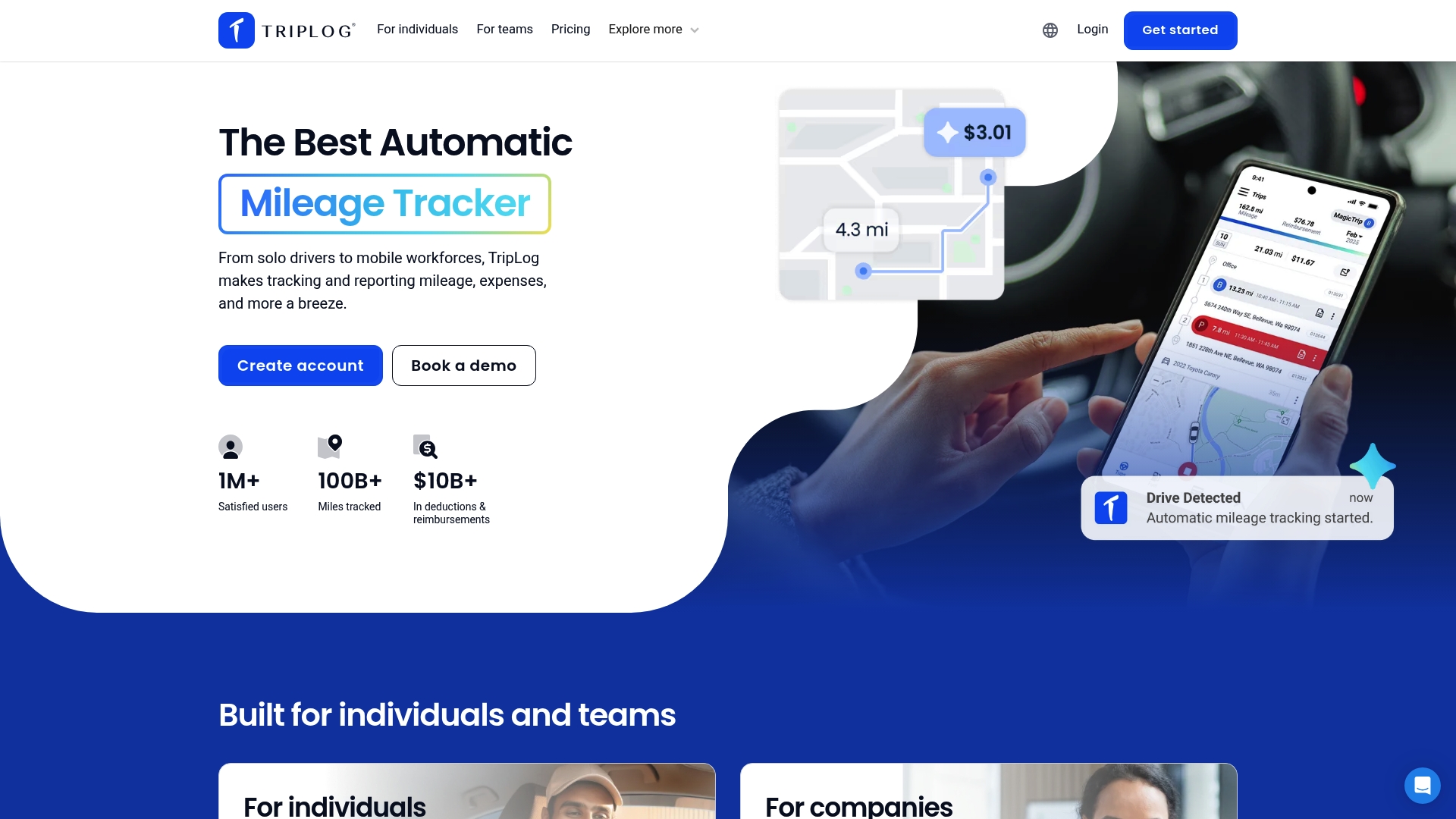
TripLog ships hardware support like GPS devices and Bluetooth beacons alongside phone apps, which makes it one of the few mileage tools that can capture trips offline and inside dense fleet workflows. User feedback also flags reliability problems, customer support headaches, and confusing auto renewal billing.
Core Features
- Automatic mileage tracking and reporting with device and phone-based capture.
- Expense management with receipt scanning and bank feed synchronization.
- Time and attendance with location-based clock in and clock out for mobile teams.
- Hardware options that include dedicated GPS units and Bluetooth beacons for vehicle-level telemetry.
- Custom reporting, approval workflows, and policy controls for mileage and expense rules.
Key Differentiator
TripLog blends physical hardware and software automation so you can run one platform for vehicle tracking, expense reconciliation, and payroll handoffs. That hardware plus workflow customization reduces manual data stitching when you manage dozens or hundreds of mobile workers.
Pros
-
Strong reimbursement features. Expense flows and bank syncs accelerate month end for accounting teams.
-
Project oriented tracking. You can attach trips and expenses to clients or job codes for clearer cost allocation.
-
Wide payroll and finance connectors. Built in links to common systems simplify payroll handoffs.
-
Fast receipt capture. The app extracts receipt data reliably enough to cut down manual entry for mobile staff.
-
Detailed trip reports. Managers get route level logs and summary exports useful for audits.
Cons
-
Automatic tracking reliability is uneven on some devices which can create missed trips or duplicate entries.
-
Support is frequently reported as hard to reach and slow to resolve billing or sync problems.
-
Auto renewal billing has produced surprise charges for some customers and adds overhead to vendor management.
-
App crashes and sync errors are a recurring theme, especially on older phones.
When It May Not Fit
If you need flawless automatic logging with minimal intervention, TripLog’s reported stability issues make it a risky primary solution. If your organization requires white glove support or strict predictable billing for a tight procurement cycle, this product may cause friction.
Notable Integrations
- SAP Concur
- QuickBooks
- Xero
- ADP
- UKG
- Sage Intacct
- Emburse
- Paychex
Who It’s For
Business owners, fleet managers, consultants, and mobile employees who want combined mileage, expense, and time tracking with hardware options and payroll linkage. Best for teams that can budget hardware and tolerate a learning curve to get reliable device setups.
Real World Use Case
A delivery company equips vans with TripLog Drive GPS devices to capture mileage offline. Administrators reconcile expenses using bank feeds and scanned receipts. Managers export project level logs for quarterly tax filings and payroll adjustments.
Pricing
TripLog offers a free tier plus a Premium plan starting at $4.99 per month per user. Hardware devices and additional enterprise features carry extra fees and custom team plans are available for larger deployments.
Website: https://triplog.net
CompanyMileage
At a Glance
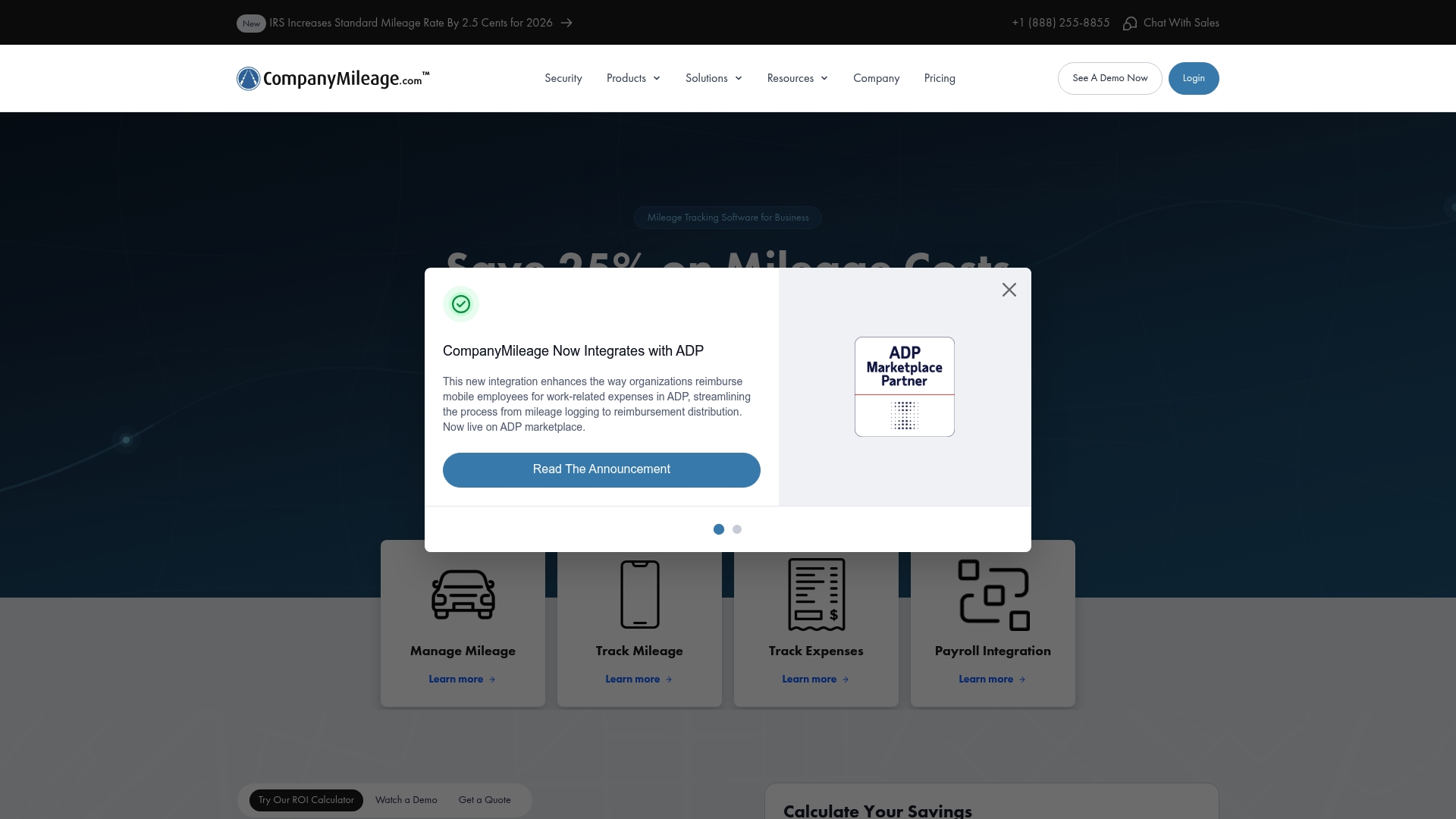
The vendor advertises integrations with over 70 payroll and accounting systems, a reach aimed at companies that already run complex pay and ledger workflows. CompanyMileage pairs route-based, point-to-point mileage math with a mobile app, approval flows, and anomaly flagging to cut down on manual reimbursements.
Core Features
- Automated point-to-point mileage calculation for route-optimized distances rather than odometer-only estimates.
- Trip verification and visit verification to help validate field activity.
- Mobile app for real-time trip logging and on-the-spot expense capture.
- Customizable approval workflows and automatic flagging for duplicates or anomalous claims.
- Integration options intended to plug into payroll and accounting stacks.
Key Differentiator
CompanyMileage emphasizes route optimization as the primary accuracy lever. Their point-to-point approach attempts to match actual driven routes and stops instead of using straight-line or manual entries, which is where they say fraud and reimbursement error risk declines. That route focus is the product’s single standout feature.
Pros
- Automates what normally takes hours of back-and-forth. For teams that run dozens of monthly trips, automated calculations reduce spreadsheet work and reconciliation.
- The route approach improves reimbursement precision, which lowers overpayments and audit exposure when compared with flat per-mile estimates.
- Real-time logging on mobile devices shortens approval cycles. Field staff can submit trips as they finish, so finance gets cleaner data earlier.
- Extensive integrations make payroll handoffs simpler. If you already use major payroll or ERP tools, the integration set reduces duplicate data entry and export juggling.
- Custom workflows let you gate approvals by role and flag unusual mileage automatically, which speeds exception handling.
Cons
- There are no substantive third-party user reviews publicly available, so independent experience signals are limited.
- The vendor does not publish side-by-side comparisons with competitors, making it harder to judge relative strengths beyond the features list.
- The system depends on device GPS and user inputs, so accuracy will vary in urban canyons, low-signal rural routes, or on devices with poor location permissions.
When It May Not Fit
If your workforce is primarily office-based with occasional commute reimbursements, this product offers more mobile-first controls than you need.
If you operate in areas with inconsistent GPS coverage or require offline-first trip capture, the device-dependence above may create gaps in the record you cannot easily fix.
Notable Integrations
- Xero
- QuickBooks
- SAP
- ADP
- Paychex
- Workday
- NetSuite
- Sage
Who It’s For
Companies with a fleet of mobile employees across sales, service, field healthcare, or property management that need precise mileage accounting and tight payroll handoffs. Best when finance already uses a supported payroll or accounting system.
Real World Use Case
A regional property management firm replaces expense spreadsheets with CompanyMileage. Field agents log trips on the app, the system flags unusually long routes, and payroll receives cleaned, verified mileage entries every pay period, cutting reimbursement disputes.
Pricing
Pricing is not explicitly stated on the site. The vendor describes tiered offerings generally billed on a pay-per-employee basis with options for mileage-only or full expense management; you must contact sales for exact quotes and volume pricing.
Website: https://companymileage.com
Mileage Quest
At a Glance
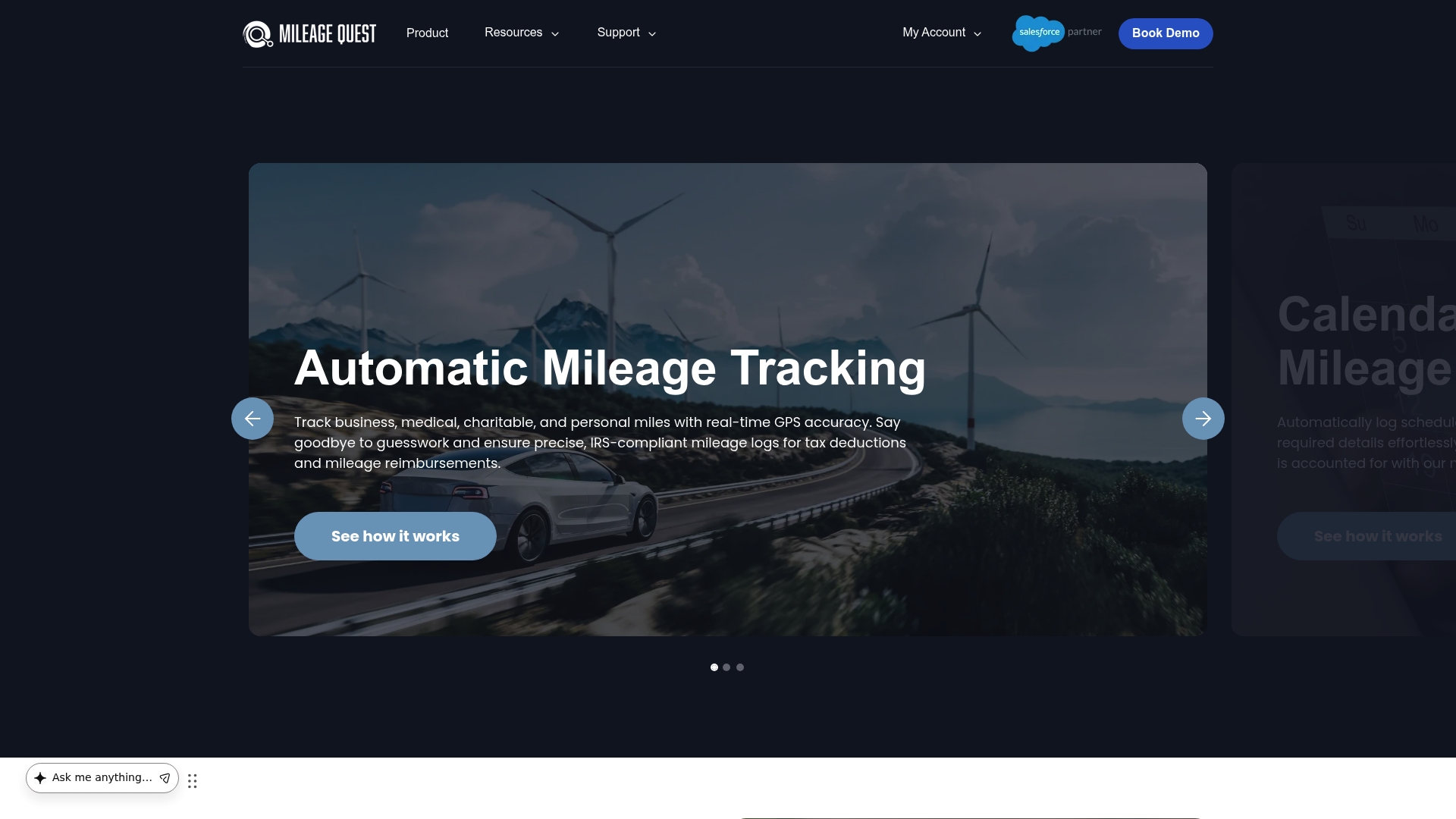
Founded by CPAs and account managers, Mileage Quest pairs calendar sync with GPS to capture trips automatically and, the vendor advertises, produce IRS-compliant reports suitable for deductions and reimbursements. It also offers a Vacation Mode to pause tracking during breaks.
Core Features
- Automatic mileage tracking with GPS that records routes without manual start or stop.
- Calendar integration for automatic trip capture from scheduled events and meetings.
- Customizable IRS-compliant reports that group trips by category for tax or reimbursement use.
- Trip categorization for business, medical, charitable, and personal miles.
- Vacation Mode to pause logging during nonwork periods.
Key Differentiator
Mileage Quest focuses on combining calendar events with GPS trails so trips are logged with context rather than raw odometer numbers. That combo plus the reporting templates aims to reduce manual corrections and speed report prep. The reporting claim above is the feature that differentiates it for tax-heavy use cases.
Pros
- Automates most of the logging work so you stop missing deductible miles. The automation reduces time spent on manual entry and spreadsheet reconciliation.
- Syncing with both calendars and GPS improves accuracy compared with calendar-only tools. Event metadata helps tag client visits without extra input.
- Vacation Mode and work period scheduling prevent false positives during holidays and personal travel. Small teams will appreciate the control.
- Offers multiple mileage categories which makes year-end reporting and audit trails clearer for accountants and bookkeepers.
- Generates exportable reports formatted for tax and reimbursement workflows which cuts the prep time for finance teams.
Cons
- No way to sync or export data into other mileage management apps today. If you rely on another corporate system, expect manual handoffs.
- The tiered pricing structure may confuse users who only need a basic tracker. Multiple plans mean you must compare features before subscribing.
- Limited independent reviews or third-party validation are available, so user experience claims come primarily from the vendor.
- Accuracy depends on GPS quality and how detailed your calendar events are, so poor signal or sparse calendar entries reduce reliability.
When It May Not Fit
If your company already uses a centralized mileage platform that requires two-way syncing, Mileage Quest is a poor match because it lacks integrations. If you need enterprise grade validation or many public reviews to justify a procurement decision, the current review scarcity could be a blocker.
Who It’s For
Small to medium businesses, self-employed professionals, and individuals who regularly track miles for deductions or employee reimbursement. Best for teams that already use calendar scheduling as the source of truth for client visits.
Real World Use Case
A real estate agent lets Mileage Quest capture client showings from calendar invites while GPS records routes. Trips are auto categorized as business. At tax time the agent exports a ready report and hands it to their CPA, saving multiple hours of manual logging and reducing audit risk.
Pricing
Monthly plans start at $19.95 per user for individuals. The vendor advertises discounts for team, group, and enterprise plans and offers yearly billing options across tiered rates. Compare tiers if you plan to scale across several employees.
Website: https://mileagequest.app
Comparative Analysis: Mileage and Validation Tools
The variety of tools available for business mileage tracking and validation offers options for specific operational needs. Siift.ai emerges with a unique focus on decision guidance for early-stage ventures, whereas competitors demonstrate strengths in mileage capture, reimbursement workflows, and financial integrations.
Workflow Integration and Purpose Alignment
The ideal choice depends significantly on your primary operational requirements. Siift.ai is engineered for early-stage business validation and founder-centric workflows, excelling in hypothesis testing and experimental design for targeting business assumptions. On the other hand, Everlance emphasizes hands-free GPS tracking and IRS-compliant reporting, catering to small business owners managing tax-deductible travel records. Similarly, TripLog combines software and hardware to support vehicle tracking and mileage expense workflows, especially effective in tracking fleet vehicles. CompanyMileage’s point-to-point calculation workflows optimize routes and reimbursements efficiently with minimal manual oversight. Mileage Quest, with calendar integrations and automated logs, bridges gaps between scheduling and cost reporting but lacks enterprise-grade integrations.
Practical Versatility and Target Audience
For smaller entrepreneurial ventures, Siift.ai’s lean canvas tools and agentic AI validate strategic business paths. However, businesses relying heavily on mileage tracking or team-based logistics might prefer TripLog for hardware integration or Everlance for single-driver mileage recording. CompanyMileage fits firms needing precise route optimization within pre-existing payroll systems, while Mileage Quest’s tax-oriented tracking suits independent contractors emphasizing audit-readiness.
Best Fit Recommendations
- Select Siift.ai if you are a solo founder or a small team requiring early-stage validation tools to test and implement new ventures efficiently.
- Opt for Everlance if you operate as a gig driver or independent contractor managing tax-deductible travel expenses.
- Utilize TripLog for its hybrid hardware-software systems tailored to field teams with mileage and payroll integration needs.
- Choose CompanyMileage for mobile staffing operations requiring accurate, GPS-enabled route and anomaly detection integrated into payroll workflows.
- Adopt Mileage Quest if your preference is for calendar-synced tracking and detailed IRS-aligned mileage records.
Our Pick: Siift.ai
Siift.ai stands out by providing a platform tailored to turning strategic assumptions into experiments, distinguishing it as the tool for early-stage innovators to derisk their new ideas. However, users exclusively focused on mileage and expense workflows will find superior alternatives for their specific needs among its competitors.
Business Validation and Mileage Tracking Tools Comparison
When evaluating tools, it’s crucial to identify the platform that aligns with your specific operational needs, from startup validation workflows to comprehensive mileage tracking.
| Product Name | Primary Use Case | Key Differentiator | Ideal For | Pricing | Notable Limitation |
|---|---|---|---|---|---|
| Siift.ai | Business validation and strategy execution | AI-guided workflows optimized for founders | Solo founders and early-stage entrepreneurs | Not disclosed | Limited applicability for large, multi-team organizations |
| Everlance | Mileage and expense tracking for gig and small teams | IRS-compliant mileage and receipt integration | Drivers and small reimbursements managers | Starts at $69.99/year | Automatic trip detection may occasionally miss entries |
| TripLog | Comprehensive mileage and expense management solutions | Includes GPS hardware and custom reporting | Fleet managers and mobile employees | Starts at $4.99/month per user | Support issues with billing and technical syncs |
| CompanyMileage | Automated mileage calculation for payroll workflows | Route-optimized mileage accuracy | Medium to large teams needing tight payroll integration | Contact sales | Heavily dependent on GPS signals in urban or rural areas |
| Mileage Quest | GPS and calendar-synced mileage tracking | Calendar-based trip categorization | Self-employed professionals monitoring tax-deductible miles | Starts at $19.95/month per user | Limited integration options with existing mileage platforms |
Unlock Clearer Paths Beyond Mileage Apps for Business
Mileage apps help track trips and expenses, but what about the bigger challenge every founder faces: turning your idea into a validated business? Siift goes beyond miles and logs by guiding entrepreneurs step-by-step through validation and go-to-market strategy with AI-powered clarity and focus. If you feel stuck juggling tools that only handle part of your business, Siift is designed to help you pick the riskiest assumptions, run prioritized experiments, and build a roadmap with confidence.
Stop guessing and start building with purpose. Discover how Siift’s New Business OS turns abstract strategy into actionable tests so you can accelerate traction faster than generic tools like Claude or Openclaw. Take control of your Founder’s Journey at siift.ai and get the structured guidance you need to move from idea to scalable business.
Frequently Asked Questions
How does Siift’s AI-driven validation support founders in their business planning?
Siift offers AI-powered business validation tools that prioritize the riskiest assumptions for early-stage ventures. This feature helps founders design effective tests to validate their ideas instead of just brainstorming. To get started, you can experiment with Siift’s platform during its Early Access phase.
What is the difference between Siift and Everlance in terms of user focus?
Everlance is specifically designed for self-employed drivers and gig economy workers who need real-time GPS tracking for mileage reimbursement. In contrast, Siift is crafted for solo founders and early-stage entrepreneurs who require a compact, AI-guided system for validating business ideas. If you need support for business ideation rather than just mileage tracking, Siift would be the better fit.
Can I use TripLog for automatic mileage tracking while managing accounting workflows?
Yes, TripLog includes automatic mileage tracking with GPS and supports expense management through various integrations. However, keep in mind that users have reported issues with automatic tracking reliability, so ensure you evaluate how it fits into your specific accounting processes before committing.
Does Siift address privacy concerns for early-stage companies sharing sensitive information?
Yes, Siift emphasizes a privacy-minded design, making it suitable for founders who need to share sensitive early intellectual property. This allows users to engage in testing and validation without compromising on privacy, which is critical for early-stage ventures.
How does the guided strategy feature of Siift help in experimentation?
Siift provides guided, AI-native interactions designed to turn hypotheses into prioritized experiments, enabling a more structured validation process. By streamlining the path from strategy to execution, it allows founders to focus on execution rather than getting lost in ideation. Consider using it as a focused method for developing your business strategy.