
TL;DR:
Pain points analysis helps small businesses identify and address core obstacles for growth.
AI accelerates pain points discovery by quickly analyzing large datasets like reviews and support tickets.
Successful AI adoption requires clear goals, small pilots, and thoughtful validation to avoid common pitfalls.
AI is increasingly being used by small businesses for research, customer support, content, and operational tasks. But having access to AI tools does not automatically solve a business problem. Founders still need to identify which problems are worth solving, gather evidence from customers and operations, and test whether a proposed change actually improves the outcome. Pain points analysis provides that structure by helping businesses identify, prioritize, and validate the problems that are quietly slowing growth.
Table of Contents
Key Takeaways
Point | Details |
|---|---|
Pinpoint real pain points | Start by identifying core problems, not just adopting new tools. |
Leverage AI for insights | Use AI to efficiently analyze feedback and patterns that humans might miss. |
Pilot and validate | Always test AI findings with real data before scaling up solutions. |
Watch for pitfalls | Prevent failures by setting clear goals, reviewing AI outputs, and protecting privacy. |
What is pain points analysis and why does it matter?
Pain points analysis means systematically discovering and assessing the core challenges that block your business from growing. It’s not a one-time audit. It’s an ongoing discipline, a habit of asking: what’s slowing us down, frustrating our customers, or leaking revenue? When you make that habit systematic, you stop reacting to symptoms and start solving root causes.
Think about it from the customer’s side. Slow response times, confusing onboarding, or inconsistent product quality aren’t just inconveniences. They’re reasons people leave and never come back. On the operational side, repetitive manual tasks, poor documentation, and low sales conversion rates drain your team’s energy and your bottom line. Every one of these is a pain point. And every pain point you leave unaddressed is a quiet tax on your business.
Here’s where AI changes the game. Instead of relying on gut instinct or quarterly surveys, AI tools can help analyze large collections of customer reviews, support tickets, and sales call notes, making it easier to surface recurring patterns for human review. Learning about AI tools for entrepreneurs shows just how accessible this analysis has become, even for solo founders with no data science background.
The most common entrepreneurial pain points tend to cluster around four themes:
Customer experience: Slow support, unclear communication, friction in the buying process
Operations: Repetitive manual tasks, poor process documentation, inconsistent output quality
Sales and marketing: Low conversion rates, unclear positioning, wasted ad spend
Strategy: No clear product-market fit, scattered priorities, reactive decision-making.
AI initiatives can fail for many reasons, including unclear objectives, weak data, poor implementation, privacy issues, and insufficient human review. Rather than relying on a single industry-wide failure percentage, founders should evaluate each AI initiative against a clearly defined business outcome.
How AI-driven tools uncover hidden business pain points
So how does AI actually accelerate pain points discovery? The process is more straightforward than most founders expect. It starts with gathering the right raw data: customer complaints, negative reviews, support tickets, churn feedback, and web analytics. This is the signal. AI is the amplifier.
Here’s a simple workflow to get started:
Collect your data. Pull together customer reviews, NPS feedback, support logs, and sales call notes from the last 90 days.
Apply an AI prompt framework. Tools like ChatGPT respond powerfully to structured prompts. A structured prompt can help organize raw feedback by asking an AI tool to categorize recurring issues, summarize themes, and flag patterns for human review. Resources like free AI tools for entrepreneurs include ready-to-use prompts built specifically for this.
Cross-reference with competitor intelligence. A prompt framework like Marketing Bloodhound can generate a competitor SWOT analysis, helping you spot gaps where rivals are also struggling, or where you’re falling behind.
Validate findings with your team. AI surfaces patterns. Your team confirms context.
Prioritize by impact and effort. Not every pain point deserves immediate attention. Rank them by revenue impact and ease of resolution.
Worked example: From customer feedback to a testable hypothesis
Consider an illustrative SaaS onboarding scenario. A small SaaS team notices that new users are signing up, but some do not complete the first meaningful onboarding action.
The team reviews recent onboarding feedback, support conversations, and cancellation comments. An AI tool can help organize that feedback into recurring themes, but those themes should be checked against the underlying customer evidence.
Suppose the review suggests that some users understand the product's value but are unsure what to do immediately after creating an account.
The team could turn that observation into a testable hypothesis:
Hypothesis: Giving new users one clear first-step prompt will increase the percentage who complete the first meaningful onboarding action.
Before changing the process, the team should record a baseline—for example, the percentage of new users who currently complete that action during a defined period. It should then set a success threshold and test period in advance.
For illustration, the team might define a two-week pilot and decide that the change is worth continuing only if the activation rate improves by a predefined amount without creating a meaningful negative effect on another important metric.
At the end of the pilot, the team should record the actual result and compare it with the baseline. The result can then be evaluated against the decision rule defined before the test: continue if the success threshold is met, iterate if the evidence is inconclusive, or stop if the change does not produce the intended improvement. Record the baseline, test conditions, result, and final decision in the Pain Points Validation Worksheet so the analysis remains tied to measurable evidence.
Important: This is an illustrative workflow, not a reported customer result. The numbers, test period, and outcome should be replaced with actual evidence if a documented case is later available.
Real Siift Research-to-Decision Case
A documented Siift example shows how exploratory evidence can be used to identify a potential problem and inform a positioning decision without overstating what the research proves.
Siift’s early-access survey contained 27 responses. In the survey, 23 of 27 respondents (85.2%) reported using AI chatbots for project decisions. In a separate question where respondents could select up to two options, 13 selected idea validation, 12 selected structured guidance, 11 selected AI that challenges assumptions, 9 selected workflow automation, and 5 selected organizing data and strategy.
This provides a measurable starting point: AI chatbots were already part of the decision-making workflow for 23 of the 27 respondents in this sample, while respondents also reported several types of support they valued.
The survey did not establish dissatisfaction with existing AI tools, willingness to pay, product-market fit, retention, conversion, or switching intent. The multi-select responses also cannot be treated as separate customer segments because respondents could choose more than one option.
Result: Based on this exploratory research, Siift’s founder reported a decision to strengthen differentiation from general AI chatbots while maintaining broader use cases across the business-building process.
This is a research-to-decision example, not a completed behavioral validation experiment. No predefined pass/fail threshold, payment result, retention result, or downstream conversion result was recorded from this survey.
The next test should therefore measure behavior rather than stated preference. Siift can define a target audience, specific differentiated offer, test period, budget, observable commitment, and decision threshold before collecting new results.
Use the evidence worksheet → to record the evidence, assumptions, test conditions, threshold, result, limitations, and resulting decision.
Validate the pain point yourself
Use the Pain Points Validation Worksheet to record the evidence, establish a baseline, define a test, measure the result, and decide whether to continue, iterate, or stop.
Use the pain-points validation worksheet →
The contrast between manual and AI-powered analysis is stark:
Factor | Manual analysis | AI-assisted analysis |
|---|---|---|
Speed | Can take longer as the volume of feedback increases | Can accelerate sorting and summarization of larger datasets |
Data volume | Often constrained by available staff time | Can process larger volumes quickly, depending on the tool and data |
Pattern discovery | Human reviewers can identify context and nuance | Can surface recurring themes that may be difficult to spot manually |
Judgment | Relies on human interpretation and context | Still requires human review and validation |
Cost | Primarily staff time and research effort | May reduce analysis time but can involve tool or usage costs |
ROI visibility | Requires defined metrics and measurement | AI does not automatically prove ROI; outcomes still need to be measured |
AI tools like ChatGPT and Perplexity address pain points across content, customer service, and inventory management, making them practical for small business owners at every stage. Exploring the best AI tools for founders can help you match the right tool to your specific challenge.
Pro Tip: Always review AI-generated findings before acting on them. AI hallucinations, where the model confidently produces inaccurate outputs, are real. Treat every AI insight as a hypothesis, not a verdict.
The most common business pain points and how AI solves them
Let’s get specific. After the discovery phase, the next step is mapping pain points to solutions. Here are the most frequent struggles founders face, and the AI tools making a real difference:

Pain point | Symptom | AI solution |
|---|---|---|
Slow customer support | High ticket backlog, poor CSAT | AI chatbots (Intercom, Tidio) |
Poor content quality | Low engagement, high bounce rate | Grammarly, ChatGPT |
Market research gaps | Wrong audience targeting | Perplexity, ChatGPT research mode |
Repetitive admin tasks | Staff burnout, errors | Zapier AI, Make.com |
Unclear product-market fit | Low conversions, high churn | AI-assisted customer discovery tools |
Which types of businesses benefit most from AI-driven pain points analysis?
Retail and e-commerce: Inventory management, personalized recommendations, review analysis
SaaS founders: Churn prediction, onboarding friction detection, feature prioritization
Service providers: Proposal automation, client communication, capacity planning
Marketplaces: Fraud detection, seller/buyer matching, feedback loops
One of the real barriers to AI adoption is the gap between identifying a promising use case and implementing it effectively. Businesses may face challenges with data quality, unclear objectives, privacy, or uncertainty about whether an AI-assisted process will produce a measurable improvement. A small, well-defined pilot can help test the idea before committing more time or resources.
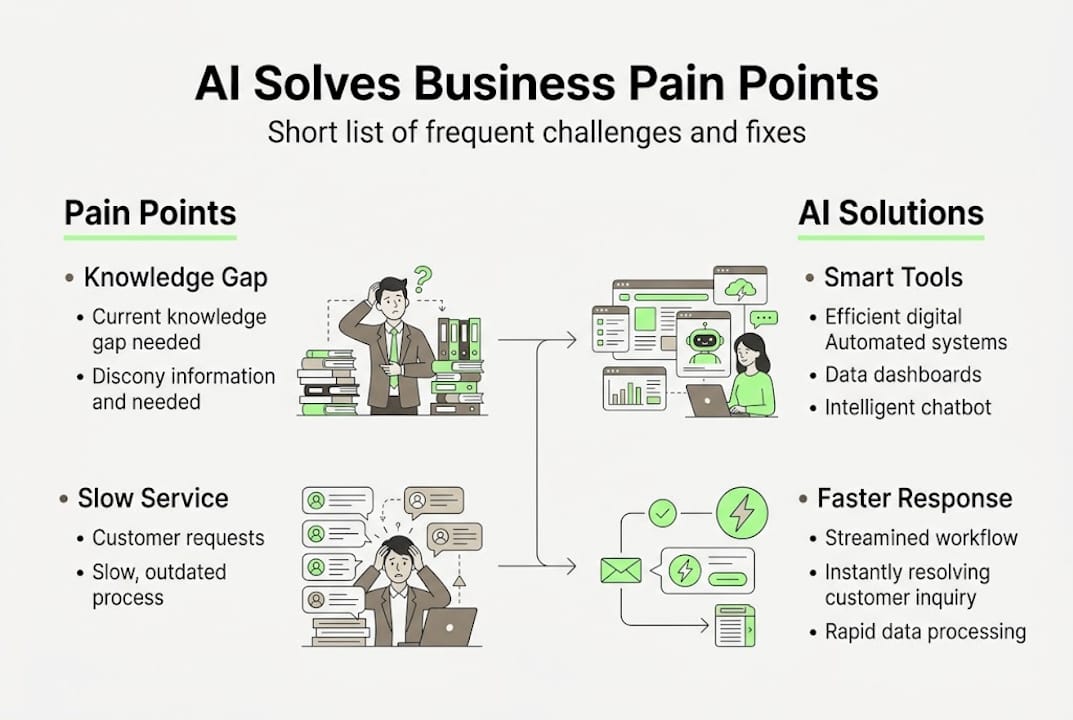
AI tools like Grammarly and ChatGPT can support content, customer service, and operational workflows for small businesses. Understanding how to use essential AI tools for entrepreneurs means you can evaluate these tools in the context of a clearly defined business problem and test whether they produce a useful outcome for your specific situation.
Pro Tip: Start with a small, measurable pilot on one pain point. Define the baseline, success threshold, test period, and decision rule before changing the process. The goal is not to prove that AI works; it is to find out whether a specific intervention improves a specific business outcome.
Pitfalls, limitations, and expert strategies for AI-driven pain points analysis
The practical lesson is not that AI projects are destined to fail. It is that unclear goals, weak validation, poor data handling, and lack of human review can make an AI initiative difficult to evaluate or scale.
The top five pitfalls to avoid:
Unclear objectives: Deploying AI without a defined question produces noise, not insight
Over-automation: Automating broken processes just produces broken results faster
Privacy blind spots: Customer data fed into AI tools may violate privacy regulations if not handled carefully
Skipping output review: AI hallucinations are a documented risk. Always validate before acting
Tool-first thinking: Choosing a shiny tool before defining the problem is the most common and costly mistake
Here’s a practical strategy checklist to keep you on track:
Clarify your objective. What specific pain point are you investigating? Write it down in one sentence.
Validate with real data. Use actual customer feedback, not assumptions or third-party benchmarks alone.
Start small. Pilot on one process or one customer segment before expanding.
Train your team. AI adoption fails without human champions who understand both the tool and the goal.
Monitor outcomes. Set a measurable baseline before you start, so you can prove (or disprove) impact.
Consider the privacy dimension carefully. AI hallucinations need human review, and sensitive customer data carries real legal exposure if mishandled. This isn’t a reason to avoid AI. It’s a reason to use it thoughtfully.
Learning how to improve productivity with AI and following a structured AI entrepreneurship guide can help you build the habits that make AI adoption stick, rather than fizzle out after the first pilot.
“The founders who win with AI aren’t the ones with the most tools. They’re the ones who ask the sharpest questions.”
Why pain points analysis must evolve for the AI era
Here’s an important challenge for founders using AI: choosing a tool before clearly defining the business problem can make it difficult to evaluate whether the technology is actually creating value. A pain-first approach starts with the underlying problem, identifies the evidence needed to understand it, and then evaluates whether an AI-assisted solution is appropriate.
The shift required is philosophical before it’s technical. AI can be a useful problem-solving partner, but its value depends on how clearly the underlying business problem is defined and how the resulting ideas are validated. A pain-first approach helps founders avoid choosing a tool simply because it is available and instead evaluate whether a proposed solution addresses a meaningful, measurable problem.
The real competitive advantage in using AI is not simply having access to more tools. It is defining the right problem and evaluating whether an AI-assisted solution improves a meaningful business outcome. A pain-first approach, where you define the friction before choosing the fix, can help founders avoid unnecessary tool adoption and focus their experiments on measurable business needs.
Exploring AI-assisted customer discovery can help founders practice this pain-first discipline by organizing customer feedback before they decide what to build or optimize.
Accelerate success with siift.ai’s AI-powered solutions
If this article has clarified anything, it’s that pain points analysis works best when it’s systematic, not sporadic. That’s exactly what siift.ai was built for. siift’s Intelligent Business Canvas is the agentic AI platform that guides founders step by step through ideation, validation, and go-to-market strategy, helping you identify your real pain points, validate your assumptions, and build a business model that actually holds up. It’s not a generic chatbot. It’s a structured operating system for your founder journey.
Whether you’re a millennial launching your first venture or a small business owner ready to scale smarter, siift makes it easy to get started without getting lost. Explore what best AI for founders looks like in practice, and see how siift helps you turn sharper questions into faster traction.
Frequently asked questions
What is a pain point in business?
A pain point is a recurring problem or obstacle that disrupts your business operations or growth. Identifying it clearly is the first step toward fixing it sustainably.
How does AI help with pain points analysis?
AI analyzes large datasets like customer reviews and support tickets to quickly spot and categorize business problems, surfacing patterns that manual review would miss.
Are there risks to using AI for analyzing pain points?
Yes. Risks include data privacy concerns, AI hallucinations that need review, and project failure when objectives aren’t clearly defined before deployment.
What’s a simple way to get started with AI-powered analysis?
Begin with one specific business problem, use an AI tool to organize relevant feedback or operational data, and define a measurable baseline and success threshold before making changes. Run a small, time-bounded pilot, review the results, and decide whether the evidence supports continuing, changing, or stopping the approach.
Which AI tools are best for pain points analysis?
Popular options include ChatGPT, Perplexity, and Grammarly, each addressing different pain points across content quality, research depth, and customer service efficiency.