What makes an AI-driven product truly memorable in a crowded tech hub like Singapore or San Francisco? The answer often lies in capturing a bold emotional vibe and unique differentiation signals right from the design stage. Today’s vibe coding paradigms empower solopreneurs to shape their software’s intent and personality with natural language prompts, letting AI translate high-level ideas into expressive, user-centered experiences. This guide reveals how to harness emotional resonance and smart coding strategies to set your business apart.
Table of Contents
- Step 1: Define Your AI-Driven Product Vibe
- Step 2: Map Unique Differentiation Signals In Your Code
- Step 3: Implement Standout Features With Your Vibe
- Step 4: Test Differentiation With Real User Feedback
- Step 5: Refine Your Vibe Coding For Market Fit
Quick Summary
| Key Point | Explanation |
|---|---|
| 1. Define your product’s emotional vibe | Convey how users should feel by identifying core emotional intentions and translating them into design aspects. |
| 2. Identify unique differentiation signals | Analyze customer feedback and usage patterns to reveal what makes your product stand out in the market. |
| 3. Implement features reflecting your vibe | Ensure features resonate emotionally by translating the product vibe into technical specifications and interactive designs. |
| 4. Validate with real user feedback | Collect structured feedback from users to assess if your product meets emotional and functional expectations effectively. |
| 5. Continuously refine vibe for market fit | Use ongoing feedback and adapt your design to maintain relevance and alignment with evolving user preferences. |
Step 1: Define your AI-driven product vibe
Defining your product’s vibe is about capturing the emotional essence and intent behind your AI creation. This critical step transforms your vision from abstract concept to concrete design blueprint.
With emerging vibe coding paradigms, developers can now specify both functional requirements and qualitative emotional resonance. This approach allows you to communicate not just what your product does, but how it should feel to users.
Here’s how to nail your product’s vibe:
- Identify core emotional intention: What feeling do you want users to experience?
- Specify qualitative descriptors: Use evocative language like “calm”, “energetic”, “playful”
- Translate feelings into design elements: Match emotional intent with visual and interaction design
The key is thinking beyond pure functionality. AI-driven development enables you to encode not just code, but emotional context.
Here’s a quick comparison of ways to integrate emotional resonance into AI product development:
| Approach | Emotional Impact | Implementation Difficulty | Typical Use Case |
|---|---|---|---|
| Vibe Coding | High, deeply personalized | Moderate, requires creative input | When designing user-driven AI interfaces |
| UI/UX Design | Medium, relies on visuals | Low, standard design process | Branding and first impression experiences |
| Algorithmic Bias Adjustment | Variable, data-dependent | High, technical expertise needed | Personalizing recommendations and outputs |
| Manual Feedback Loops | Low to medium, user-guided | Low, simple systems required | Early-stage product testing and refinement |
Your product’s vibe is its personality - make it memorable and authentic.
Pro tip: Conduct user interviews or create user personas to deeply understand the emotional landscape your product aims to inhabit.
Step 2: Map unique differentiation signals in your code
Identifying unique differentiation signals transforms your AI product from generic to extraordinary. This step helps you decode the specific attributes that will make your solution stand out in a crowded marketplace.
AI-powered product development techniques enable sophisticated mapping of distinctive features through advanced algorithmic analysis. By leveraging multimodal data sources, you can uncover nuanced signals that reflect your product’s unique value proposition.
Here’s a strategic approach to mapping differentiation signals:
- Analyze customer feedback: Extract sentiment and subtle preference indicators
- Examine usage patterns: Identify unexpected interaction points
- Compare against competitor baselines: Highlight your unique capabilities
- Track performance metrics: Quantify distinctive features
Big data integration allows deeper insights into what truly distinguishes your product. This means going beyond surface-level features to understand the underlying emotional and functional uniqueness.
Your differentiation signals are the DNA of your product’s competitive advantage.
Pro tip: Create a “difference dashboard” that systematically tracks and visualizes your product’s unique signals across multiple dimensions.
Step 3: Implement standout features with your vibe
Transforming your product’s unique vibe into tangible features requires strategic thinking and creative implementation. This step bridges the gap between conceptual design and functional innovation.
Vibe coding paradigms enable developers to express complex functionalities through natural language prompts, allowing for more intuitive and emotionally resonant product development. By articulating your product’s core emotional intent, you can guide AI to generate code that reflects both technical requirements and experiential qualities.
Key strategies for implementing standout features include:
- Translate emotional intent into technical specifications
- Design interaction flows that reflect your product’s unique personality
- Create contextual experiences beyond standard functionality
- Integrate unexpected moments of delight
Look for opportunities to surprise users by embedding your product’s distinctive vibe into every interaction. This means going beyond basic features to create experiences that feel uniquely yours.
Your product’s most memorable features emerge when technical capability meets emotional intelligence.
Pro tip: Conduct rapid prototype testing to validate how well your implemented features actually communicate the intended vibe.
Step 4: Test differentiation with real user feedback
Validating your product’s unique vibe requires direct engagement with the people who matter most - your potential users. This step transforms theoretical differentiation into measurable insights about how your product truly resonates in the market.
Iterative user feedback processes are critical for understanding whether your implemented features genuinely capture the intended emotional and functional experience. By systematically collecting and analyzing user responses, you can refine your product’s distinctive qualities.
Effective user feedback strategies include:
- Conduct targeted prototype testing
- Design structured interview protocols
- Collect both qualitative and quantitative data
- Create user personas to contextualize feedback
AI-driven product development demands continuous refinement through user insights. This means going beyond surface-level reactions to understand the deeper emotional and functional expectations of your target audience.
Real innovation emerges from understanding the nuanced needs your users didn’t even know they had.
Pro tip: Create a feedback scoring matrix that weights emotional resonance alongside functional performance to holistically evaluate your product’s differentiation.
Step 5: Refine your vibe coding for market fit
Perfecting your product’s market resonance is an ongoing journey of strategic adaptation and intelligent iteration. This critical phase transforms initial concepts into truly compelling solutions that deeply connect with your target audience.
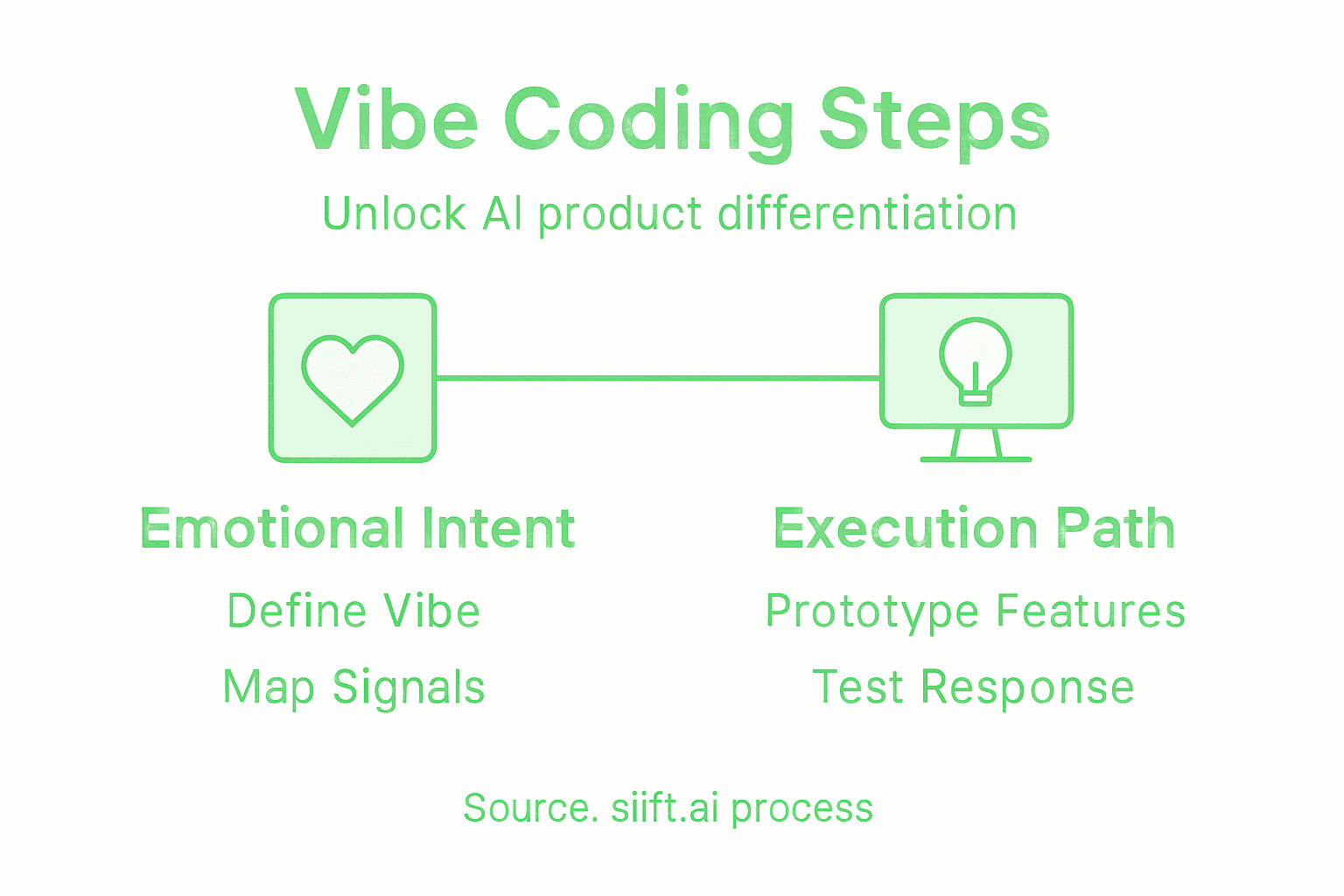
Human-AI collaboration techniques provide powerful mechanisms for continuously evolving your product’s functional and emotional dimensions. By treating your vibe coding as a dynamic, adaptive system, you can create increasingly sophisticated experiences that feel intuitively aligned with user expectations.
Key refinement strategies include:
- Implement continuous feedback loops
- Analyze user interaction data systematically
- Adjust AI model training based on real-world insights
- Maintain flexibility in design approach
AI-driven product development demands persistent attentiveness to subtle shifts in user preferences. This means treating your product as a living ecosystem that evolves through ongoing dialogue between your vision and user experiences.
The following table summarizes the business impact of continuous vibe refinement through Human-AI collaboration:
| Refinement Method | Business Benefit | Market Fit Advantage | Example Outcome |
|---|---|---|---|
| Real-time Feedback Analysis | Rapid product improvement | Fast response to changing user needs | Enhanced user satisfaction |
| Adaptive Model Training | Better personalization | Improved alignment to audience | Increased retention rates |
| Flexible Design Iteration | Faster innovation cycles | Easier pivot to market shifts | Broader customer appeal |
Market fit is not a destination, but a continuous journey of discovery and adaptation.
Pro tip: Create a dedicated “vibe metrics” dashboard that tracks both quantitative performance indicators and qualitative emotional resonance signals.
Unlock Your AI Product’s Unique Vibe with siift.ai
Struggling to transform your AI product’s emotional intent into standout features that truly differentiate you from competitors? This article highlights the challenge of mastering vibe coding differentiation, a vital step to ensure your product resonates deeply with users while capturing a distinct market position. Key pain points like encoding emotional resonance, mapping unique differentiation signals, and refining your product through real user feedback speak directly to the complexity of building a memorable AI solution.
That is where siift.ai steps in with its Intelligent Business Canvas. This intuitive AI platform guides founders through every stage from ideation to go-to-market, providing personalized feedback, fresh insights, and prioritized actions to de-risk and accelerate your product’s journey to market fit. Harness the power of human-AI collaboration to continuously refine your product’s vibe coding and unlock authentic emotional connections that will set you apart.
Ready to bridge the gap between emotional intent and market success? Explore how siift.ai’s step-by-step founder’s insights can help you build an AI product that stands out for all the right reasons. Start shaping your unique vibe today at siift.ai and bring your vision to life with confidence.
Frequently Asked Questions
How do I define my AI product’s vibe effectively?
Defining your AI product’s vibe involves identifying the core emotional intention you want users to experience. Begin by brainstorming words that evoke the desired feelings, such as “energetic” or “calm,” and then translate these feelings into specific design elements in your product.
What steps should I take to map differentiation signals in my AI product?
To map differentiation signals, analyze customer feedback and examine usage patterns to identify unique attributes. Create a system to track these signals, allowing for a clearer understanding of what sets your product apart from competitors.
How can I test if my AI product’s vibe resonates with users?
To test your product’s vibe, conduct targeted prototype testing with potential users and gather both qualitative and quantitative feedback. Use structured interviews to collect insights that help you refine your product’s emotional and functional experience.
What are some key features to implement that reflect my product’s vibe?
Implement standout features by translating your emotional intent into technical specifications and designing interaction flows that showcase your product’s personality. Aim to create contextual experiences that surprise and delight users, enhancing overall engagement.
How do I continuously refine my AI product’s vibe for better market fit?
Continuously refine your product’s vibe by implementing feedback loops, analyzing user interaction data, and adjusting your approach based on real-world insights. Make it a goal to review and adapt your strategies regularly, ideally every month, to maintain alignment with user expectations.