TL;DR:
Most startups achieve traction by focusing on direct outreach and engaging early users manually. Building product-market fit through passionate customers is essential before scaling with paid ads or content strategies. Patience and customer insight are vital for sustainable growth and long-term success.
Business traction is defined as measurable progress in customer acquisition, revenue growth, and market presence that signals your startup is actually working. It is the concrete evidence investors look for and the feedback loop founders need to stay sane. Knowing how to get traction in business separates the side hustlers who break through from the ones who quietly fold after six months. The good news: traction follows a pattern, and that pattern is learnable. This guide breaks it down channel by channel, mistake by mistake, so you can build momentum that compounds.
What are the best channels to get traction in business?
The fastest path to your first customers is direct outreach. Direct conversation converts at 10–30%, compared to 2–4% for traditional channels like email blasts or cold ads. That gap is enormous. It means one hour of genuine one-on-one conversation outperforms a week of spray-and-pray marketing.
Your first 10–30 customers will almost certainly come from manual effort. Manual outreach teaches founders the exact language customers use to describe their problem, which becomes your best marketing copy. You cannot buy that insight with an ad budget.
Here is how the main early-stage channels stack up:
Channel | Typical conversion rate | Best timing |
|---|---|---|
Direct outreach (DMs, calls, email) | 10–30% | Day 1 onward |
Community engagement (Slack, Discord, forums) | 20–30% of early users | Weeks 1–8 |
Launch sequences (Product Hunt, directories) | Traffic spike, lower conversion | After warm-up |
Organic SEO and content | Compounds over months | Month 3 onward |
Paid ads | Varies, often low early | After 100 customers |
Community engagement deserves more credit than most founders give it. Niche Slack groups, Reddit threads, and Discord servers are where your early adopters already hang out. Showing up there as a helpful contributor, not a promoter, builds the trust that converts to users. Pair that with a timeline takeover campaign on X and you can spike visibility fast when you have something worth sharing.
Launch sequences on platforms like Product Hunt generate real traffic spikes, but only when you warm up an audience first. A well-warmed launch where you nurture a crowd beforehand amplifies success dramatically. Launching cold wastes your one-time window.
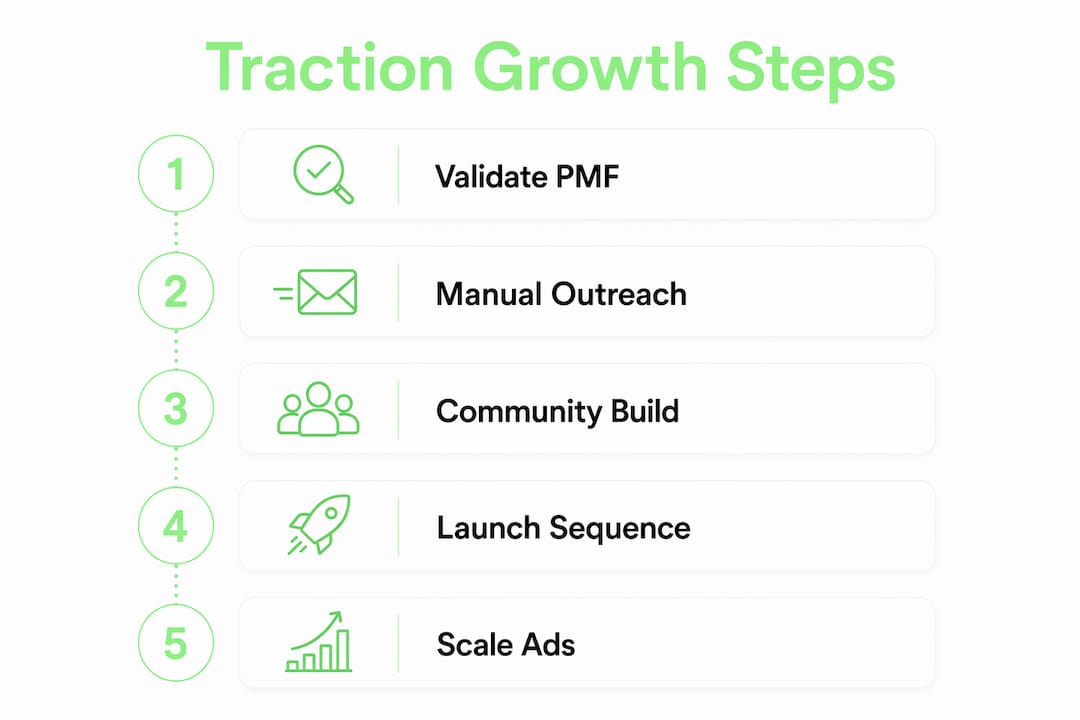
SaaS SEO builds sustainable growth and lowers customer acquisition costs over time, but it takes months to compound. Treat it as a long-term asset, not a quick fix.
Pro Tip: Before you spend a dollar on ads, get to 100 customers through manual channels. Paid ads amplify a working funnel. They cannot fix a broken one.
How do you validate product-market fit to accelerate traction?
Product-market fit (PMF) is the industry term for the state where your product satisfies a strong market demand. Without it, every traction effort leaks. You pour users in the top and they drain out the bottom through churn.
Early traction is about learning from ten users who genuinely love your product, not chasing large numbers who are indifferent. Ten passionate users tell you more than a thousand lukewarm sign-ups. They show you what to build next, what to say in your marketing, and what price feels fair.
Treat your first users as development partners, not just customers. Here is how to do that in practice:
Talk to them weekly. Schedule 20-minute calls. Ask what they almost switched to, what they wish your product did, and what they would tell a friend.
Listen for repeated language. When three people use the same phrase to describe their problem, that phrase belongs in your headline.
Track retention, not just sign-ups. If users come back week after week, you have something real. If they disappear after day one, you have a PMF problem.
Test pricing early. Ask users what they pay for similar solutions. Mispricing kills traction quietly and fast.
Iterate in short cycles. Ship a small change, measure the response, repeat. Speed of learning beats perfection of execution.
Poor PMF is the silent killer of traction efforts. 9 out of 10 startups fail, and a third of those fail specifically because of a lack of product-market fit. That is not a small risk to ignore.
Pro Tip: Ask your best users: “If this product disappeared tomorrow, how would you feel?” If fewer than 40% say “very disappointed,” you have more work to do before scaling.
For a deeper framework on this, the product-market fit playbook from siift walks through the validation process step by step.
What mistakes do founders make when trying to gain traction?
Most traction failures are self-inflicted. The good news is they are also predictable, which means you can sidestep them before they cost you months of runway.
Scaling before product-market fit. Startups that scale aggressively in year one are 20–40% more likely to fail. The average successful startup scales after four years, not four months. Scaling a broken model just burns cash faster.
Chasing every shiny channel. Founders suffer from shiny object syndrome, jumping between growth opportunities without a focused strategy. Doing five channels at 20% effort beats doing one at 100% only if you have the team for it. Early on, you almost certainly do not.
Running paid ads too early. Paid ads do not fix broken messaging. They amplify what is already working. Spending on ads before you have validated funnels is the startup equivalent of pouring water into a cracked bucket.
Skipping systematic experimentation. Founders who experiment systematically build scalable models and avoid premature commitment to unproven strategies. A/B testing your onboarding, your pricing page, and your outreach copy is not optional. It is how you find what actually works.
Ignoring what creates real value. Traction is a byproduct of genuine value delivery. Founders who obsess over growth hacks and ignore customer outcomes end up with metrics that look good in a deck but collapse in real life.
Pro Tip: Pick two traction channels and go deep for 60 days. Measure everything. Then decide whether to double down or pivot. Breadth before depth is a trap.
Avoiding these traps is covered in detail in the common startup mistakes guide from siift, which is worth a read before you commit to any growth strategy.
How do you sustain and scale business traction long-term?
Getting your first 100 customers is a sprint. Sustaining growth beyond that is a marathon with different rules.

The shift from manual to scalable channels is the critical transition. Direct outreach gets you to 100 customers. SEO, content, partnerships, and referral programs get you to 10,000. The mistake is trying to skip the manual phase or staying in it too long.
Here is what sustainable traction looks like in practice:
Invest in your team. Employee well-being directly improves customer value and engagement. Founders who treat their team well build cultures that customers feel. That is not soft advice. It shows up in retention numbers.
Use data to sharpen your targeting. Firmographic data (company size, industry, revenue) and technographic data (tools your customers use) help you find more customers who look like your best ones. Stop marketing to everyone.
Build partnerships early. A single integration with a tool your customers already use can drive more qualified leads than months of cold outreach.
Maintain media presence. Thought leadership content, podcast appearances, and press mentions build credibility that compounds. One good article can drive inbound leads for years.
Transition paid ads in deliberately. Once organic channels prove conversion, paid ads become a multiplier. Run small tests, measure cost per acquisition, and scale only what is profitable.
The discipline here is balance. Growth requires both seizing opportunities and saying no to distractions. Growth is not one-size-fits-all. What works for a B2B SaaS is different from what works for a consumer app. Know your model before you copy someone else’s playbook.
Key Takeaways
Business traction requires validated product-market fit, focused channel selection, and a deliberate transition from manual outreach to scalable growth systems.
Point | Details |
|---|---|
Direct outreach wins early | Manual conversations convert at 10–30% and teach you the language your customers use. |
PMF before scale | Learn from 10 passionate users before chasing large numbers to avoid high churn. |
Avoid premature scaling | Startups that scale in year one are 20–40% more likely to fail. |
Paid ads come last | Validate organic funnels first; ads amplify what works, they do not fix what does not. |
Sustain through team and data | Employee satisfaction and firmographic targeting drive long-term, compounding growth. |
Why I think most founders get traction backwards
Here is the uncomfortable truth I have seen play out repeatedly: most founders treat traction as a marketing problem when it is actually a listening problem. They want the shortcut, the viral post, the Product Hunt spike. And those things can work. But they work because the product underneath them is genuinely good, not because the launch was clever.
The founders who build real momentum are the ones willing to do the unglamorous work first. They send 200 cold DMs. They hop on calls with strangers. They ask hard questions and sit with uncomfortable answers. That manual phase feels slow, but it is where the real intelligence lives. Every conversation is a data point that shapes your product, your messaging, and your positioning.
I have also seen what happens when founders skip it. They raise a round, hire a growth team, run ads, and then discover six months later that their churn rate is 40% because they never actually understood why customers stayed. That is an expensive lesson.
Patience is not passivity. It is the discipline to keep learning before you start scaling. The founders who resist the hype of premature growth and stay close to their early users are the ones who build something that lasts. Data-driven decisions, made with real customer insight, will always outperform gut-feel growth bets.
— Samim Safaei
siift helps founders build traction with clarity and confidence
Building traction is hard enough without flying blind. siift’s New Business OS guides founders step by step through ideation, validation, and go-to-market, so you are not guessing which channel to prioritize or whether your product is ready to scale. The platform filters out the noise, the biases, and the blindspots that derail early-stage founders. If you are serious about accelerating your path to product-market fit and building momentum that compounds, siift gives you the structure and AI-driven intelligence to do it faster and with far less wasted effort than going it alone.
FAQ
What does business traction mean for a startup?
Business traction is measurable progress in customer growth, revenue, engagement, and market presence. It signals to investors and founders that the business model is working.
How long does it take to get traction in business?
Early-stage startups typically reach their first 100 users within two to six months using direct outreach, community engagement, and launch sequences. Timeline varies by market and channel mix.
What is the fastest way to gain traction for a startup?
Direct outreach is the fastest channel, converting at 10–30%. Start with personal conversations, identify your most passionate early users, and build from there before moving to scalable channels.
Why do most startups fail to get traction?
A third of startups fail due to lack of product-market fit. Premature scaling, unfocused channel strategy, and running paid ads before validating organic funnels are the most common causes.
When should I start using paid ads to grow my business?
Run paid ads only after organic channels prove conversion and you have at least 100 customers. Ads amplify a working funnel. They do not create one from scratch.