

To innovate means to introduce something new or do something in a noticeably different way, whether that’s a tweak to your morning routine or a full business model overhaul. Merriam-Webster backs the plain-English version: innovate means introducing new methods, ideas, or products. Founders at siift treat it the same way: sometimes it’s a small fix, sometimes it’s the whole company.
TL;DR:
- Most innovation involves improving or changing existing products, processes, or business models rather than creating entirely new ideas from scratch.
- Incremental innovation, such as app updates, is safer and more common than radical shifts like building completely new platforms, and it drives steady growth.
- Clear decision rights, diverse perspectives, and specific challenges accelerate innovation within organizations, while outdated approval processes often cause failure.
- Technology and digital tools have drastically shortened prototyping cycles, allowing small teams to test ideas quickly and reduce risk.
- Measuring innovation success requires tracking both leading indicators, like prototypes created, and lagging metrics, such as revenue impact, to adjust efforts effectively.
Table of Contents
- What Innovate Actually Means and Where It Comes From
- How Do You Use Innovate in a Sentence?
- How Do You Actually Start Innovating?
- Why Does Innovation Stall Inside Companies?
- Where Can You Learn More About Innovation?
- What Has Innovation Actually Changed in Society?
- How Are Technology and Digital Transformation Changing Innovation?
- How Do You Measure Whether Innovation Actually Worked?
- What Frameworks Help Structure Innovation Work?
- Why Innovate Matters More Than the Word Suggests
- Sources
- FAQ
What Innovate Actually Means and Where It Comes From
The Merriam-Webster definition is refreshingly unfussy: to innovate is to introduce something new or make changes in something already established, especially by introducing new methods, ideas, or products. It’s a verb, pronounced IN-uh-vast, and it traces back to the Latin innovare, meaning “to renew or change.” That root matters. Innovation was never about starting from a blank page. It was always about changing what already exists.
You’ll usually see it paired with a noun: innovate a product, innovate a process, innovate a business model. That collocation pattern is worth noticing, because “innovate” on its own sounds vague, but “innovate the onboarding process” tells you exactly what changed.
A handful of near-synonyms get thrown around interchangeably, but they carry different weight:
- Modernize implies updating something outdated, not necessarily creating something new.
- Transform suggests a deeper, structural shift, often in identity or function.
- Revolutionize is the big swing, complete disruption of how something works.
- Pioneer means being first, staking a claim before anyone else gets there.
- Invent means creating something that didn’t exist before, the strongest and rarest of the bunch.
Reach for “innovate” when you want a word flexible enough to cover both a minor process fix and a category-defining launch. That flexibility is the whole point.
How Do You Use Innovate in a Sentence?
Everyday usage tends to be casual: “She’s always innovating with new recipes” or “The school innovated its grading system this year.” Business usage gets more specific, and it usually falls into one of two buckets.
- Incremental innovation. A coffee chain innovates its loyalty app by adding mobile ordering. Small, low-risk, builds on what already works.
- Radical innovation. A film rental company innovates by killing DVDs entirely and building a streaming platform from scratch. High-risk, category-defining, occasionally company-ending if it flops.
Most companies live closer to the incremental end, and that’s not a knock. McKinsey’s research on top performers found that the strongest growth strategy is often extending existing strengths into adjacent markets rather than chasing moonshots. A software company that sells project management tools innovating into time tracking is a much safer bet than pivoting into hardware.
The word “innovate” tends to imply radical change when paired with words like “disrupt” or “reinvent,” and incremental change when paired with “improve” or “refine.” Context does most of the heavy lifting. When someone says a startup wants to “innovate the industry,” they usually mean the big swing. When a manager says “let’s innovate this workflow,” they mean something smaller and more immediately useful.
How Do You Actually Start Innovating?
Here’s the part most definitions skip: knowing what “innovate” means doesn’t tell you how to do it. The good news is there’s a repeatable shape to it, borrowed from design practice and refined by decades of founders learning the hard way.
- Identify a meaningful challenge. Vague goals (“be more innovative”) produce vague results. Pick a specific problem worth solving.
- Generate and prioritize ideas. Quantity first, judgment later. Narrow down once you’ve got real options on the table.
- Prototype and experiment. Build the cheapest possible version of the idea that still tests the core assumption.
- Learn and iterate. Treat every result as data, not a verdict.
- Scale or stop. Not every experiment deserves more investment. Killing a bad idea fast is itself a skill.
Stanford d.school’s design resources offer concrete exercises for the prototyping stage, turning fuzzy assumptions into testable hypotheses instead of theoretical debates. And innovation isn’t just a process problem, it’s a mindset problem. The Center for Creative Leadership points to curiosity and tolerance for ambiguity as the traits that separate teams who actually ship new ideas from teams who just talk about them.
Pro Tip: Match your decision cadence to your learning speed. If your team runs a customer test every week but your leadership only reviews results monthly, you’re strangling your own experiments before they finish. HBS research on decision-making makes this exact point: slow approvals kill fast learning.
A second habit worth stealing from design thinking: defer judgment during ideation. The moment someone says “that won’t work” in a brainstorm, the room stops generating ideas and starts defending them. Save the critique for the prioritization step.
Why Does Innovation Stall Inside Companies?
Innovation rarely dies from a lack of ideas. It dies from friction. The HBS analysis on decision-making names slow, outdated approval processes as one of the biggest killers of breakthrough work, right alongside narrow leadership perspectives and resource allocation that always favors the safe, proven bet over the risky new one. Add a lack of clear purpose, teams innovating for innovation’s sake with no problem attached, and you’ve got a recipe for a lot of expensive meetings and nothing shipped.
Leaders who actually fix this tend to do a few specific things:
- Clarify decision rights so nobody’s waiting three weeks for a sign-off that should take three days.
- Deliberately include diverse perspectives instead of the same five people who always agree with each other.
- Set a specific innovation challenge instead of a vague mandate to “be more innovative.”
- Protect experimental teams from the pressure to hit this quarter’s numbers with next year’s bet.
The CCL’s research on organizational innovation frames this as a toolset, skillset, and mindset problem, and warns that training only one of the three rarely produces lasting change. You can hand a team the best prototyping tools in the world, but if leadership still punishes failed experiments, nothing changes. Founders wrestling with this exact tension might find siift’s guide on what drives innovation useful for working through the decision-rights piece specifically.
Where Can You Learn More About Innovation?
A short, trustworthy reading list beats a long, generic one. Start here:
- Merriam-Webster for the baseline definition and etymology.
- Harvard Business School for the decision-cadence research that shapes how leadership either accelerates or kills innovation.
- Center for Creative Leadership for practical leadership behaviors that actually move the needle.
- Stanford d.school for hands-on design tools and prototyping exercises.
If you’re building something and want to go from definition to action, siift’s guide to curiosity and startup mindsets and its feature prioritization framework are both built for exactly that jump. Neither claims to be the only path forward, just a solid next step.
What Has Innovation Actually Changed in Society?
Innovation’s track record isn’t subtle. The printing press turned literacy from a luxury into an expectation. The assembly line didn’t just make cars faster to build, it created the modern middle class by making mass employment possible at scale. Electricity rewired entire cities, and later, entire economies, around a resource nobody had priced correctly a generation earlier.
What’s easy to miss is how often industry-defining innovation came from someone reapplying an existing idea rather than inventing something from nothing. The steam engine existed for decades before it got paired with rail transport. The internet existed as a research network years before anyone built a browser people wanted to use. Innovation, historically, is often less about the initial spark and more about who connects the dots first.
That pattern holds today. Every major industry shift, from retail to healthcare to finance, tends to follow the same arc: an existing technology reaches a tipping point, someone applies it to an unsolved problem, and the rest of the market either adapts or gets left behind. Founders building today are operating inside that same historical current, just with a faster feedback loop than the printing press ever had.
How Are Technology and Digital Transformation Changing Innovation?
Technology hasn’t just given innovators new tools, it’s compressed the entire cycle. What used to take a manufacturing team months to prototype, a software team can now test in an afternoon. That speed changes the calculus on risk: when a failed experiment costs a week instead of a year, teams can afford to run far more of them.
Digital transformation also lowered the entry barrier. A solo founder with a laptop can now access market research, prototyping tools, and distribution channels that used to require a corporate budget and a department. That’s part of why so much innovation now comes from small teams instead of R&D labs, the infrastructure that used to be exclusive is now table stakes.

AI has pushed that compression further still, showcasing the power of AI-driven SEO and marketing in revolutionizing the digital landscape. Tasks that once needed a research team, market analysis, competitor mapping, early validation, can now happen in a fraction of the time with the right tooling. That’s not a replacement for judgment, but it does mean founders can test more ideas before committing real capital to any single one.
How Do You Measure Whether Innovation Actually Worked?
This is where a lot of well-meaning innovation efforts quietly fail: nobody defined what success looks like before starting. “Be more innovative” isn’t a metric. Revenue from products launched in the last two years is. Time-to-market for new features is. Customer adoption rate of a new offering within its first quarter is.
The honest answer is that innovation ROI is messier to measure than most financial metrics, because a lot of the value shows up downstream, in retention, in competitive positioning, in the ability to respond faster than rivals. Smart teams track a mix: a leading indicator (experiments run per quarter, or ideas that made it to prototype), and a lagging one (revenue or margin impact six to twelve months later). Tracking only the lagging metric means you find out something failed long after you could have adjusted course.
What Frameworks Help Structure Innovation Work?
Two names show up constantly in this space, and they solve different problems. Design thinking, the approach Stanford d.school built its reputation on, structures innovation around empathy for the end user, rapid prototyping, and testing assumptions before committing resources. It’s particularly strong for product and experience problems, where the biggest risk is building something nobody actually wants.
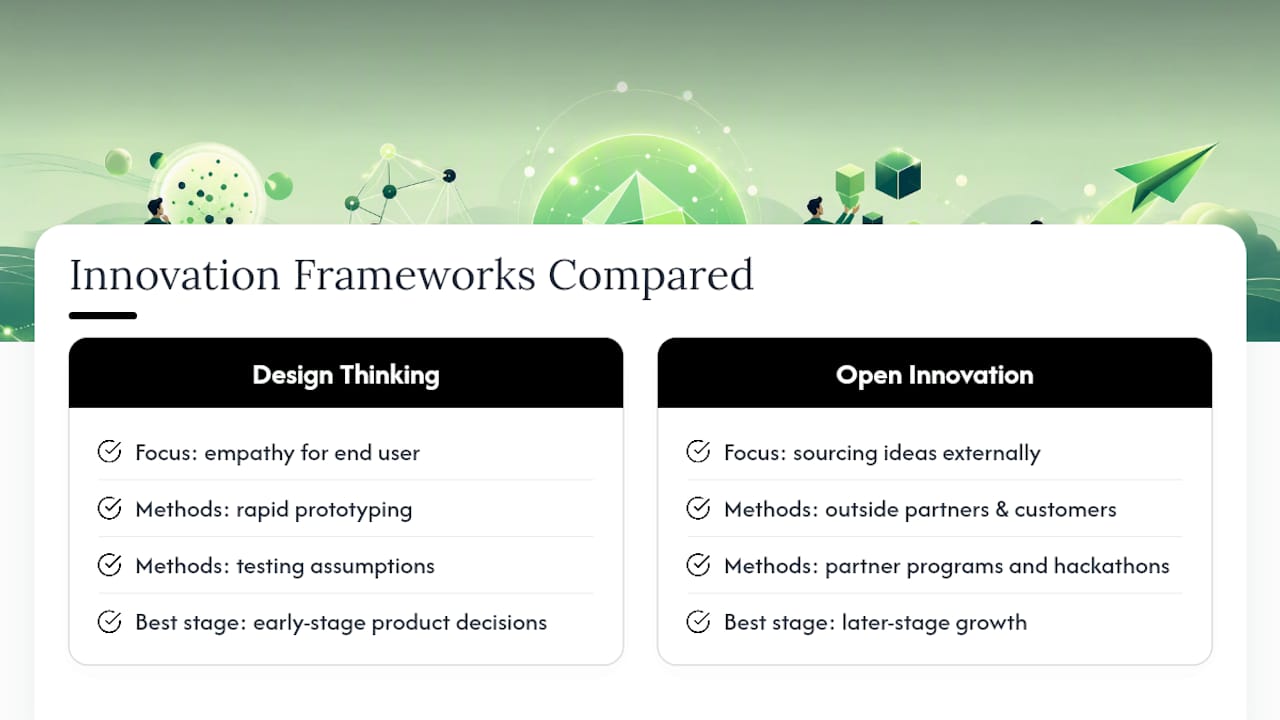
Open innovation takes a different angle: instead of assuming all good ideas come from inside your own walls, it deliberately pulls in outside partners, customers, even competitors, to source and develop new ideas. It’s why so many companies now run partner programs, hackathons, and customer advisory boards instead of relying solely on an internal R&D team.
Neither framework is universally “better.” Design thinking tends to fit early-stage product decisions where you’re still figuring out what to build. Open innovation tends to fit later-stage growth, where you already know your core product and want to find adjacent opportunities faster than you could alone, which loops back to that McKinsey finding on extending existing strengths into nearby markets. Picking the wrong framework for your stage is a common, avoidable mistake.
If you’re at the ideation stage and want a structured way to work through which framework fits your situation, siift’s solution for startup idea validation is built around exactly that decision point, and once you’ve validated the idea, its go-to-market planning tools pick up where validation leaves off. For founders ready to see the full platform, siift’s pricing page lays out the plans clearly.
Why Innovate Matters More Than the Word Suggests
Founders don’t wake up asking “how do I innovate today.” They ask “should I fix this onboarding flow or rebuild it,” and that question is innovation in disguise. The word gets treated as a buzzword because people use it to sound ambitious instead of using it to make a decision. But strip away the hype, and it’s just a tool for describing change, and every founder makes that call daily, often without naming it.
What separates founders who innovate well from those who spin their wheels isn’t bigger ideas. It’s tighter feedback loops and the discipline to kill what isn’t working. If you’re staring down that decision right now, a small experiment beats another week of debate.
— Samim Safaei
Sources
- INNOVATE Definition & Meaning | Merriam-Webster
- Drive Innovation with Better Decision-Making | HBS
- 3 practices that will help drive innovation in your organization | CCL
- Innovate | Stanford d.school
- How top performers use innovation to grow within and beyond the core | McKinsey
FAQ
What Does It Mean to Innovate Something?
To innovate something means to change it by introducing a new method, idea, or approach, ranging from a minor tweak to a complete overhaul of how it works.
What Is Another Word for Innovate?
Common alternatives include modernize, transform, revolutionize, pioneer, and invent, though each carries a slightly different level of intensity, from small updates to entirely new creations.
What Does the Word Innovate Mean in Business?
In a business context, to innovate typically means developing new products, processes, or business models to gain a competitive edge, ranging from incremental process improvements to disruptive new offerings.
Is Innovate Inc. a Real Company?
Multiple companies use “Innovate” as part of their name across different industries, so it depends on which specific entity is being referenced; there’s no single, universally known company called simply “Innovate Inc.”
Is Innovating the Same as Inventing?
No. Inventing means creating something that never existed before, while innovating usually means changing or improving something that already exists, which is why most innovation is incremental rather than groundbreaking.