

The fastest way to innovate with AI is to pair focused learning with a repeatable prioritize-validate-scale framework, then run timeboxed pilots instead of open-ended experiments. Adoption is already the default: a large majority of organizations use AI in some part of their operations(https://www.edx.org/resources/how-industries-leverage-ai). What follows is the framework, the scoring math, and the exact next step to run this week.
TL;DR:
- Focusing on rapid, timeboxed pilots over open-ended experiments allows founders to test AI-driven ideas within two to three weeks effectively.
- Prioritization should be based on impact, feasibility, and speed to learn, with ideas scoring below 9 out of 15 deferred for later, avoiding wasted effort.
- Structured prompts that challenge assumptions and generate critical feedback outperform vague questions, saving weeks of ambiguous validation.
- A dedicated platform like siift streamlines the entire AI innovation process, replacing disconnected tools with guided workflows, validation templates, and actionable deliverables.
- Responsible AI implementation requires thorough governance, including data minimization, human oversight, bias checks, and clear decision-tracking before scaling pilots.
Table of Contents
- What AI-Driven Innovation Actually Looks Like
- A Repeatable Framework for AI Innovation
- How Do You Prioritize and Validate AI Opportunities?
- Implementing and Scaling What Works
- Keeping AI Experiments Responsible
- Why a Platform Beats Piecemeal Tools Here
- A Founder’s Honest Take on Moving Fast With AI
- Try siift and Skip the Six Disconnected Tools
- Sources
- FAQ
What AI-Driven Innovation Actually Looks Like
Most founders picture AI innovation as some flashy new feature. In practice, it shows up in four quieter, more useful forms: automated processes that free up your week, faster experimentation cycles, insight generation from data you already have, and yes, occasionally, a genuinely new feature or product line.
The mindset shift matters more than the tool. Business leaders often treat AI as a cost-cutting lever when the bigger opportunity is using it to imagine products and services that didn’t exist before. Executive programs that build in structured project work, not just lecture content, consistently turn that mindset into something concrete. IMD’s tech innovation courses, for instance, thread a value-creation project through the entire curriculum so learning doesn’t stay theoretical.
Here’s the pattern in miniature: a two-person team learns prompt-based market research techniques over a weekend, spends one week testing a positioning hypothesis with 40 cold outreach messages, and cuts their planned build time by a month because the AI-assisted research surfaced a market segment they’d overlooked. That’s the whole game.
- New or improved product features
- Process automation that reclaims founder hours
- Insight generation from existing customer or market data
- Faster, cheaper experimentation cycles
A Repeatable Framework for AI Innovation
Skip the framework and you’re just improvising with a fancier vocabulary. Here’s a five-step loop you can run on a single idea in two to three weeks:
- Define the outcome and KPI. Write down what success looks like in a number, not a feeling. “20 signups in two weeks” beats “see if people like it.”
- Generate and stress-test hypotheses. Draft your assumption, then explicitly prompt an AI model to argue against it. This single move catches more bad assumptions than a week of internal debate.
- Prioritize by impact, feasibility, and learning speed. Not every good idea deserves your next two weeks. Score it before you build it.
- Design a timeboxed validation. Set a hard deadline, build the smallest version that answers your question, and write down what “pass” looks like before you start.
- Interpret and decide. Pivot, persevere, or scale. No fourth option, no “let’s give it one more week.”
Pro Tip: Run step 2 twice, once asking the AI to argue against your idea, once asking it to argue against the counterargument. The second pass usually surfaces the objection that actually matters.
This loop borrows from a “learning-rate” lens: prioritize whichever experiment gives you the most information per unit of time, not whichever one sounds most impressive in a pitch deck, since that discipline is what keeps a validation process from quietly turning into a six-month side project.
How Do You Prioritize and Validate AI Opportunities?
Scoring an idea sounds bureaucratic until you’ve watched a founder burn eight weeks on a “sure thing” that scores a 2 out of 10 on feasibility. A simple rubric fixes that. Score each opportunity 1 to 5 on three axes:
- Impact: How much revenue, retention, or cost savings if this works?
- Feasibility: Can you build a testable version with current tools and skills in under two weeks?
- Time-to-learn: How fast will you get a clear signal, good or bad?
Anything scoring below 9 out of 15 combined goes on the “revisit later” list, not the trash. Once something clears that bar, use targeted prompts to sharpen the test itself: ask the model to “play devil’s advocate against this pricing hypothesis,” “summarize the strongest market signals for or against this niche,” or “design a two-week prototype test with a clear pass/fail line.” Structured prompting that hunts for flaws consistently beats vague “is this good?” questions.
Pro Tip: Define your sample size, success metric, and deadline before you write a line of code or a single ad. If you can’t state all three in one sentence, you’re not ready to test yet. For a step-by-step walkthrough, siift’s guide on the fastest way to validate a business idea covers experiment design in more detail, and the validate before you build resource is worth a look before you commit real budget.
Implementing and Scaling What Works
A pilot that works is only half the job. Someone has to decide whether it graduates to production, and that decision needs actual owners, not a group chat vote. Product typically owns the pilot itself, engineering signs off on technical readiness, and legal or a designated steward reviews data handling before anything touches real customers.

Tooling matters here too. A copilot assists a human doing the work. A lightweight agent completes a bounded task with light supervision. An integrated platform coordinates multiple steps, context, and handoffs on its own. Know which one you’re actually building before you promise your team “automation.”
Before anything scales past a pilot, run this checklist:
- Security review of data access and third-party integrations
- Monitoring for drift, errors, and unexpected model behavior
- A documented rollback plan if the system misbehaves in production
- Training so the team using the tool isn’t just guessing at prompts
Reporting on small-business AI use backs this up directly: real productivity gains show up when teams weigh integration, privacy, and cost tradeoffs upfront rather than discovering them after launch. For infrastructure patterns around agents and integrations specifically, Sendmux is worth a look, and siift’s piece on improving productivity with AI walks through practical workflow integration if you want more detail before you commit engineering time.
Keeping AI Experiments Responsible
Speed without guardrails just means you break things faster. Before any pilot touches real customer data, run through a short governance checklist: minimize the data you actually feed the model, keep a human reviewing outputs before they go live, check for bias in whatever the AI is scoring or ranking, and log decisions so you can trace what happened later.
- Collect only the data the specific test actually requires
- Keep a human in the loop for anything customer-facing
- Check outputs for skewed or biased patterns before shipping
- Maintain an audit trail of what the AI decided and why
Sensitive data is where teams cut corners fastest, and it’s the wrong place to cut. If you’re testing on anything remotely private, consider a local model or a much smaller data slice. A minimal production setup for agentic systems should include context cataloging, permissions mapping, data lineage tracking, and clear human escalation points, guardrails that a scrappy AI due diligence approach can help you evaluate before you scale past the pilot stage. Document every ethical call you make on a pilot in one place. Future-you will thank present-you when a customer or investor asks how a decision got made.
Why a Platform Beats Piecemeal Tools Here
Running the framework above with five disconnected tools works, technically. It also means you’re the integration layer, manually copying context from your research doc into your prompt into your strategy deck, every single time.
siift’s New Business OS builds the whole loop into one place: guided ideation, validation templates that already encode the “argue against yourself” prompt pattern, and go-to-market planning that turns validated pilots into actual deliverables instead of another slide deck nobody opens. That’s closer to how enterprise innovation platforms structure roles, inspirer, analyst, matchmaker, organizer, mapped to each stage of the loop, minus the enterprise price tag and the six-week onboarding.
- Step-by-step ideation that doesn’t start from a blank page
- Validation templates built around bias-reducing prompt patterns
- Go-to-market planning that outputs usable deliverables, not just frameworks
- A single context thread instead of five disconnected tools
A platformed OS makes the most sense when you’re moving fast and don’t have a research team or a strategy consultant on retainer. If you’ve already got both, piecemeal tools can work fine. Most solo founders and early-stage teams don’t have that luxury, which is exactly the gap siift is built to close. For more on how AI supports the strategy layer specifically, see siift’s piece on business model strategy and product-market fit.
A Founder’s Honest Take on Moving Fast With AI
Here’s what I keep coming back to: the founders who win with AI aren’t the ones with the best prompts. They’re the ones who run more loops. Five mediocre two-week validations beat one “perfect” three-month build, every time, because each loop teaches you something the last one couldn’t.
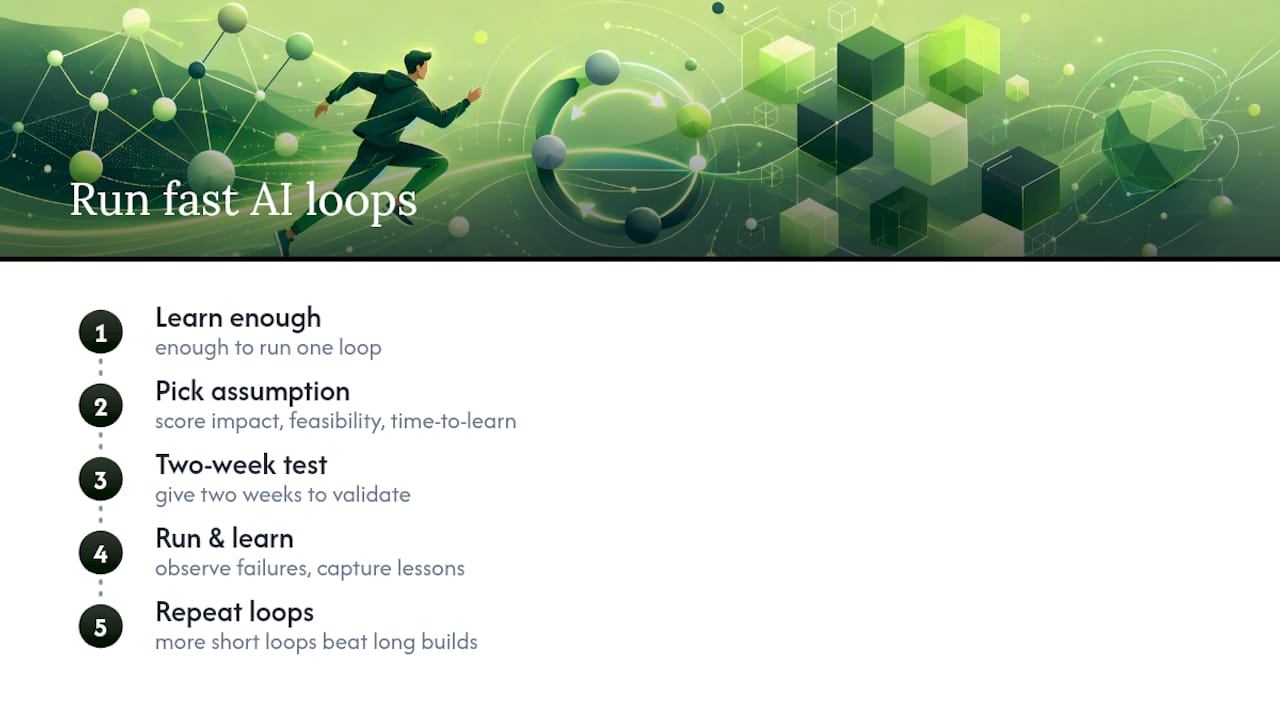
The conventional advice to “learn AI first, then build” gets the order backward for most early-stage founders. Learn enough to run one loop. Run it. Learn from what breaks. Repeat. The framework in this article isn’t theoretical, it’s designed to survive contact with a founder who has six hours a week and no patience for a semester-long course.
So here’s the actual next step: pick your shakiest assumption right now, score it on the impact, feasibility, and time-to-learn rubric above, and if it clears the bar, give yourself two weeks to test it. Not two months. Two weeks.
— Samim Safaei
Try siift and Skip the Six Disconnected Tools
Most founders piece together AI innovation from a course, a spreadsheet template, a prompt library, and a consultant call, and then spend half their week stitching those pieces together. siift replaces that stack with one guided path from idea to validated strategy: structured ideation, validation workflows built on bias-reducing prompts, and go-to-market deliverables you can actually hand to an investor or a co-founder. It won’t touch your books, your contracts, or your HR paperwork, that’s not the job. What it does is compress the loop above into days instead of weeks. If you’ve got a hypothesis sitting in a notes app right now, start validating it with siift’s startup idea validation platform and see where it actually stands.
Sources
- How AI Can Drive Innovation in Your Industry | HBS Online
- Leverage AI tools and resources for your business | Microsoft Learn
- How small businesses can leverage AI | MIT Technology Review
FAQ
What does it mean to innovate with AI as a small business?
It means using AI tools for process automation, faster market research, and rapid prototyping rather than just cost-cutting. Reporting on small-business AI use shows real gains come from weighing integration, privacy, and cost tradeoffs before committing to a tool.
How long should an AI validation pilot take?
Two to three weeks is typically enough to get a clear signal if you define your KPI and success metric before you start. Longer pilots usually signal a vague hypothesis, not a bigger opportunity.
What’s the best way to prioritize multiple AI use cases?
Score each one on impact, feasibility, and time-to-learn, a method aligned with guidance that recommends prioritizing by value, feasibility, and time-to-value before committing resources. Anything scoring low on feasibility should wait, regardless of potential impact.
Do I need a data science team to innovate with AI?
No. Most early validation and prototyping work can run on existing tools and a structured framework, which is exactly why platforms like siift exist for founders without a technical hire yet.
What’s the biggest mistake founders make when innovating with AI?
Treating AI as a shortcut to skip validation instead of a tool to speed it up. Asking the model to argue against your own hypothesis, rather than confirm it, consistently produces more useful signal than naive validation prompts.