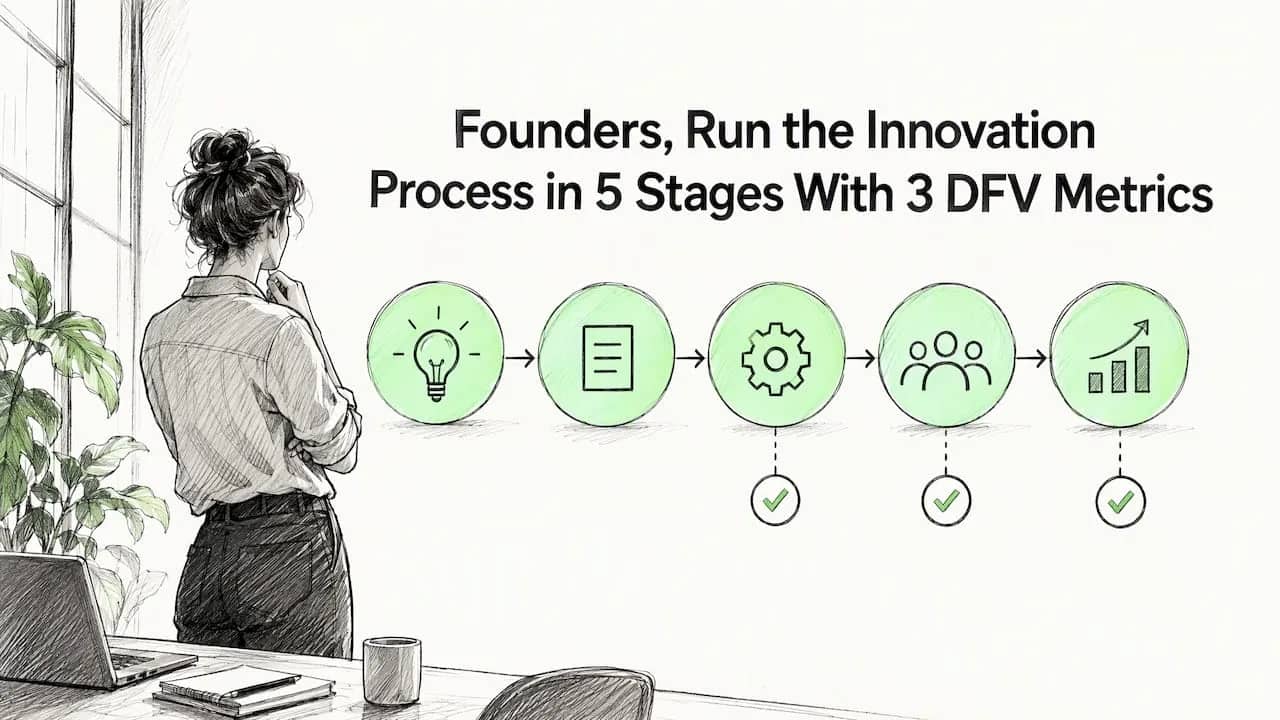

An innovation process is a staged, iterative sequence that takes a raw idea and turns it into something people pay for, and the most useful way to run one is Search, then Select, then Implement, then Capture. That rhythm keeps good ideas from dying in a drawer and keeps bad ones from eating your runway. What follows is the stage-by-stage playbook, the metrics that catch trouble early, and the traps that kill most projects before they ever reach a customer.
TL;DR:
- Skipping the mobilization stage and failing to secure senior sponsorship are among the most common reasons good ideas are never decided upon.
- Building prototypes without testing the riskiest assumptions first wastes time and resources, increasing project failure risk.
- Relying solely on outcome metrics like revenue delays course correction, so minimal signals like desirability, feasibility, and viability are crucial during development.
- Implementing fixed cadence gate reviews, cross-functional teams, and clear decision owners can significantly shorten innovation cycle times.
- Starting with a pilot and gradually scaling using core templates and shared portfolio reviews makes adopting the process practical for teams of any size.
Table of Contents
- What the Innovation Process Actually Means
- The Stage-by-Stage Playbook: From First Idea to Launch
- Governance That Makes the Process Repeatable
- Measuring Progress Before the Market Tells You
- Rolling the Process Out in Your Organization
- Common Failures and How to Fix Them Fast
- How We Think About This at siift
- Run This Process Without Guesswork
- FAQ
- Sources
What the Innovation Process Actually Means
Invention is coming up with a new idea. Innovation is getting that idea to create value, which usually means someone pays for it, adopts it, or changes behavior because of it. That distinction matters because a lot of “innovative” companies are really just good inventors who never cross the finish line.
Three models dominate how practitioners structure this work. The first is a simple Search, Select, Implement, Capture cycle (sometimes labeled SSIC), which treats innovation like a funnel you manage on repeat. The second is MIT Sloan’s five-stage model, built from interviews with executives at more than 30 U.S. and European companies: idea generation, mobilization, advocacy and screening, experimentation, and commercialization. The third is the stage-gate system described in PDMA’s structured innovation guidance, which pairs defined project phases with go/no-go decision gates and front-end concept development.
You don’t need to pick a religion here. Solo founders often run a lightweight SSIC loop. Larger teams benefit from the gate discipline of stage-gate paired with MIT’s emphasis on mobilization, the step most organizations quietly skip.

The Stage-by-Stage Playbook: From First Idea to Launch
Here’s the operational version you can actually run this week, whether you’re auditing an existing pipeline or starting fresh.
- Idea generation and opportunity discovery. Pull ideas from customer complaints, support tickets, competitor gaps, and internal brainstorming sessions, then capture each one in a one-page idea brief with problem, audience, and hypothesis. Keep the format dead simple so people actually fill it out.
- Mobilization and advocacy. Move the idea to the people who can fund or kill it, using a screening rubric with three or four weighted criteria like strategic fit, market size, and technical feasibility. MIT Sloan’s research flags this as the stage most teams skip, and skipping it is why good ideas quietly die with no decision ever made.
- Experimentation and development. Build toward a minimum delightful experience, a minimum functional test, or a minimum viable product, depending on what you’re actually trying to learn, and design each experiment to kill your riskiest assumption first, not to prove you were right.
- Commercialization and diffusion. Set explicit launch criteria before you ship: a conversion benchmark, a technical readiness checklist, and a clear owner for the handover from the project team to whoever runs it day to day.
- Post-launch review and lessons learned. Schedule a review 30 to 60 days after launch to capture what worked, what didn’t, and what you’d change, then feed those lessons back into your next idea brief.
The PDMA guidance describes this as an integrated stage-gate and portfolio system: mild screening early, tougher gates later, and a post-launch review loop that closes the circle. If you want templates for the front end specifically, our guide on practical idea generation techniques walks through exercises that feed stage one directly, and our step-by-step validation guide picks up right where stage three begins.
Governance That Makes the Process Repeatable
A stage model only works if someone actually runs the gates. That means scheduled reviews, not ad hoc hallway conversations, and a portfolio view so you’re comparing projects against each other, not evaluating them in isolation. The PDMA synthesis notes that formal project management, cross-functional teams, and senior sponsorship consistently shorten cycle time and raise success rates, largely because parallel work streams replace the slow relay-race approach of handing a project from department to department.
A few practices carry most of the weight, as highlighted by PROJECT-JTH’s practical leadership tools:
- Run gate reviews on a fixed cadence (monthly works for most teams) so projects don’t drift indefinitely without a decision.
- Build cross-functional teams from day one: a product person, an engineer, and someone customer-facing in the same room beats three separate departments passing memos.
- Give every project a senior sponsor who can unblock resources, because mobilization dies fastest when nobody senior is watching.
- Keep your portfolio review simple: a one-page grid of project, stage, risk level, and resourcing ask is enough for most early-stage teams.
Pro Tip: Put a hard time limit on every gate review, 30 minutes maximum, or it turns into a status meeting instead of a decision.
Measuring Progress Before the Market Tells You
Outcome metrics like revenue and market share arrive too late to steer a project mid-flight. That’s the gap a Desirability, Feasibility, Viability framework is built to close. Cambridge research on in-process innovation metrics proposes minimal measures, labeled MDE, MFT, and MVP, that give you a signal before you’ve spent months building something nobody wants.
A minimal desirability metric, a minimal feasibility test, and a minimal viability signal together form in-process tracking that Cambridge’s DFV framework proposes as a way to shorten the decision lag that outcome-only metrics create. In practice, that could mean a target lift in a conversion metric for desirability, a prototype clearing a defined technical test for feasibility, and a handful of customer letters of intent for viability, all tracked before a major gate rather than after launch.

Use these three signals as your gate criteria instead of vague “does this feel ready” conversations. A project that passes desirability and feasibility but has zero viability signal is telling you exactly where the risk sits.
Rolling the Process Out in Your Organization
You don’t need a six-month transformation program to get this running. The pattern that works, echoed in PDMA’s practitioner literature, is pilot, then codify, then scale.
- Pilot one value stream for 6 to 12 weeks. Pick a single product line or team, run one lightweight gate cadence, and resist the urge to roll it out everywhere at once.
- Codify your core artifacts. Build four documents: an idea brief template, a screening rubric, an experiment plan, and a gate checklist. These four cover 90% of what any team needs to run the process consistently.
- Scale with monthly portfolio reviews. Once the pilot proves the cadence works, extend it to other teams and use a shared portfolio view to decide where resources go next.
Solo founders can run a version of this solo, using a single notebook or doc for all four artifacts and a weekly fifteen-minute self-review instead of a formal gate meeting. Small teams add a rubric and a monthly check-in. Larger organizations need the full portfolio grid and a named gatekeeper for each stage. If you’re building your first idea brief and experiment plan from scratch, our AI-guided validation steps walk through a compressed one to two week version of this exact rollout.
Common Failures and How to Fix Them Fast
Most innovation projects don’t fail because the idea was bad. They fail because a process step got skipped, and nobody noticed until it was expensive to fix.
- Skipping mobilization. The idea sits with one enthusiastic champion and never reaches a decision-maker; fix it by naming a sponsor and a decision date before the idea leaves the brief stage.
- Overbuilding the prototype. Teams spend months polishing a feature before testing whether anyone wants it; fix it by defining the riskiest assumption first and building only enough to test that one thing.
- Measuring the wrong things. Tracking revenue on a project that’s still pre-launch tells you nothing; switch to desirability and feasibility signals until you actually have customers.
- Stalled projects with no clear owner. Run a 30-minute recovery review, name a single decision-maker, and either re-scope or kill the project within a week.
How We Think About This at siift
We built our view of the innovation process from watching founders get stuck at the same points over and over: no clear screening step, prototypes that answer the wrong question, metrics that only show up after the money’s already spent. Samim Safaei has written extensively on practical ideation and validation workflows for early-stage builders, and that experience shapes how we think the process should actually run day to day, not just how it looks in a textbook diagram.
— Samim Safaei
Run This Process Without Guesswork
Reading a framework is one thing. Running it while also building a product, talking to customers, and keeping the lights on is another. Our New Business OS walks you step by step through ideation, validation, and go-to-market planning, so the stage-gate discipline above happens inside one guided workspace instead of six scattered documents. If commercialization is where you’re headed next, our go-to-market planning tools pick up right where experimentation leaves off.
Plans start with a Free tier, and paid access runs from Discover at $29 per month per user up through Focus and Enterprise. Check our pricing page to see which tier fits where you are right now.
FAQ
What are the 5 stages of the innovation process?
The most cited version comes from MIT Sloan’s research: idea generation, mobilization, advocacy and screening, experimentation, and commercialization. Other models use different labels, but most cover the same ground from first idea to market launch.
What are the 7 steps of innovation?
Seven-step versions typically break the five core stages into more granular pieces, splitting idea generation into separate discovery and capture steps, or adding a distinct post-launch review stage. The exact count varies by source, but the underlying sequence, from discovery through capture of value, stays consistent.
What are the innovation processes commonly used by companies?
Companies typically use a Search, Select, Implement, Capture cycle, the MIT five-stage model, or a formal stage-gate system with go/no-go decision points between phases. Larger organizations often pair stage-gate with portfolio management to compare projects against each other, not just against an internal checklist.
What are the main types of innovation?
The Doblin Ten Types framework groups innovation into configuration, offering, and experience categories, covering everything from business model changes to product performance to customer engagement. Doblin’s analysis found that combining multiple types, not just improving the product, tends to create more durable advantage than product tweaks alone.
Does siift replace the need for a formal innovation process?
No, our platform is built to guide you through the process, not skip it. Our ideation and validation tools give you structured workflows for the front end and experimentation stages described above, so you’re running the process with less guesswork rather than around it.
Sources
- The five stages of successful innovation
- Techniques for structured innovation — NCBI Bookshelf
- Advancing in-process innovation metrics: a framework for navigating uncertainty