
TL;DR:
Seed funding is the initial capital entrepreneurs raise to develop their product and validate the market, primarily through equity or convertible securities. It differs from pre-seed and later stages, with expectations around early traction, customer signals, and deal structures like SAFEs and convertible notes. In 2026, larger seed deals are growing, emphasizing the need for real validation, diversified investor outreach, and strategic planning to navigate a more competitive funding landscape.
Seed funding is one of those terms every aspiring founder hears constantly, yet surprisingly few can define with confidence when it counts most. The moment you sit across from an investor, the fog around terms like “pre-seed,” “convertible note,” and “SAFE” can cost you real credibility and real money. According to Stripe, seed funding is the initial investment founders raise to start a business and cover early operating expenses, but what that actually means in practice, how it differs from other capital sources, and how you position yourself to get it are where most founders get stuck. This guide cuts through the noise.
Table of Contents
Key Takeaways
Point | Details |
|---|---|
Seed funding basics | Seed funding is the initial investment founders use to launch and validate their business ideas. |
Deal mechanics matter | Most seed rounds rely on convertible notes or SAFEs, which come with practical differences. |
Traction is required | Investors in 2026 want significant proof that real customers are willing to pay. |
Trends are shifting | Larger seed rounds above $10M are more common, but competition for funding is intense. |
Validation trumps valuation | Proving customer demand and real-world traction matters more than getting the highest valuation. |
What is seed funding? Core concept and why it matters
Let’s start with the foundation. Seed funding is the initial investment used to start a business and cover early operating expenses. It’s the capital that funds your first real sprint: building a product, validating a market, and proving there’s a customer willing to pay. Think of it as the financial oxygen that lets your idea breathe long enough to show investors it deserves to live.
What seed funding is not is a loan in the traditional sense, a grant you don’t repay, or a casual arrangement with friends. Mechanically, seed funding is an early-stage round where investors provide capital in exchange for equity or convertible securities. You’re selling a piece of your future company today in exchange for the cash to build that future. That distinction matters enormously.
“Seed funding is the initial capital that enables founders to move from idea to early-stage operation. It’s not just money; it’s a signal of belief in your potential.”
Here’s why understanding this properly matters for your strategy:
Equity exchange means giving up ownership. Every dollar of seed funding typically comes with a slice of your company attached. The earlier you raise, the more expensive that equity is in hindsight.
Seed is for validation, not scaling. Seed capital should fund market validation and early product development. Confusing it with growth capital leads founders to underprice their equity and run out of runway.
Seed is distinct from bootstrapping. Bootstrapping means funding growth through revenue or personal savings. Seed means outside capital, different accountability, and a new set of stakeholders.
Understanding the startup funding stages as a whole helps contextualize where seed sits. If you’re still figuring out what a startup actually is versus a small business, start there before worrying about which instrument to use. Now that we’ve established what seed funding is, let’s clarify how it fits into the broader early-stage funding landscape.
Seed vs pre-seed and beyond: What founders need to know
This is where things get genuinely confusing, and honestly, even experienced investors disagree on terminology. The important thing to understand is that seed and pre-seed are not perfectly distinct categories. Labels vary, the line between stages can blur, and different investors use the same words to mean different things. So instead of chasing perfect definitions, focus on what you’re trying to de-risk at each stage.
Here’s a practical comparison to orient you:
Stage | Typical investors | What they expect | Typical check size |
|---|---|---|---|
Pre-seed | Friends, family, angels | Just an idea and a strong team | $50K to $500K |
Seed | Angels, micro-VCs, seed funds | Early traction, prototype, or customer signals | $500K to $5M |
Series A | Institutional VCs | Revenue, repeatable growth, product-market fit | $5M to $20M+ |
Grants/Accelerators | Government, nonprofits | Sector fit, social impact, innovation criteria | Variable, often $25K to $500K |
One often-overlooked category is non-dilutive funding. Non-dilutive seed-like funding can exist through grants and programs, but most conventional seed funding discussions refer to dilutive startup capital. Translation: you’ll give up equity. Grants don’t require that, which sounds great until you realize how competitive and slow they often are.
Pro Tip: If you’re at the very earliest stage with no product and no customers, skip calling it a “seed round” in your outreach. Frame it as a pre-seed or a friends-and-family round, and be honest about where you are. Investors respect founders who know exactly what stage they’re at.
Some tactical distinctions that actually matter:
Pre-seed rounds rarely involve formal term sheets or lead investors. Seed rounds almost always do.
Startup accelerator programs often sit between pre-seed and seed, providing small checks plus mentorship for equity.
If you’re considering bootstrapping as an alternative, know that some founders deliberately bootstrap through early validation to negotiate better seed terms later.
With these definitions clarified, understanding how seed funding gets structured helps you navigate investor conversations more confidently.
How seed rounds work: Instruments and deal mechanics
Let’s get into the mechanics, because this is where deals are won or lost in the fine print. Most seed rounds use SAFEs or convertible notes rather than priced equity rounds. A priced round means you and the investor agree on a valuation today and issue shares at that price. At seed stage, that’s often premature and expensive to negotiate.
Here’s a quick breakdown of the most common instruments:
SAFE (Simple Agreement for Future Equity): Created by Y Combinator, this is now the dominant seed instrument. A SAFE converts into equity at your next priced round, usually at a discount or according to a valuation cap. No interest. No maturity date. Straightforward.
Convertible note: This is a short-term debt instrument that converts to equity at a future financing round. Unlike a SAFE, convertible notes include debt concepts like interest rates and a maturity date, which can create founder pressure or negotiation dynamics that SAFEs may avoid.
Priced equity round: You set a valuation, issue shares directly, and bring in a lead investor. This is more common at Series A but occasionally happens at seed, especially for larger rounds.
Instrument | Interest? | Maturity date? | Complexity | Best for |
|---|---|---|---|---|
SAFE | No | No | Low | Early seed, speed |
Convertible note | Yes | Yes | Medium | Founders with existing debt investors |
Priced equity | N/A | N/A | High | Larger rounds, institutional lead |
Pro Tip: If an investor insists on a convertible note with a short maturity date (say, 12 to 18 months), think carefully. If your next round takes longer than expected, that note matures and you may face pressure to repay or renegotiate under duress. SAFEs sidestep that stress entirely.
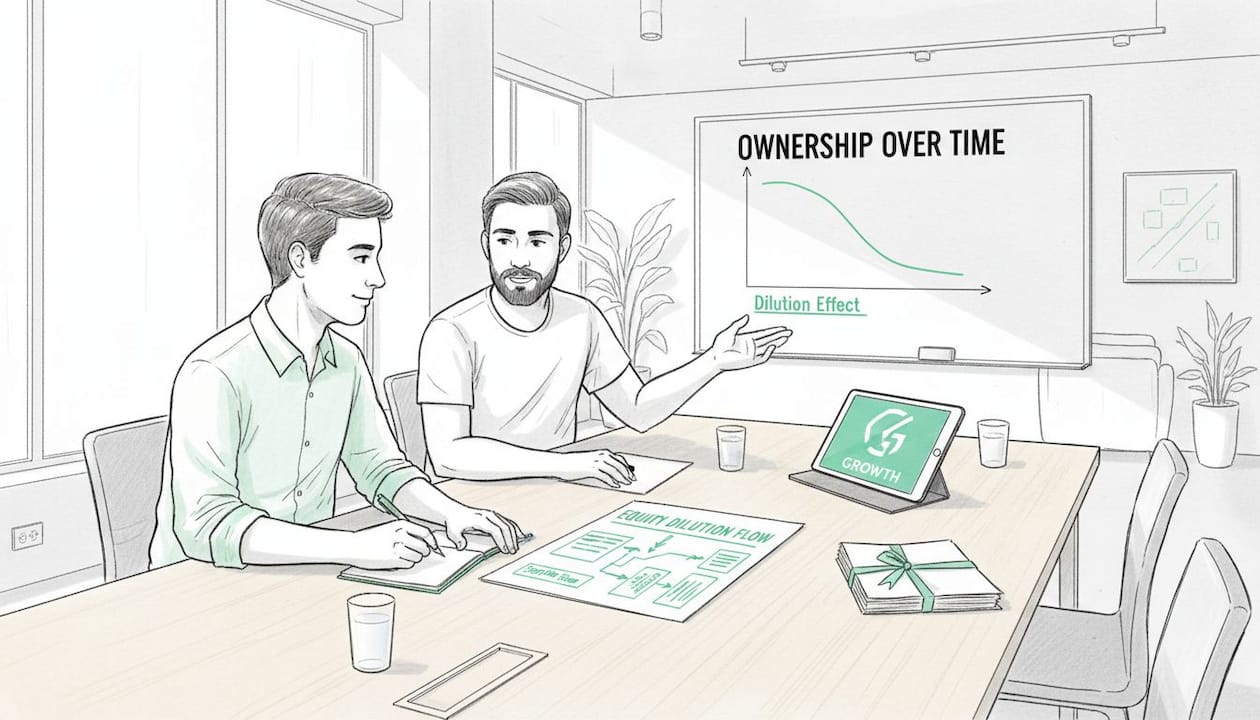
A key concept to understand is dilution: every time you issue new equity, your ownership percentage shrinks. This isn’t inherently bad. A smaller slice of a much bigger pie is often worth far more. But dilution becomes dangerous when you give up too much equity too early at a valuation that doesn’t reflect your real progress. Pair your pitch deck preparation with a clear model of how each funding round affects your cap table. Knowing this before you sign is empowering. Discovering it after is painful.
Knowing how deals are structured, let’s focus on what you should have in place before approaching seed investors.
What makes a startup ‘seed-ready’?
This is the question that keeps founders up at night: “Am I ready to raise?” And the honest answer is that most founders ask too late or too early. A typical seed-ready profile involves early traction and customer demand signals. Seed investors look for evidence that customers will pay for what you built, not just that you can build it. That distinction is everything.
What does “early traction” actually look like in 2026? Here’s what investors consistently respond to:
Active users: Even a few hundred engaged users who return weekly is more powerful than thousands of sign-ups who never came back.
Revenue: Even $1K to $5K monthly recurring revenue signals that real humans value what you’ve built enough to pay for it.
Customer interviews: Documented proof that you’ve spoken to 50 or more potential customers and understand their pain deeply.
Waitlist or pre-orders: Demand signals that exist before your product is fully built.
Retention metrics: Investors love to see that customers stay, not just that they arrive.
Seed funding is typically used to validate an idea and develop it into an operational business, often after early product demo readiness and early customer signals. That means investors expect you to have something working, even if it’s imperfect.
Pro Tip: Before approaching investors, spend 60 days focused purely on getting traction for your startup. Even modest but real traction changes investor conversations from “interesting idea” to “let’s talk terms.” You can also use this period to sharpen how you show traction to investors as a compelling narrative, not just raw data.
The benchmark is shifting too. As seed rounds grow larger, investors are applying standards that used to belong to Series A conversations. If you’re getting your startup off the ground right now, know that your path to seed-readiness may require more runway-building than it did five years ago. The playbook for achieving startup traction systematically has never mattered more.
Now that you know what seed investors are looking for, let’s see how the size and structure of seed deals is changing and what that means for your raise.
The 2026 seed funding landscape: Trends and real-world deal sizes
The seed funding market in 2025 and 2026 has gone through a meaningful shift, and founders who don’t account for it will calibrate their expectations badly. In 2025, more seed dollars went into larger deals above $10M, while the total number of deals below $10M actually fell. This is a bifurcation of the market: a few well-positioned startups are raising big, while the volume of smaller rounds has contracted.
What does that mean practically?
Deal size | Trend in 2025 to 2026 | What it signals for founders |
|---|---|---|
Under $1M | Declining | Harder to get institutional attention |
$1M to $5M | Stable but competitive | Requires clear traction and differentiation |
$5M to $10M | Moderately growing | Needs strong team and early product-market fit signals |
$10M+ | Fastest-growing segment | Reserved for breakout startups with proven demand |
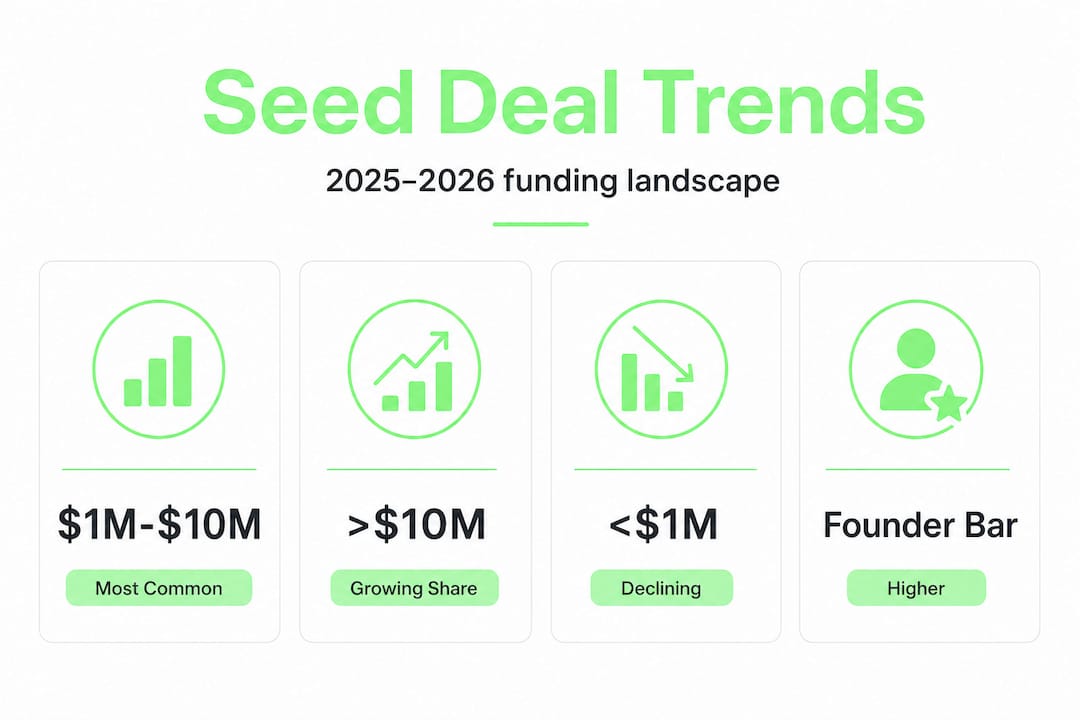
The implications are real. If you’re targeting a $500K seed round, know that many traditional seed funds have shifted their minimum check size upward. You may find more success with angel syndicates, micro-VCs, or hybrid approaches that blend small institutional capital with individual angels.
Here’s what this bifurcated market means for your strategy:
Traction requirements are rising. What used to get you a $2M seed round now might only get you a conversation.
Your fundraising target must match your traction level. Overreaching on valuation or raise size without the metrics to back it up will stall your process fast.
Diversify your investor pipeline. Don’t rely on a single VC firm. Mix angels, funds, and accelerators to build momentum and create social proof.
This is where the reality of 2026 fundraising gets clarifying rather than discouraging. The bar is higher, yes. But so is the quality of the startups breaking through. If you build real customer demand and demonstrate it clearly, you will find capital.
What most guides miss about seed funding in 2026
Here’s our honest take, the perspective you won’t read in the generic “how to raise a seed round” listicles: most founders are optimizing for the wrong thing. They spend months obsessing over their pitch deck, their narrative arc, and their slide design. All of that matters, of course. But in this market, investors are not buying stories alone. They’re buying evidence.
Raising seed today is less about theoretical market size and more about showing you can reliably acquire and keep customers, even in a risk-averse landscape. The founders who are closing rounds in 2026 aren’t necessarily the most polished presenters. They’re the ones who can open their analytics dashboard and show real numbers that trend upward.
There’s another uncomfortable truth about convertible instruments that most guides gloss over. If you raise on a convertible note with an 18-month maturity and your next round takes two years, you face a negotiation under time pressure when you have the least leverage. SAFEs solve that problem. But even with SAFEs, founders need to understand what their valuation cap implies for future dilution. We’ve seen founders celebrate their seed close only to realize later that their cap table made Series A term sheets nearly impossible to structure. Don’t let that be you.
The deeper insight is this: your go-to-market clarity and your ability to show early customer acquisition signals will open more real doors than a perfect investment readiness guide or pitch deck alone. Validation is your superpower. Use it. Obsess over it before you obsess over your deck.
To make the most of this advice, let’s connect you with more actionable resources to help you start your journey.
Start your seed funding journey with Siift.ai
Getting seed-ready is a process, not a moment. And doing it systematically gives you a massive edge over founders who wing it. At Siift.ai, we built a platform specifically to help founders like you derisk your business from day one, filtering out the biases, blindspots, and uncertainty that stall so many promising startups before they ever reach an investor’s inbox. Siift’s Agentic AI walks you step by step through ideation, validation, and go-to-market strategy, so by the time you’re sitting across from a seed investor, your traction story is real, your numbers are solid, and your confidence is earned. Start your seed journey with the tools that actually move you forward.
Frequently asked questions
How much seed funding do most startups raise in 2026?
Most startups are targeting $1M to $10M seed rounds, but the largest share of seed dollars in 2025 and 2026 is being concentrated in deals above $10M, reflecting rising traction requirements.
Is seed funding always dilutive?
Most seed funding is dilutive because investors receive equity or convertible securities, but non-dilutive options like grants exist, though they are competitive and often slower to access.
Do I need a working product to raise seed funding?
Most investors expect at least a working product and early validation signals because seed capital is typically used after early demo readiness and initial customer demand has been demonstrated.
What’s the difference between a SAFE and a convertible note?
SAFEs convert to equity with no interest or maturity date, while convertible notes accrue interest and must convert or be repaid by a set deadline, which can pressure founders during slow fundraising periods.
Can you get seed funding without giving up equity?
While possible through grants and select accelerator programs, most seed capital requires selling equity or issuing convertible instruments, making non-dilutive seed funding the exception rather than the norm.