

Entrepreneurs identify opportunities, build businesses around them, and then do whatever it takes to keep those businesses alive. That’s the short version. The longer version involves strategy, customer discovery, cash flow management, sales, hiring, legal basics, and a surprising amount of crisis management on any given Tuesday. Stanford Online defines entrepreneurship as individuals or small teams creating a new business while assuming most of the risk. Investopedia adds that successful entrepreneurs combine resources to create goods or services that produce profit, jobs, and productivity gains. BDC broadens the picture further: an entrepreneur can be a small-business owner-manager with strategic control, not just a Silicon Valley founder chasing a billion-dollar exit.
The bottom line: Entrepreneurship is not one job. It’s a rotating set of jobs that demands both high-level vision and ground-level execution, often from the same person, on the same day.
Table of Contents
- What does entrepreneurship really mean?
- What entrepreneurs actually do day-to-day
- What skills do successful entrepreneurs need?
- What types of entrepreneurs are there?
- How do you move from an idea to a launched business?
- Startup vs. small business: which path is right for you?
- What obstacles do entrepreneurs commonly face?
- Do entrepreneurs make money?
- Is entrepreneurship the right fit for you?
- Where do entrepreneurs operate?
- How do modern tools and AI change the founder’s job?
- Key Takeaways
- The real cost of going it alone
- siift helps founders move faster with less guesswork
- Useful sources and further reading
- FAQ
What does entrepreneurship really mean?
Most people hear “entrepreneur” and picture a hoodie-wearing founder pitching VCs. The reality is messier and more interesting. Entrepreneurship, as both Stanford and BDC frame it, is a mindset first: the ability to spot a market gap, believe it’s worth solving, and then commit resources to solving it under conditions of real uncertainty.
That’s different from simply owning a business. A franchise owner follows a proven playbook. An entrepreneur writes the playbook, tests it, tears it up, and writes a better one. Investopedia is clear that the “risk-taker” label is misleading. The best founders are calculated risk-takers who validate ideas before betting the farm.
Pro Tip: Before you commit time or money to an idea, spend two weeks talking to 20 potential customers. If you can’t find enough people willing to have conversations about the problem, that’s your first data point.
What entrepreneurs actually do day-to-day
Here’s where most explainers go soft. The day-to-day of a founder is not glamorous. According to CareerExplorer, core responsibilities span budgeting, cash flow, market research, product design, operations, and sales. In practice, that looks like this:
- Strategy and vision: Setting quarterly priorities, deciding what not to build, and keeping the team aligned on the mission.
- Customer discovery: Talking to users, reading support tickets, running surveys, and translating feedback into product decisions.
- Product development: Defining features, working with designers or engineers, and managing the build-test-iterate cycle.
- Finance and cash flow: Tracking burn rate, managing invoices, forecasting runway, and deciding when to raise or cut costs.
- Sales and marketing: Closing early customers, writing copy, running ads, and building the first repeatable sales process.
- Operations: Vendor management, tools, processes, and keeping the machine running without the founder touching every lever.
- Hiring and legal basics: Writing job descriptions, interviewing, onboarding, and staying compliant with employment and business regulations.
The mix shifts over time. In month one, you’re doing all of it. By month eighteen, if things go well, you’re delegating operations and finance to specialists while focusing on strategy, fundraising, and key hires. The tyranny of the urgent is real: administrative fires and crisis management eat the calendar, and vision work gets squeezed into early mornings or late nights.
What skills do successful entrepreneurs need?
Five skills separate founders who persist from those who quit. None of them are fixed traits you either have or don’t.

Decision-making under uncertainty is the core skill. You will rarely have complete information. Practicing structured decision frameworks (writing out assumptions, assigning rough probabilities, identifying the reversible vs. irreversible choices) builds this muscle faster than any book.
Resilience is not about being emotionally bulletproof. It’s about recovering quickly. Founders who maintain healthy habits and a small support network tend to recover from setbacks more effectively.
Customer empathy means genuinely caring about the problem your customer has, not the solution you’ve already built. The fastest way to develop it: spend an hour a week on customer calls, even after you think you know the answer.
Financial literacy doesn’t require a CPA. It requires understanding your unit economics, knowing your burn rate, and being able to read a basic P&L. Resources like the SBA’s business guide cover the fundamentals clearly.
Communication compounds everything else. Founders who write and speak clearly close more customers, attract better talent, and raise capital more efficiently.
Pro Tip: You don’t need to be the expert in everything. Build a small circle of trusted advisors: a lawyer, an accountant, and one experienced founder who’s been where you’re going. That trusted-advisor network is one of the highest-leverage, lowest-cost risk-reduction moves you can make.
What types of entrepreneurs are there?
Entrepreneurship is not one-size-fits-all. Knowing which profile fits you saves years of friction.
- Startup founder: Building for rapid, scalable growth, usually with VC or angel funding. High risk, high upside, long timeline to profitability. Think early-stage SaaS or biotech.
- Small-business owner: Running a profitable, stable business with strategic control. A local restaurant, a law firm, a plumbing company. Growth is steady rather than exponential.
- Lifestyle entrepreneur: Building a business designed around personal freedom rather than scale. A freelance designer who caps clients at ten, or a travel blogger monetizing through sponsorships.
- Social entrepreneur: Solving a social or environmental problem through a business model. Revenue is a means to mission, not the mission itself. Think TOMS or Patagonia’s early model.
- Serial entrepreneur: Builds one company, exits or winds it down, then starts another. Thrives on the early-stage chaos and gets bored once the business stabilizes.
- Intrapreneur: Operates inside a large organization, pursuing new ideas with the company’s resources and absorbing less personal financial risk, but with less autonomy. Stanford notes that large firms actively cultivate intrapreneurship to replicate startup energy without spinning off new entities.
Your goals and risk tolerance are the compass here. If you need income within six months, a lifestyle or small-business model is more realistic than a VC-backed startup. If you’re energized by ambiguity and can survive on ramen for two years, the startup path might fit.
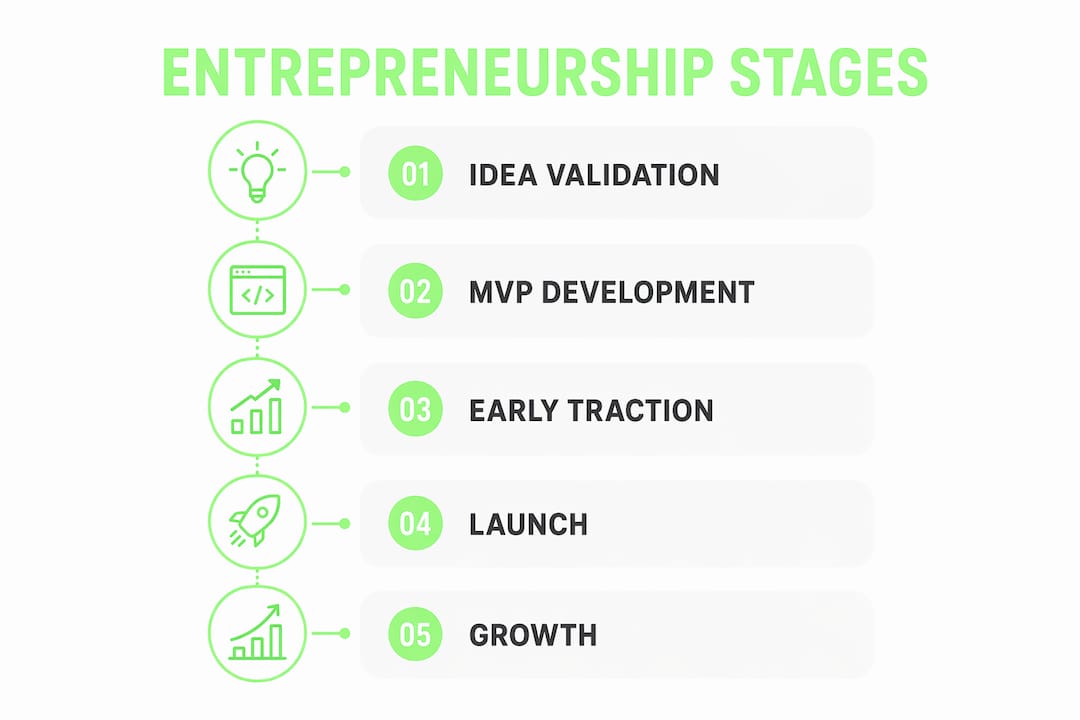
How do you move from an idea to a launched business?
The sequence matters more than the speed. Rushing past validation is the single most common reason early businesses fail.
Phase 1: Validation (weeks 1–8). Before writing a line of code or signing a lease, confirm that real people have the problem you think they have and that they’d pay to solve it. Conduct customer discovery interviews, build a simple landing page, and measure whether strangers click “sign up” or bounce. Your minimum deliverable: ten conversations with potential customers and at least one person who says “I’d pay for this right now.”

Phase 2: MVP (months 2–5). Build the smallest version of your product that delivers the core value. Not the full vision. The slice of it that solves the validated problem. Measure usage, not compliments. If users don’t return without prompting, the MVP isn’t working yet.
Phase 3: Early traction (months 4–9). Traction is evidence that the market wants what you’re selling. It could be revenue, retention, or referrals, but it must be measurable. This is also where most founders encounter their first pivot decision: market signals often contradict the original assumptions, and the founders who survive are the ones who listen rather than defend.
Phase 4: Launch (months 6–12). “Launch” is less a moment than a milestone. You’ve validated, built, iterated, and now you’re scaling distribution. A data-driven approach to tracking your early metrics keeps you honest about what’s actually working.
Startup vs. small business: which path is right for you?
These two models get conflated constantly, and the confusion leads to mismatched expectations on funding, growth, and daily work.
| Dimension | Startup | Small Business |
|---|---|---|
| Primary goal | Rapid, scalable growth | Steady profitability |
| Funding | VC, angels, seed rounds | Personal savings, SBA loans, bank credit |
| Team structure | Lean, generalist, equity-compensated | Functional roles, salary-based |
| Revenue timeline | Often 12 months to meaningful revenue | Typically profitable within year one |
| Exit expectation | Acquisition or IPO | Owner-operated long-term or local sale |
| Risk level | Very high | Moderate |
Take hiring as a concrete example. A startup founder hires a generalist engineer who can wear five hats and accepts equity in lieu of market salary. A small-business owner hires a bookkeeper at a fixed hourly rate because the books need to be clean and the role is well-defined. Same task, completely different logic.
The honest question to ask yourself: do you want to build something that could be worth $50 million in ten years, or something that pays you well and gives you control of your time in three? Neither answer is wrong. But they lead to very different decisions on day one.
What obstacles do entrepreneurs commonly face?
Every founder hits turbulence. The ones who survive know which signals to take seriously.
- Cash flow problems: The most common killer. Revenue is lumpy; expenses are not. Mitigation: maintain at least three months of operating runway at all times and review cash flow weekly, not monthly.
- Product-market mismatch: Building something nobody wants badly enough to pay for. Red flag: users say they love it but won’t refer anyone. Fix: go back to customer discovery before adding features.
- Hiring mistakes: A bad early hire costs more than their salary in lost momentum and team morale. Take longer to hire, move faster to part ways when it’s clearly not working.
- Founder burnout: Not a personality flaw. A structural problem. Build recovery time into the calendar the same way you’d schedule a board meeting.
- Regulatory missteps: Skipping business registration, misclassifying contractors, or ignoring industry-specific licenses. The IRS checklist and SBA’s 10-step guide cover the legal basics every founder needs to handle before launch.
- Fundraising reality check: Most startups don’t raise VC. Most don’t need to. Alternatives include revenue-based financing, SBA loans, angel networks, and seed-strapping (growing on early customer revenue). Explore your risk management options before assuming equity is the only path.
Pro Tip: When a problem feels urgent, ask whether it’s a symptom or a cause. Founders who fix symptoms (running another ad campaign when the real issue is churn) burn cash without moving the needle.
Do entrepreneurs make money?
Yes, but rarely on the timeline they expect. The honest answer depends on the business model and the stage.
Common revenue models include product sales, subscriptions, service retainers, marketplace fees, licensing, and B2B contracts. Each has a different cash flow profile. A subscription model builds predictable monthly recurring revenue but takes longer to reach meaningful scale. A services business can be profitable in month one but hits a ceiling tied to the founder’s hours.
On founder compensation: most early-stage founders pay themselves below market rate for the first one to three years. The SBA’s guidance recommends building founder salary into the financial plan from day one, even if it’s modest, to avoid the trap of treating the business as a personal ATM or burning out because you’re working for free. A useful benchmark: pay yourself enough to cover your personal runway without stress, and revisit the number every six months as revenue grows.
For a deeper look at choosing the right revenue model early, siift’s guide on business model strategy walks through the tradeoffs for first-time founders.
Is entrepreneurship the right fit for you?
Honest self-assessment beats enthusiasm every time. Work through these questions before committing:
- Can you cover your personal expenses for at least 12 months without income from the business?
- Are you comfortable making decisions with incomplete information and living with the outcome?
- Do you have (or can you quickly build) a working knowledge of your target market?
- Can you handle rejection from customers, investors, and partners without losing momentum?
- Are you willing to do unglamorous work (cold calls, bookkeeping, customer support) before you can hire for it?
- Do you have a support system (partner, family, community) that understands the demands of building a business?
- Are you genuinely curious about the problem you’re solving, not just excited about the idea of being a founder?
If you answered yes to 5 or more: You’re likely ready to start validating an idea now. Focus on customer discovery first.
If you answered yes to 3 or 4: Spend six months in an adjacent role. Join an early-stage startup, freelance in your target industry, or take on a side project that forces you to sell something.
If you answered yes to fewer than 3: Intrapreneurship or freelancing might be a better starting point. Both build the skills and financial cushion that make full entrepreneurship more survivable later.
Where do entrepreneurs operate?
Entrepreneurship shows up in every industry. The day-to-day looks radically different depending on the sector.
Tech: A SaaS founder’s week centers on product roadmap decisions, user interviews, and investor updates. Validation often happens through a landing page and a waitlist before a single line of code is written.
Food and beverage: A restaurant founder spends the first year on supplier relationships, health code compliance, staff scheduling, and margin management. Validation means a pop-up or farmers market booth, not a full buildout.
Social enterprise: A founder building a workforce training nonprofit structures revenue around grants, government contracts, and corporate partnerships. Validation looks like a pilot cohort with measurable employment outcomes.
Industry shapes everything: the validation tactic, the funding source, the regulatory burden, and the timeline to profitability. The common thread is the same across all three: talk to the customer before you build, measure what matters, and stay solvent long enough to learn.
How do modern tools and AI change the founder’s job?
AI doesn’t replace the founder’s judgment. It compresses the time between question and answer. That’s genuinely useful in the early stages when speed of learning is the competitive advantage.
Practical use cases include market research automation (summarizing competitor positioning, identifying underserved segments), idea prioritization (stress-testing assumptions against market data), and go-to-market planning (drafting messaging frameworks, mapping distribution channels). Tools like siift’s Business OS guide founders step-by-step through ideation, validation, and GTM planning in a structured way that generic AI tools don’t. The difference is the system: siift filters out the biases and blind spots that solo founders are most susceptible to, rather than just answering whatever question you happen to type.
The limits are real, though. AI won’t replace a customer call, a lawyer’s review of your contracts, or an accountant’s read of your tax exposure. Use it to accelerate the thinking, not to skip the human judgment. And if you’re using AI tools to work on sensitive business ideas, non-disclosing AI options protect your IP while you build.
Pro Tip: Use AI to pressure-test your assumptions before your first customer conversation, not instead of it. Ask it to argue the strongest case against your idea. The objections it surfaces are usually the ones your first ten customers will raise.
Key Takeaways
Entrepreneurs are opportunity-seekers, risk managers, and relentless learners who build businesses by combining vision with the daily discipline to execute, adapt, and survive.
| Point | Details |
|---|---|
| Mindset before model | Entrepreneurship is a calculated, opportunity-driven mindset, not just a business structure. |
| Responsibilities are broad | Founders handle strategy, sales, finance, product, and operations, often simultaneously in the early stage. |
| Validation comes first | Talk to potential customers before building anything; it’s the fastest way to de-risk an idea. |
| Startup vs. small business | These paths differ in goals, funding, and daily work; choose the one that matches your ambition and risk tolerance. |
| siift accelerates the process | siift’s Business OS guides founders through ideation, validation, and GTM planning with structure that generic AI tools lack. |
The real cost of going it alone
Most first-time founders underestimate one thing: how much time they’ll spend figuring out what they don’t know. Not the hard skills, those are learnable. The blind spots. The assumptions baked so deep into your thinking that you don’t even know to question them. That’s where most early businesses quietly die, not from lack of effort, but from lack of the right feedback at the right moment.
The founders I’ve seen navigate this well share a common habit: they build feedback loops early and deliberately. They talk to customers before they’re ready. They share half-baked ideas with advisors who’ll push back. They treat every assumption as a hypothesis, not a fact. That posture, more than any skill or trait, is what separates the founders who figure it out from the ones who run out of runway still waiting for certainty.
Entrepreneurship is demanding in ways that are hard to describe until you’re in it. But it’s also one of the few paths where the work you do compounds directly into something you own. That’s worth something. Start with honesty about where you are, build the feedback loops, and don’t wait until you feel ready.
siift helps founders move faster with less guesswork
Most founders spend their first six months reinventing wheels that already exist: validation frameworks, GTM templates, positioning exercises. siift’s New Business OS gives you a structured, AI-guided path through ideation, validation, and go-to-market planning so you spend that time learning from the market instead of figuring out where to start.
It’s built specifically for first-time founders and early-stage entrepreneurs who need clarity and a repeatable process, not a blank chat window. siift filters out the biases and blind spots that derail solo founders, and guides you toward product-market fit faster than working from scratch with generic tools.
Ready to turn your idea into a validated strategy? Start your GTM plan with siift today.
Useful sources and further reading
- 10 Steps to Start Your Business | U.S. Small Business Administration — The definitive U.S. government checklist covering legal structure, registration, EIN, licenses, and funding.
- What Is an Entrepreneur? | Investopedia — Clear definition, risk framing, and overview of how entrepreneurs create economic value.
- What Is Entrepreneurship? | Stanford Online — Stanford’s framing of entrepreneurship as a mindset and the distinction between founders and intrapreneurs.
- What Is an Entrepreneur? | BDC — Practical, owner-manager perspective that broadens the definition beyond tech startups.
- Checklist for Starting a Business | IRS — Federal tax and compliance requirements every U.S. founder needs to address before launch.
- Guide to Starting a Business | Bank of America — Practical financial and operational guidance, including the case for building an advisor network.
- Market Research Basics: Validate and Grow Your Startup | siift — Step-by-step customer discovery and validation guide for early-stage founders.
- Business Model Strategy for First-Time Founders | siift — Revenue model frameworks and early monetization decisions explained for new founders.
- Navigating Startup Risk | siift — Common failure modes and risk mitigation tactics for founders at every stage.
FAQ
What do entrepreneurs do on a daily basis?
Entrepreneurs manage a rotating mix of strategy, customer conversations, product decisions, sales, and operations. In the early stage, most founders handle all of these simultaneously before delegating to specialists as the business grows.
What are the 7 types of entrepreneurs?
Common types include startup founders, small-business owners, lifestyle entrepreneurs, social entrepreneurs, serial entrepreneurs, intrapreneurs, and scalable-startup founders. Each differs in goals, risk tolerance, and funding approach.
What skills do you need to be an entrepreneur?
The five most critical skills are decision-making under uncertainty, resilience, customer empathy, financial literacy, and clear communication. All five are learnable through deliberate practice, mentorship, and real-world customer interaction.
Do entrepreneurs make money?
Yes, though the timeline varies by business model. Service businesses can be profitable in the first year; product and SaaS startups often take one to three years before founders draw a meaningful salary. Building founder compensation into the financial plan from day one is the recommended approach.
What jobs do entrepreneurs do?
Entrepreneurs function as strategist, salesperson, product manager, financial controller, marketer, and operations lead, often all at once in the early stage. The role shifts toward leadership and delegation as the team grows and the business stabilizes.