
TL;DR:
- Strategic word of mouth builds trust, lowers customer acquisition costs, and creates scalable growth.
- Authentic WOM depends on genuine product value and positive customer experiences, not just incentives.
- Monitoring dark social channels and activating satisfied customers amplify organic brand advocacy.
Word of mouth is not a lucky accident. It is one of the most powerful, scalable, and cost-efficient marketing forces available to any founder, and the best part is that you can build it deliberately. Most early-stage entrepreneurs treat word of mouth as something that just happens when customers are happy. That framing leaves enormous growth on the table. The truth is that strategic word of mouth, when built on a foundation of genuine product value, can dramatically lower your customer acquisition costs, accelerate trust, and create the kind of compounding momentum that paid ads simply cannot replicate. Let’s break down exactly how it works and how you can engineer it.
Table of Contents
- Understanding word of mouth marketing
- How word of mouth multiplies your marketing efforts
- Nuances, pitfalls, and authenticity in word of mouth
- Practical strategies to spark word of mouth for your brand
- What experts miss: Word of mouth is amplified, not engineered
- Leverage advanced marketing insights with siift
- Frequently asked questions
Key Takeaways
| Point | Details |
|---|---|
| Product-market fit is critical | Word-of-mouth marketing succeeds when your product truly satisfies a real customer need. |
| Amplify through social currency | Use exclusivity and incentives wisely in referral programs to encourage authentic sharing. |
| Monitor and respond quickly | Negative feedback spreads faster than positive—address issues openly for trust. |
| Use easy sharing tools | Making it simple for customers to refer multiplies your reach and effectiveness. |
| Track hidden WOM via dark social | Keep an eye on private sharing channels like WhatsApp to measure real impact. |
Understanding word of mouth marketing
Word of mouth marketing, often called WOM, is the process by which customers voluntarily share their experiences with a product or service to others, influencing purchase decisions without paid advertising. Simple enough. But the nuances matter enormously when you are building a brand from scratch.
There are three distinct types of word of mouth worth knowing:
- Organic advocacy: Customers share spontaneously because their experience genuinely moved them. No prompting, no reward.
- Traditional referrals: A structured exchange where customers recommend your product in return for an incentive, a discount, or a reward.
- Amplified WOM: Deliberate campaigns or tools designed to encourage sharing at scale, often through social platforms or referral programs.
Here is where most founders get tripped up. They confuse satisfaction with advocacy. A satisfied customer will not complain. An advocate will actively recruit. The gap between the two is significant, and bridging it requires specific mechanisms. Simply delivering a good product is not enough to turn customers into vocal champions.
“Word of mouth works best when a business has already achieved product-market fit, not as a standalone growth tactic applied too early.” WOM: Word of mouth marketing unpacked
This is a critical insight. If your product has not yet found its audience or solved a pressing problem in a compelling way, no referral script or incentive program will save you. Understanding product-market fit impact is therefore the prerequisite, not the afterthought, when designing any word of mouth strategy.
Think of WOM as an amplifier, not a generator. It takes the signal your product already creates and broadcasts it louder. If the underlying signal is weak, the noise gets amplified too, and that is a dangerous place to be. Focus first on creating an experience worth talking about. Then build the systems to make talking easy.
How word of mouth multiplies your marketing efforts
Let’s get into the numbers, because the business case for WOM is genuinely compelling.
Referred customers consistently show lower customer acquisition costs (CAC), higher lifetime value, and stronger brand loyalty than those acquired through paid channels. Why? Because trust is pre-loaded. When a friend recommends a product, the skepticism that would otherwise slow down a purchase decision is already dissolved.
| Metric | Paid acquisition | Word of mouth referral |
|---|---|---|
| Customer acquisition cost | High | Significantly lower |
| Conversion rate | Moderate | Up to 4x higher |
| Customer lifetime value | Baseline | 16-25% above average |
| Trust level at first touch | Low | High (pre-established) |
The WOM multiplier effect is real: referral-acquired users lower your overall CAC by distributing the cost of acquisition across a larger organic base. Every dollar you spend on a paid channel works harder when a portion of your new customers are arriving through warm referrals.
The compounding dynamic is what makes this so exciting. Paid marketing is linear. You spend money, you get traffic, you stop spending, and traffic stops. Word of mouth is non-linear. One delighted customer tells three friends. Two of those three become customers. Each of them tells two more. The math compounds in your favor over time, especially when you have built the right AI tools for market fit into your growth strategy.

Social currency is another concept worth understanding here. People share things that make them look good, feel smart, or feel like insiders. When your referral program or your product experience taps into this, customers become motivated to share not just because they get a reward, but because sharing your product reflects positively on them. Build that into your business referrals guide.
Key benefits of a WOM-first acquisition approach:
- Shorter sales cycles due to pre-existing trust
- Higher net promoter scores over time
- Organic SEO benefits from brand mentions and earned media
- Reduced dependency on volatile paid advertising platforms
Nuances, pitfalls, and authenticity in word of mouth
Here is the part most growth guides skip: word of mouth is a double-edged tool. The same dynamics that accelerate positive sharing also accelerate negative sharing, and bad news travels faster than good.
Research consistently shows that negative WOM spreads faster, and over-incentivizing referrals can erode the authenticity that makes the whole mechanism work. If customers feel like they are being paid to fake enthusiasm, their referrals carry less weight, and savvy consumers notice.
Comparing WOM approaches:
| Approach | Strength | Risk |
|---|---|---|
| Organic advocacy | High authenticity | Hard to scale |
| Incentivized referral | Scalable, trackable | Can feel transactional |
| Influencer seeding | Wide reach | Low trust if misaligned |
| Community-led sharing | Deep engagement | Slow to build |
So how do you navigate this? A few principles:
- Respond publicly and quickly to negative feedback. A visible, empathetic response to a complaint often converts skeptics into believers more effectively than positive reviews.
- Keep incentives modest and meaningful. A small, thoughtful reward signals appreciation. A large cash payout signals desperation.
- Make sharing frictionless. The easier you make it to share, the more organic it feels, even within a structured program.
- Monitor dark social. Dark social refers to private sharing channels like WhatsApp, Slack groups, or direct messages, where referrals happen invisibly. This is where a large portion of actual word of mouth occurs, and most founders are not tracking it at all.
Pro Tip: Use unique referral links or discount codes per customer to estimate dark social activity. When someone claims a code you cannot trace to a public post, it likely came from a private channel.
For founders still validating product-market fit, this is especially important. You need to know what customers are actually saying in private, not just what they post publicly. That signal will shape your product roadmap as much as any survey. And when you are actively working on startup traction tips, understanding where referrals originate is essential intelligence.
Practical strategies to spark word of mouth for your brand
Now for the part you have been waiting for. Here is a practical framework you can implement starting this week.
Build referral programs around social currency, not just cash. Customers share things that make them look knowledgeable, generous, or ahead of the curve. Exclusive early access, limited edition features, or a “founding member” status all tap into this. As noted in the research, you should use social currency in your referral scripts and actively monitor dark social channels to understand where your organic buzz is actually happening.
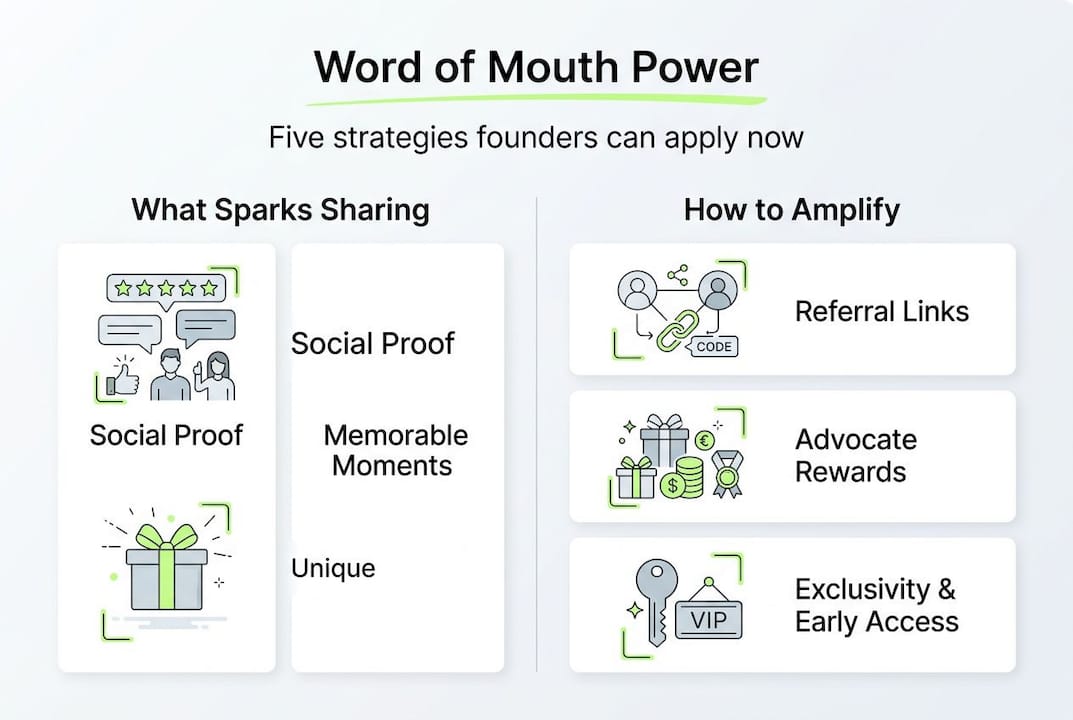
Design your customer experience for memorable moments. The moment a customer first succeeds with your product is your best opportunity to prompt a share. A well-timed “tell a friend” nudge right after a win feels natural, not pushy.
Activate your happiest customers as advocates. Do not wait for them to share. Identify your top users, reach out personally, and invite them into an inner circle. Give them something special. Ask for their story. People love being recognized, and that recognition becomes its own form of social currency.
Key tactics to implement:
- Create a referral landing page with pre-written social messages that customers can customize
- Send personalized thank-you notes or messages when referrals convert
- Build a community space (Slack group, Discord, or private newsletter) where advocates feel seen
- Use your startup traction guide to systematically track which channels produce the highest-quality referred users
Pro Tip: When reaching out to your first satisfied customers to ask for referrals, lead with curiosity, not a pitch. Ask what they would tell a friend about your product. Their answer is your best referral script, in their own words.
For early-stage founders, your first referral program does not need to be sophisticated. It needs to be genuine. Start with direct outreach to your early customer acquisition base and ask them who else would benefit from what you built.
What experts miss: Word of mouth is amplified, not engineered
Here is the uncomfortable truth that most growth marketing content will not say directly: you cannot manufacture authentic word of mouth. You can only create the conditions for it to grow.
The scripts matter less than the product experience behind them. The referral program matters less than the satisfaction that motivates someone to use it. As the research puts it, it is critical to distinguish satisfaction from advocacy, and advocacy requires specific mechanisms like easy sharing tools, combined with a product experience strong enough to generate genuine enthusiasm.
We see founders sometimes invest in elaborate referral mechanics before they have truly earned the right to ask for a referral. That is backwards. Fix the founder-market fit insights gap first, build something your users genuinely love, and then layer on the amplification tools.
The entrepreneurs who win with WOM are not the ones with the cleverest campaign. They are the ones who obsess over the customer experience to the point where sharing feels inevitable. That is the real foundation.
Leverage advanced marketing insights with siift
Building a word of mouth engine is one of the highest-leverage things you can do as a founder, and it is also one of the most complex to execute without clear direction. At siift, our Intelligent Business Canvas is designed to help you cut through exactly that kind of complexity. From validating your product-market fit to designing go-to-market strategies that naturally encourage brand advocacy, siift guides you step by step through the decisions that matter most. If you are ready to build a business that earns referrals rather than chasing them, explore our word-of-mouth tools and see how structured AI guidance accelerates your path to traction.
Frequently asked questions
Can word of mouth marketing work for new startups?
Yes, but it works best once you have real product-market fit, not as a standalone tactic applied before customers genuinely love what you built.
How can I encourage customers to share about my business?
Tap into social currency principles by making customers feel like insiders, keep sharing frictionless, and reward advocacy without making it feel transactional.
Is negative word of mouth unavoidable?
Some negative feedback is inevitable, but a fast, empathetic public response and a strong underlying product experience can contain the damage before it spreads, as negative WOM travels faster than positive.
What are ‘dark social’ channels and why do they matter?
Dark social refers to private sharing spaces like WhatsApp or direct messages where referrals happen invisibly; monitoring dark social with unique referral codes helps you capture the true scale of your word of mouth activity.
How is word of mouth tracked or measured?
Track referral source, share volume, and the CAC for referred users compared to paid channels, since referred customers typically convert at higher rates and lower costs.