
Starting a business is exhilarating, but many entrepreneurs stumble when financial chaos strikes. 60% of small businesses use the cash accounting method for its simplicity and immediate benefits, proving you don’t need complex systems to succeed. Mastering basic accounting transforms your ability to manage finances, make strategic decisions, and avoid costly mistakes that derail promising startups.
Table of Contents
- Why Basic Accounting Is Critical For Entrepreneurs
- Core Accounting Concepts Every Entrepreneur Should Know
- Comparison Of Accounting Methods: Cash Vs Accrual
- Common Misconceptions About Accounting For Entrepreneurs
- Basic Tax Compliance And Accounting
- Practical Tools And Tips For Basic Accounting Setup
- Conceptual Framework: The Accounting Cycle
- Unlock Your Startup Potential With siift.ai
- Frequently Asked Questions About Basic Accounting For Entrepreneurs
Key Takeaways
| Point | Details |
|---|---|
| Accounting drives cash flow control | Understanding financial flows prevents shortfalls and enables strategic resource allocation. |
| Master core financial statements | Income statements, balance sheets, and cash flow reports reveal business health at a glance. |
| Choose the right accounting method | Cash basis suits most startups; accrual basis fits businesses with inventory or receivables. |
| Delayed bookkeeping costs you money | Putting off record keeping leads to tax penalties and missed deduction opportunities. |
| Start simple with consistent processes | Basic tools and regular updates beat complex systems you won’t maintain. |
Why Basic Accounting Is Critical for Entrepreneurs
Accounting is the financial backbone of every successful startup. It’s not about crunching numbers for tax season; it’s about understanding where your money comes from and where it goes every single day. Cash flow management determines whether you can pay suppliers, hire talent, or invest in growth opportunities.
Startups without basic accounting face a 20% higher chance of early financial failure. This statistic isn’t meant to scare you but to highlight a preventable risk. When you track income and expenses systematically, you spot problems before they become catastrophic. You identify which products generate profit and which drain resources.
Financial knowledge empowers strategic choices. Should you hire another employee or invest in marketing? Can you afford that new equipment, or should you lease? These decisions require real data, not guesswork. Entrepreneurs who understand their numbers make confident choices that align with their business goals.
Early financial discipline creates sustainable habits. Start with simple tracking and build from there. The entrepreneurs who succeed aren’t necessarily the ones with accounting degrees; they’re the ones who commit to understanding their financial story from day one. Learning startup failure reasons helps you avoid common pitfalls that derail promising ventures.
Core Accounting Concepts Every Entrepreneur Should Know
Let’s break down the fundamental building blocks. Assets are everything your business owns: cash, inventory, equipment, and accounts receivable. Liabilities represent what you owe: loans, credit card balances, and unpaid bills. Revenue is money flowing in from sales, while expenses are costs incurred running operations.
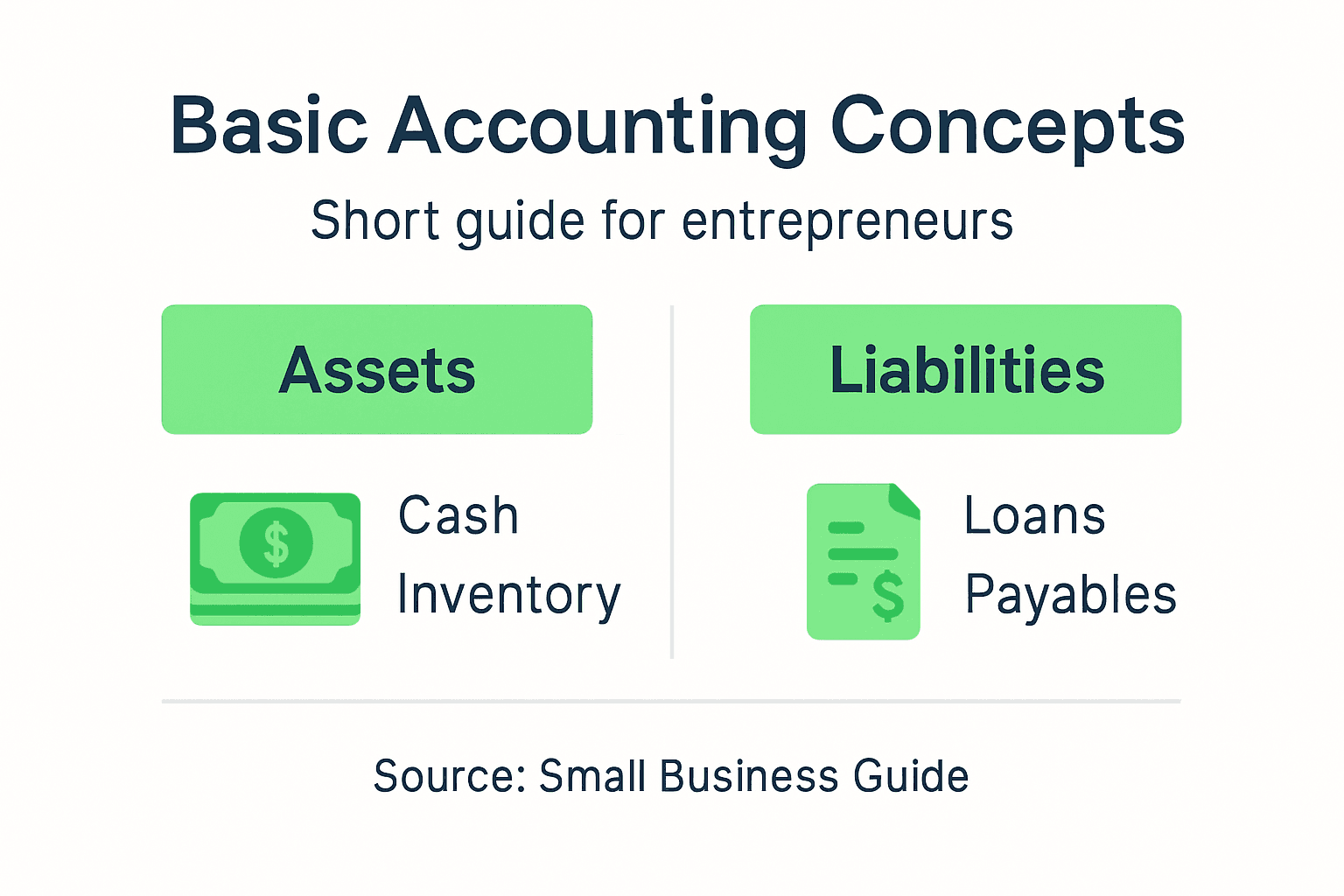
Three financial statements form your financial command center. The income statement shows profitability over a period by subtracting expenses from revenue. Your balance sheet provides a snapshot of assets, liabilities, and equity at a specific moment. The cash flow statement tracks actual money movement, revealing how operations, investing, and financing activities affect your bank balance.
Reading these statements isn’t complicated once you understand the logic. Your income statement answers “Did we make money?” The balance sheet tells you “What do we own and owe?” Cash flow explains “Can we pay our bills?” Each statement serves a distinct purpose in understanding business health.
Accurate classification of assets, liabilities, and revenues impacts business valuation and credit decisions. Lenders and investors scrutinize these categories to assess risk. Mislabeling a loan payment as an expense instead of a liability reduction distorts your financial picture and can cost you funding opportunities.
Pro Tip: Review all three statements monthly, not just your bank balance. Cash can look healthy while profit margins shrink, or vice versa. Understanding key financial metrics for founders helps you track what truly matters for growth. Avoiding common accounting blindspots prevents expensive mistakes.
Comparison of Accounting Methods: Cash vs Accrual
You have two primary accounting methods to choose from, and the decision affects how you record transactions. Cash basis accounting records income when money hits your account and expenses when you pay them. It’s straightforward and matches your bank statements perfectly. Accrual basis records revenue when earned and expenses when incurred, regardless of cash movement.

60% of small businesses use cash basis accounting due to its simplicity. The IRS allows most small businesses to use this method, making it ideal for service businesses without significant inventory. You see exactly what cash you have available, which helps with immediate decision making. Tax reporting becomes simpler because you only report actual cash received.
Accrual accounting provides a more accurate financial picture for growing businesses. If you invoice clients with 30-day payment terms, accrual records that revenue immediately rather than waiting for payment. This method shows true business performance by matching revenues with related expenses in the same period. Companies with inventory or complex operations benefit from this clarity.
| Feature | Cash Basis | Accrual Basis |
|---|---|---|
| Records transactions | When cash moves | When incurred or earned |
| Best for | Service businesses, startups | Inventory businesses, growing companies |
| Complexity | Simple, matches bank statements | More complex, requires tracking |
| Tax reporting | Straightforward | More detailed |
| Financial accuracy | Good for cash flow | Better for performance analysis |
Pro Tip: Start with cash basis if you’re a solo entrepreneur or small service provider. Switch to accrual when you carry inventory, extend credit to customers, or need more sophisticated financial analysis. Many businesses stick with cash basis throughout their lifecycle if it meets their needs. Understanding bootstrapping tips helps you manage finances efficiently regardless of your chosen method.
Common Misconceptions About Accounting for Entrepreneurs
Many entrepreneurs believe accounting is only necessary at tax time. This mindset creates financial blind spots that accumulate throughout the year. Accounting is a continuous process that informs daily decisions, not a once-yearly scramble. Regular bookkeeping reveals trends, catches errors early, and prevents cash flow surprises.
Another dangerous myth: “I’ll catch up on bookkeeping later.” Delaying bookkeeping increases tax errors and penalties by 30%. When you wait months to enter transactions, you forget context, lose receipts, and make classification mistakes. The IRS doesn’t care that you were busy building your business; they expect accurate records and timely filings.
Some founders assume they need expensive, complex software from day one. The truth? Simple tools work perfectly well for most startups. A basic spreadsheet beats no system at all. Free or inexpensive accounting software handles the needs of most small businesses. Complexity should match your business reality, not some imagined future state.
The biggest misconception might be that accounting requires specialized knowledge you don’t have. Yes, tax codes get complicated, but basic bookkeeping is learnable. You track money in, money out, and categorize transactions logically. Start simple, stay consistent, and learn as you grow. Recognizing startup accounting mistakes helps you avoid common pitfalls.
Pro Tip: Set aside 30 minutes weekly for bookkeeping rather than facing a monthly marathon. Weekly updates keep transactions fresh in your mind and catch problems while they’re still small. This habit transforms accounting from an overwhelming chore into a manageable routine. Debunking misconceptions in any business area starts with education and consistent practice.
Basic Tax Compliance and Accounting
U.S. tax compliance starts with choosing your accounting method for IRS purposes. Most small businesses qualify to use cash basis, but you must apply it consistently. The IRS requires businesses with inventory exceeding certain thresholds to use accrual accounting. Simplified compliance options exist for businesses under $25 million in average annual gross receipts.
Accurate record keeping protects you during audits and maximizes deductions. The IRS expects you to substantiate every expense claimed on your tax return. Keep receipts, invoices, bank statements, and mileage logs organized by category. Digital copies work fine; you don’t need boxes of paper receipts cluttering your office.
Penalties for improper compliance add up quickly. Late filing fees, accuracy penalties, and interest charges compound when you ignore deadlines or submit incomplete returns. The IRS takes a dim view of “I didn’t know” as an excuse. Self-employed individuals face quarterly estimated tax payments, and missing these triggers penalties even if you pay the full amount by year-end.
Simplified bookkeeping meets legal requirements without overwhelming complexity:
- Separate business and personal finances completely with dedicated accounts
- Categorize every transaction as it occurs using consistent labels
- Reconcile bank statements monthly to catch discrepancies
- Store digital copies of all financial documents for at least seven years
- Track mileage and home office use if you claim these deductions
Understanding business registration guidelines helps you start on solid legal footing. Different business structures have different tax implications, so choose wisely from the beginning. Some entrepreneurs also benefit from understanding capital gains tax guidelines when planning asset sales or investments.
Practical Tools and Tips for Basic Accounting Setup
Early adoption of accounting software saves time and reduces errors compared to manual tracking. Start with user-friendly options designed for small businesses. Look for features that match your needs: invoice creation, expense tracking, bank integration, and basic reporting. Many platforms offer free tiers perfect for solo entrepreneurs.
Setting up your bookkeeping system requires these essential steps:
- Open a dedicated business bank account and credit card
- Choose accounting software or create a structured spreadsheet
- Establish a chart of accounts with consistent expense categories
- Link bank accounts for automatic transaction imports
- Set a recurring calendar reminder for weekly bookkeeping time
- Reconcile accounts monthly to ensure records match statements
Routine financial reviews prevent small issues from becoming big problems. Check your cash balance weekly to avoid overdrafts. Review your income statement monthly to spot revenue trends or expense spikes. Quarterly reviews help you assess progress toward annual goals and adjust strategies accordingly.
Know when to call in professional help. Complex tax situations, multi-state operations, or rapid growth often require expert guidance. Hiring a bookkeeper for monthly cleanup costs less than fixing a year’s worth of mistakes. Tax accountants earn their fees by finding legitimate deductions you’d miss and keeping you compliant.
Pro Tip: Automate what you can, but review everything. Software can miscategorize transactions or duplicate entries. A quick weekly scan catches these errors before they multiply. The startup validation guide emphasizes building solid operational foundations, and accounting systems are part of that base. Exploring small business accounting tools helps you find solutions that fit your workflow.
Conceptual Framework: The Accounting Cycle
Following the accounting cycle ensures accurate financial statements and systematic bookkeeping. This five-step framework organizes how you process financial information from transaction to report. Understanding this cycle helps you see accounting as a logical sequence rather than random tasks.
-
Analyze transactions: Examine each business event to determine its financial impact. A sale increases revenue and either cash or accounts receivable. A supply purchase decreases cash and increases expenses.
-
Record journal entries: Document each transaction with debits and credits in your accounting journal. This creates a chronological record of all financial activities with supporting details.
-
Post to ledger accounts: Transfer journal entries to individual account ledgers, organizing transactions by category. This step groups all rent expenses together, all sales together, and so forth.
-
Prepare trial balance: Sum all ledger accounts to verify that total debits equal total credits. This mathematical check catches many recording errors before they reach financial statements.
-
Generate financial statements: Create your income statement, balance sheet, and cash flow statement from the balanced ledger accounts. These reports now accurately reflect your business performance.
| Step | Purpose | Output |
|---|---|---|
| Analyze Transactions | Identify financial impact | Transaction understanding |
| Record Journal Entries | Create chronological record | Detailed transaction log |
| Post to Ledger | Organize by account type | Categorized transactions |
| Trial Balance | Verify mathematical accuracy | Balanced account totals |
| Financial Statements | Summarize business performance | Income statement, balance sheet, cash flow |
This structured process builds reliability into your financial records. Each step depends on the previous one being done correctly. When you follow the cycle consistently, your financial statements become trustworthy tools for decision making rather than questionable guesses. The startup business model insights you gain from solid financial data inform strategic pivots and growth investments.
Unlock Your Startup Potential with siift.ai
Accounting knowledge gives you financial control, but building a successful startup requires more. siift.ai’s Intelligent Business Canvas guides you through ideation, validation, and go-to-market strategies with personalized feedback. Our platform helps you transform ideas into viable businesses by filtering out biases, blindspots, and uncertainty. Access our business model canvas guide to structure your thinking and the startup validation guide to test assumptions before investing heavily. Visit siift.ai to accelerate your founder’s journey with AI-powered insights that complement your financial discipline.
Frequently Asked Questions About Basic Accounting for Entrepreneurs
What is the best accounting method for a new entrepreneur?
Cash basis accounting works best for most new entrepreneurs because it’s simple and matches your actual cash position. You record income when money arrives and expenses when you pay them, making it easy to understand and maintain. Service-based businesses particularly benefit from this straightforward approach.
How often should I update my bookkeeping records?
Update your books weekly for best results. This frequent cadence keeps transactions fresh in your memory and prevents overwhelming backlogs. Monthly updates work if your transaction volume is low, but never let more than a month pass without recording activity.
Do I need expensive software to start accounting?
No, expensive software isn’t necessary for basic accounting. Free or low-cost options like Wave, QuickBooks Self-Employed, or even structured spreadsheets handle most startup needs perfectly. Choose tools that match your current complexity rather than anticipated future needs.
What financial statements should every entrepreneur understand?
Master three core statements: the income statement showing profitability, the balance sheet displaying assets and liabilities, and the cash flow statement tracking money movement. Understanding how to read and interpret these three reports gives you complete visibility into business health.
When should I consult a professional accountant?
Consult a professional when facing complex tax situations, rapid growth, multi-state operations, or audit concerns. Annual tax preparation also benefits from expert review to maximize deductions and ensure compliance. If you’re spending more time confused about accounting than running your business, that’s your signal to get help.
Recommended
- Best Way to Track Business Expenses – Expert Comparison 2025 | siift
- Journaling for Entrepreneurs: Simple Steps to Start Strong | siift
- Validate Business Ideas: Guide for First-Time Founders (2026)
- Business Communication Skills for Aspiring Entrepreneurs 2025 | siift
- Rôle d’Airtable dans l’automatisation PME moderne - LMM CONNECT