
TL;DR:
- Most startup failures stem from poor planning rather than lack of passion or effort.
- AI tools enable founders to create, update, and validate business plans more quickly and effectively, reducing risks before market entry.
Most new ventures don’t fail because the founder lacked passion or worked too few hours. They fail because nobody planned for the hard questions: Who actually wants this? How do we make money? What happens when cash runs tight? About 20% of small businesses close within their first year, and roughly half are gone by year five. The good news is that a well-built business plan directly addresses these risks, and today’s AI tools make that process faster, smarter, and far more accessible than it has ever been before.
Table of Contents
- Why business plans matter and how AI changes the game
- Types of business plans: traditional, lean, and AI-assisted
- Step-by-step: Building each section of your business plan
- Common mistakes and how to avoid them
- Launching with confidence: Using your plan as a roadmap
- Perspective: Why most business plan advice falls short and how to get ahead
- Ready to build your business plan with AI?
- Frequently asked questions
Key Takeaways
| Point | Details |
|---|---|
| Planning prevents failure | Well-structured business plans address the top causes of startup failure and boost success odds. |
| Choose the right format | Lean plans are ideal for speed and learning, while traditional plans are needed for raising capital. |
| Let AI do the heavy lifting | AI tools can automate research, structure, and draft sections so you launch faster and smarter. |
| Avoid common pitfalls | Validate demand, research competition, and revisit your plan often to stay on track. |
| Your plan is a living roadmap | Update it regularly to adapt as your business and market evolve. |
Why business plans matter and how AI changes the game
Planning isn’t bureaucratic busywork. It’s the act of forcing clarity before you spend money, time, and energy on something that may not work. A business plan pushes you to examine the real demand for your idea, model your cash position, and stress-test your assumptions before the market does it for you.
The data is sobering but instructive. Top causes of startup failure include no market need (42%), cash flow issues (29 to 38%), and a weak team (23%). Each of these is a planning problem disguised as a product problem. When you work through a solid plan, you’re forced to answer: does anyone actually need this, how do I sustain cash through early growth, and do I have the right people around me?
Here’s where AI changes everything. Founders who once spent weeks wrestling with market research, financial templates, and competitive analysis can now use AI tools for founders to generate a first draft in hours. AI accelerates the research phase, helps you structure arguments logically, and flags gaps you might have missed. It doesn’t replace your judgment. It amplifies it.
What a business plan helps you do:
- Validate or reject your core assumptions before spending money
- Map a realistic revenue model and cash flow timeline
- Articulate your value proposition for customers and investors
- Create a shared reference point for your team or co-founder
- Build investor confidence with a structured, defensible strategy
| Planning activity | Without AI | With AI tools |
|---|---|---|
| Market research | 1 to 2 weeks | 1 to 3 days |
| First draft outline | 3 to 5 days | Under 1 hour |
| SWOT analysis | Half a day | 20 minutes |
| Financial projections | 1 week | 1 to 2 days |
| Revisions | Days per round | Hours per round |
Pro Tip: Don’t wait until your plan is perfect to start using it. A rough draft that you actively question and update is worth far more than a polished document sitting in a drawer.
Good decision-making best practices tell us that structured thinking before action always beats reactive decisions made under pressure. A business plan is exactly that kind of structured thinking, built before the chaos of launch begins.
Types of business plans: traditional, lean, and AI-assisted
Not every business needs a 40-page document before it can move forward. Understanding which format matches your stage and goals is critical to getting value from the planning process without drowning in it.
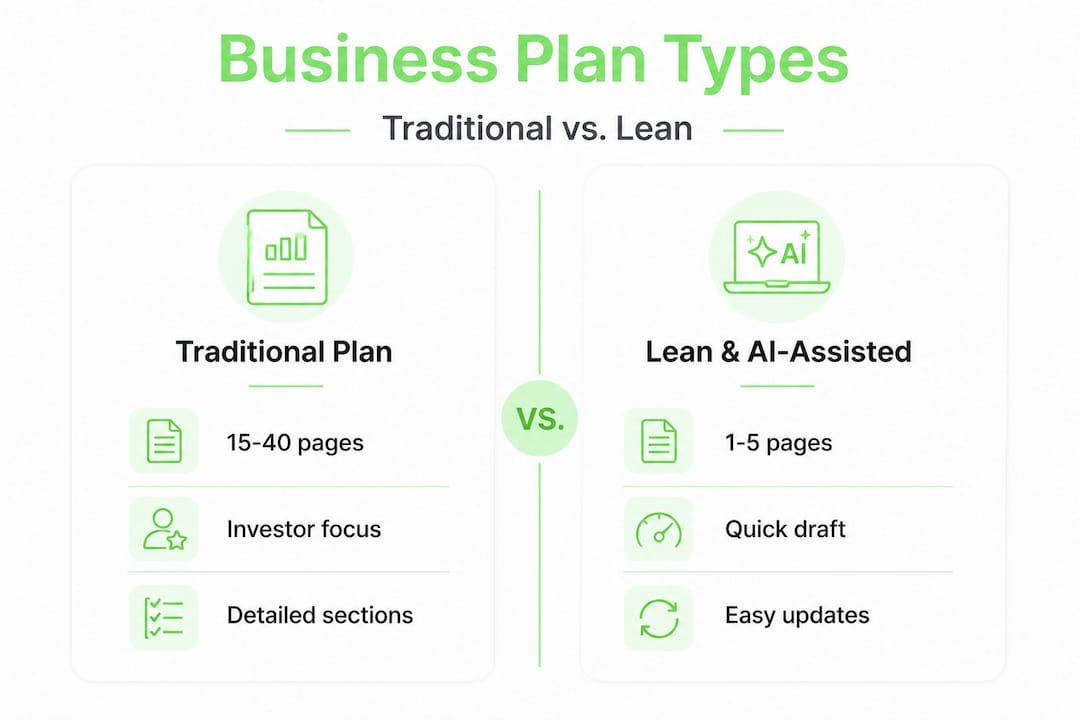
Traditional business plans are the classic investor-ready format. According to the SBA’s business plan guide, a standard plan includes nine key sections: executive summary, company description, market analysis, organization and management, products or services, marketing and sales strategy, funding request, financial projections, and appendix. These documents typically run 15 to 50 pages and are built for situations where you need to present to banks, angel investors, or venture capital firms.

Lean business plans flip the script. Instead of exhaustive documentation, a lean plan captures just the essentials: your value proposition, target market, revenue model, key costs, and near-term milestones, all on one to five pages. This format is rooted in lean startup methodology, the idea that you should test, learn, and iterate rather than plan in isolation for months. For side hustlers and first-time founders, the lean plan is often the smarter starting point.
AI-assisted plans are the emerging hybrid. Platforms built specifically for entrepreneurs use AI to guide you through ideation, validate your assumptions against real market signals, and generate structured output in either traditional or lean format depending on your needs. You get the speed of lean with the rigor of traditional, scaled to your current stage.
“The best plan is the one you’ll actually use. Start lean, build depth as your confidence in the market grows, and never stop questioning your own assumptions.”
| Format | Best for | Typical length | Key advantage |
|---|---|---|---|
| Traditional | Funding, formal pitches | 15 to 50 pages | Investor credibility |
| Lean | Validation, side hustles | 1 to 5 pages | Speed and flexibility |
| AI-assisted | All stages | Variable | Guided and iterative |
Pro Tip: If you’re building a side hustle or validating a new idea, start with a lean plan using an AI tool. Once you have early traction or are approaching investors, layer in the traditional sections. The best resources for building and validating a business plan follow exactly this progression.
Tools built specifically for founders, like the best AI tools for solopreneurs, are designed to guide you through this evolution without requiring you to know everything upfront.
Step-by-step: Building each section of your business plan
Each section of your plan has a specific job to do. Skipping one or treating it as filler creates gaps that will surface later at the worst possible time.
-
Executive summary. Write this last, even though it appears first. It’s a one to two page snapshot of everything else. Your business concept, the problem you solve, the market size, your revenue model, and your funding ask (if applicable) all belong here. Use AI to synthesize your other sections into a clean, compelling summary once the rest is drafted.
-
Company description. Explain what your business does, who it serves, and what makes it different. Be specific. “We serve small retail businesses in the Midwest that need affordable inventory software” is far stronger than “we serve small businesses.”
-
Market analysis. This is where many plans fall apart. You need real data: total addressable market (TAM), target segment size, customer behaviors, and trends. AI tools can pull and synthesize market research quickly, but verify the figures through primary sources. This section must prove there is real, paying demand.
-
Organization and management. List your team, their relevant experience, and any advisors. If you’re a solo founder, be honest about gaps and show how you plan to address them, whether through hiring, advisors, or partnerships.
-
Products or services. Describe what you offer, how it works, and why it’s better or different. Include your pricing model and any IP or proprietary advantages you hold. Connect features directly to customer problems.
-
Marketing and sales strategy. How will customers find you? How will you convert them? Map out your key channels (organic search, paid ads, referrals, partnerships) and your sales funnel. Use AI to help model customer acquisition costs and lifetime value estimates.
-
Funding request. Only include this if you’re seeking outside investment. Specify how much you need, over what period, and exactly how you’ll use it. Vague funding asks destroy credibility with investors.
-
Financial projections. Build a three-year forecast with revenue, costs, gross margin, and cash flow. Use AI tools for entrepreneurs to generate initial templates, then stress-test the assumptions. The numbers don’t have to be perfect, but the logic must hold.
-
Appendix. Include supporting documents: market research sources, team resumes, product screenshots, letters of intent, or legal documents. Think of it as the evidence locker for every claim you make in the plan.
“Your competitive advantage isn’t just what you do—it’s the unique combination of how you do it, for whom, and why they’ll choose you over a well-funded alternative.”
The best AI tools for founders in 2026 can help you draft each section in sequence, then review the whole for consistency. That kind of systematic, guided approach is what separates founders who launch with clarity from those who pivot endlessly without progress.
Common mistakes and how to avoid them
Even founders who commit to writing a plan make costly errors that undermine the whole effort. Knowing the traps in advance means you can sidestep them before they cost you real money.
The most common pitfalls include:
- The Field of Dreams fallacy. Assuming that if you build it, customers will come. Plans must prove market need, not just assert it. Demand assumptions need to be backed by surveys, interviews, or early pre-sales, not wishful thinking.
- Ignoring the competition. Every market has competition, even if the product is new. Ignoring competitors in your plan signals naivety to investors and blinds you to real threats in the field.
- Overcorrecting into product obsession. Founders often spend 80% of their plan describing features instead of demonstrating market fit. A long product description with a thin market section tells the reader you’re in love with what you built, not with solving a customer problem.
- Unrealistic financial projections. “Conservative” hockey-stick projections are still hockey sticks. Ground your numbers in comparable companies, industry benchmarks, and realistic conversion rates.
- Treating the plan as finished. A plan that sits unchanged for 12 months is no longer a guide. It’s a relic.
Pro Tip: Run your plan past someone who will challenge it hard, not a supportive friend. The best stress-test comes from someone who will ask “so what?” after every major claim you make.
“A business plan is only as strong as its assumptions. If you can’t defend those assumptions out loud, they need more work.”
Resources like startup mistakes to avoid offer real-world examples of how these errors play out, so you can recognize them in your own plan before they become expensive lessons.
Launching with confidence: Using your plan as a roadmap
A business plan is not a deliverable you submit and forget. It’s the living document that guides every consequential decision you make from launch through early scale.
Here’s how to put your plan to work:
- Set milestones, then measure against them. Your plan should include 30, 60, and 90-day goals. Track actuals against projections weekly. Gaps aren’t failures. They’re data points telling you where to adjust.
- Use it to onboard your team. When you hire your first employee or bring on a co-founder, your plan becomes the clearest introduction to your vision, strategy, and priorities. It builds alignment faster than any meeting.
- Revisit whenever the market shifts. New competitors, pricing pressure, a pivot in your product, or a funding conversation all warrant a plan review. The SBA recommends treating your plan as a living document, updating it regularly as your business evolves.
- Anchor fundraising conversations. Investors don’t just evaluate ideas. They evaluate your ability to think clearly under uncertainty. A well-maintained, updated business plan signals that you’re the kind of founder who learns and adapts.
- Use AI to accelerate each update. Tools built for AI business strategy for startups make it fast to re-run market analysis, update financial models, and rethink your go-to-market approach as new information arrives.
When you pair your plan with the right tools for AI for MVP planning, you move from planning to execution without losing the strategic clarity you built. That’s how founders find product-market fit faster. And the decision intelligence frameworks that drive smart SMB decisions all start from exactly this kind of structured, evidence-based thinking.
Perspective: Why most business plan advice falls short and how to get ahead
Here’s something most guides won’t tell you: the document itself is rarely what creates success. The thinking behind it is.
Most business plan templates hand you blank boxes to fill in. They reward completeness over clarity, length over insight. Founders dutifully fill them out, submit them to investors or a mentor, and then never look at them again. That’s not planning. That’s performance.
The founders who actually use their plans as competitive weapons treat them differently. They update them monthly, sometimes weekly during crunch periods. They use AI not just to generate content faster, but to surface the blind spots their own optimism creates. When an AI-driven startup tool tells you your revenue assumptions require a 15% month-over-month conversion rate in a market where 2% is typical, that’s not discouraging. That’s clarifying. It points you toward a better strategy before you’ve burned through your runway.
The real competitive advantage isn’t having a plan. It’s having a founder who genuinely uses their plan to make sharper decisions faster than everyone else in the market. AI makes that possible in a way that wasn’t realistic even three years ago. The tools exist. The question is whether you’ll treat your business plan as a living instrument of strategy, or as a document you write once, file away, and reference only when someone asks to see it. The founders who choose the former are the ones who find traction. Full stop.
Ready to build your business plan with AI?
Building a business plan used to mean weeks of grinding through templates, guessing at market data, and hoping your financial projections passed the sniff test. That era is over. At siift.ai, we’ve built a New Business OS that guides founders step by step through ideation, validation, and go-to-market strategy, systematically, using agentic AI that adapts to your specific idea and market. It filters out the biases, blind spots, and uncertainty that derail most early-stage ventures. Whether you’re starting from a napkin sketch or refining a lean plan for your first funding conversation, siift helps you build a holistic, validated strategy faster than any generic tool can.
Frequently asked questions
What is the most important part of a business plan?
The market analysis section is widely considered most critical, because it proves real demand for your idea rather than assuming buyers will appear automatically.
How long should a lean business plan be?
A lean plan is typically 1 to 5 pages, summarizing your value proposition, target market, revenue model, key costs, and near-term milestones for fast iteration.
Can AI really help with business plans for new founders?
Yes. AI can speed up market research, structure your outline, and flag weak assumptions, helping first-timers avoid classic mistakes while iterating much faster toward a validated strategy.
How often should I update my business plan?
Refresh your plan at least once a quarter, or immediately after any significant market shift, pivot, or new funding conversation, treating it as the living document it’s meant to be.
Recommended
- Build Your Business Plan: Siift.ai’s Guide to Launching in 2026
- Master Business Strategy to Launch Your AI Venture | siift
- Business Strategy AI for Startups: Smarter Growth Strategies
- AI Tools for First-Time Founders: Startup Success | siift
- AI strategies that actually build competitive advantage – Blue Prysm – Articles & Blogs