
TL;DR:
- Risk assessment involves systematically identifying, evaluating, and prioritizing potential threats to make informed startup decisions. It turns vague concerns into a clear, actionable plan to focus resources on the most impactful and probable risks. Embracing uncertainty and regularly updating assessments provide a competitive advantage and increase resilience.
Most entrepreneurs think risk assessment means writing a list of things that could go wrong. That’s a bit like thinking a map is just a drawing of roads. Risk assessment is actually a structured process of identifying possible risks, estimating how likely and severe each one is, and turning that uncertainty into decisions you can act on. Get it wrong and you’re guessing. Get it right and you’re running a smarter startup than 90% of your competitors, because you know exactly where to focus your limited time and money before the market punishes you for not knowing.
Table of Contents
- What is risk assessment? Breaking down the basics
- How risk assessment works: The step-by-step process entrepreneurs need
- Beyond hazards: Understanding uncertainty and prioritization in risk assessment
- Applying risk assessment to your startup: Practical examples and tips
- Common pitfalls entrepreneurs face in risk assessment and how to avoid them
- The overlooked power of risk assessment: Why founders who embrace uncertainty win
- How siift.ai supports founders in mastering risk assessment and derisking startup success
- Frequently asked questions
Key Takeaways
| Point | Details |
|---|---|
| Risk assessment essentials | Risk assessment involves identifying risks, estimating how likely they are, and understanding their potential impact to make informed decisions. |
| Practical five-step process | A clear stepwise process helps entrepreneurs identify hazards, evaluate risks, record findings, and update regularly. |
| Uncertainty matters | Documenting what you don’t know is vital for resilient decision-making and adapting as new information appears. |
| Prioritization saves resources | Consistent rating scales allow founders to focus efforts on the risks that threaten their business most. |
| Mindset is a competitive edge | Embracing and managing uncertainty strategically distinguishes startups that thrive from those that stumble. |
What is risk assessment? Breaking down the basics
Let’s clear up the basics by defining exactly what risk assessment means, so you can approach it with confidence.
The formal risk assessment definition is this: it is the process of identifying possible risks, calculating how likely they are to happen, and estimating what effects they might have, especially in the context of a company taking responsibility for the safety of its employees or members of the public. For entrepreneurs, that last part matters more than you might think. You are responsible, whether for a team of two or twenty, for the decisions that shape their livelihoods and your customers’ experience.
Risk assessment is built on three core elements:
- Identification: Spotting every potential threat your startup faces, from cash flow problems to regulatory gaps to a competitor cutting prices by 40%
- Likelihood estimation: Assessing how probable each risk actually is, not based on gut feeling, but based on evidence and logic
- Impact evaluation: Measuring how badly each risk would hurt your business if it materialized, financially, operationally, or reputationally
What makes this process valuable is that it converts vague anxiety into a ranked priority list. Instead of worrying about everything at once, you know which threats deserve attention this week and which ones you can monitor from a distance. For a deeper look at how this fits into your broader startup planning, understanding risk management for startups is a great companion read.
How risk assessment works: The step-by-step process entrepreneurs need
Now that we’ve defined risk assessment, here’s a practical way to actually perform it step-by-step.
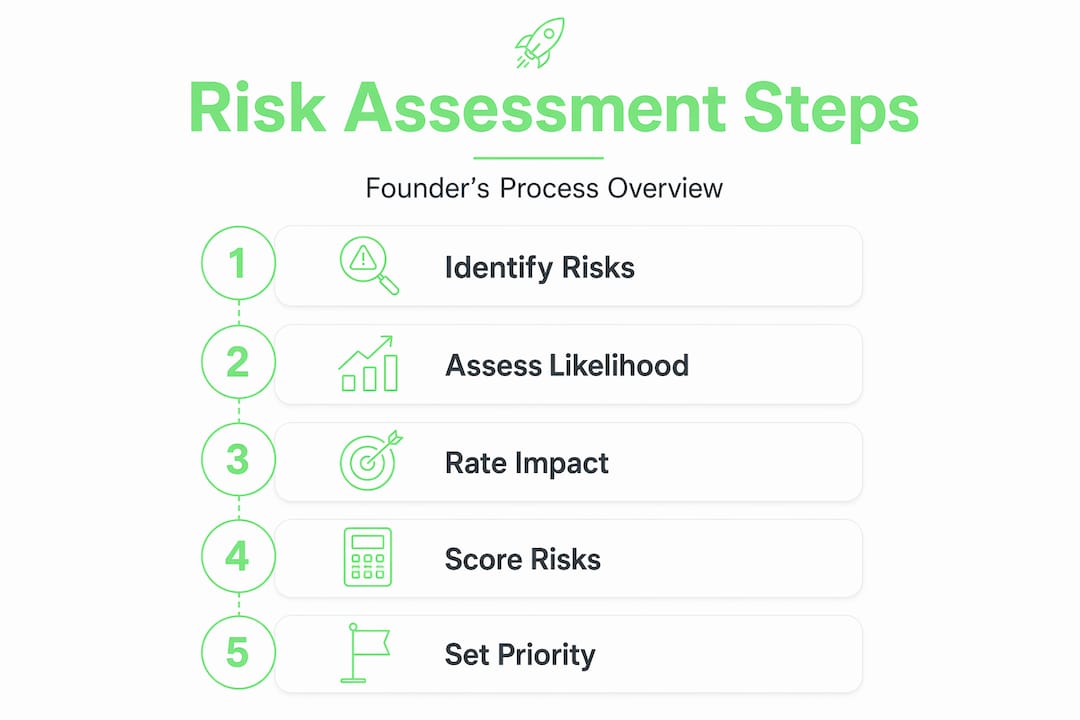
The UK Health and Safety Executive describes a five-step risk assessment workflow that applies remarkably well to startups, not just physical workplaces. It does not need to be complicated or technical. It needs to be “suitable and sufficient.” Here is how to run through it:
- Identify the hazards. What could go wrong in your startup? Think across every dimension: finances, team, technology, market, legal, and operations. Cast a wide net before narrowing down.
- Decide who or what could be harmed and how. In a startup context, this means your customers, co-founders, investors, and the business itself. A data breach harms customers and tanks your reputation. A co-founder departure harms delivery timelines and morale.
- Evaluate the risks. Assign each identified risk a likelihood score and an impact score. Use a simple scale, like 1 to 5 for each, and multiply them to get a risk score. Higher scores demand faster action.
- Record your findings. Write it down. A risk assessment that lives only in someone’s head is useless. Documentation creates accountability and a shared understanding across your team.
- Review and update regularly. Your startup is not static. A product pivot, a new hire, or a funding round all introduce new risks. Revisit your assessment after any major change.
Pro Tip: Define your scales explicitly before you start scoring. Decide in advance that “high likelihood” means it could realistically happen within the next six months, and “high impact” means it would cause a loss of more than 20% of revenue or a critical delay. Vague labels produce inconsistent scores and bad priorities. For more on making this actionable, see the best ways to derisk your business and how to derisk your business step by step.
Beyond hazards: Understanding uncertainty and prioritization in risk assessment
With the core process outlined, let’s dive into some crucial conceptual distinctions that often trip founders up.
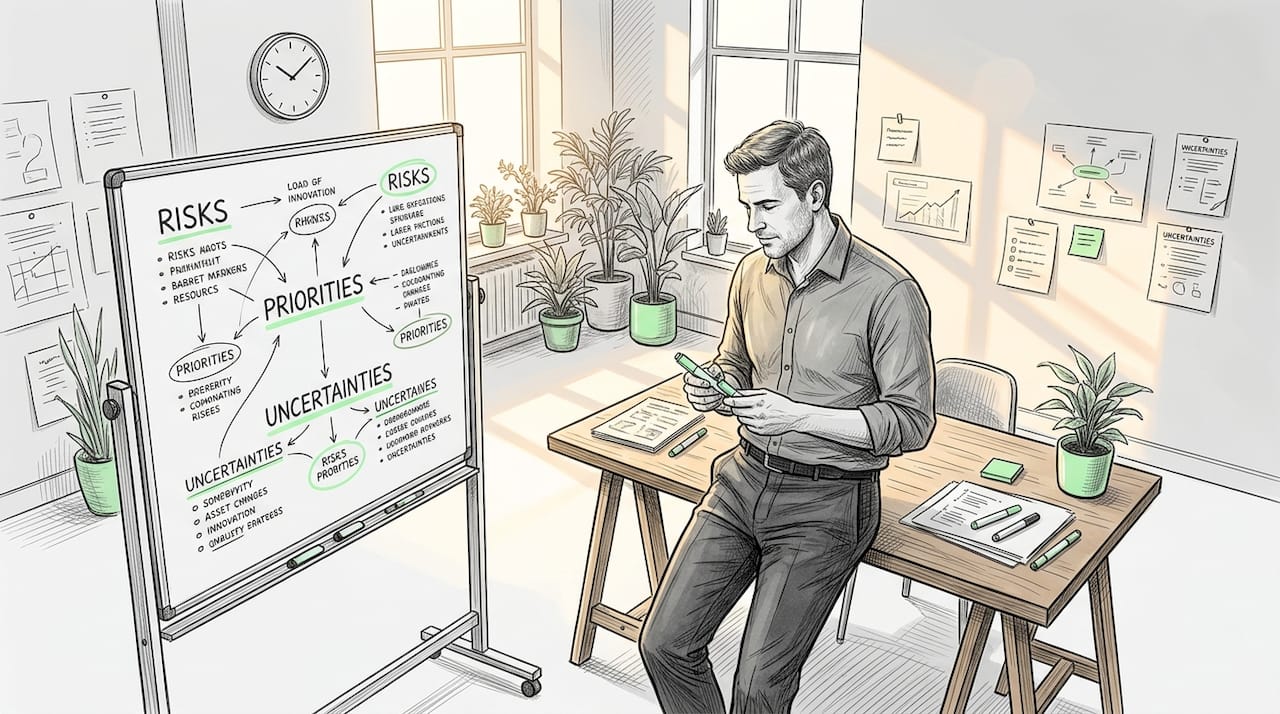
Here is one of the most common and costly mistakes in startup risk planning: conflating a hazard with a risk. A hazard is a source of potential harm. Risk is the probability that the harm actually occurs, combined with how severe that harm would be. As Splunk puts it, entrepreneurs should avoid confusing “what could hurt us” with “how likely and how bad it is.” Treating every hazard as a crisis is how founders burn out chasing shadows.
Think of it this way. A cybersecurity vulnerability in your platform is a hazard. The risk is determined by how likely it is to be exploited and how badly it would damage your business if it were. A startup with no sensitive customer data faces a very different risk level than a fintech app handling payment information, even if both have the same technical vulnerability.
“Risk assessment includes characterization of uncertainties — meaning you must document what you don’t know: data gaps, assumptions, and edge cases, so you can revisit decisions as evidence improves.” NCBI Bookshelf
That quote is important. Uncertainty is not a flaw in your risk assessment. It is a required output. When you document what you don’t yet know, you create a living signal for where to focus future research and where to build in extra flexibility. The risks you understand the least are often the ones that hurt the most.
Practical ways to prioritize using this lens:
- Rank risks by their combined likelihood and impact scores
- Flag risks with high uncertainty separately so they get closer monitoring
- Allocate the bulk of your mitigation resources to high-score, low-uncertainty risks first
- Treat high-uncertainty risks as open questions to resolve, not problems to ignore
For a deeper look at how this applies to your go-to-market and product strategy, the derisk startup strategy guide is worth your time. And for a broader view of how hazards versus risks in software development play out in practice, that context translates well to most startup environments.
Applying risk assessment to your startup: Practical examples and tips
Let’s put this all into practice with clear examples and tips that will help you make risk assessment a usable tool in your startup.
GovRAMP frames risk assessment as a structured process that turns uncertainty into a plan, not just a list of concerns. That reframe matters. The output of a good risk assessment is not a document that makes you anxious. It is a decision-ready priority list that tells you where to act first.
Start by identifying the risks most common to early-stage startups:
- Financial mismanagement: Running out of runway before achieving product-market fit
- Market competition: A better-funded competitor targeting your exact customer segment
- Cybersecurity threats: Data breaches, phishing attacks, or ransomware affecting your operations
- Legal compliance gaps: Missing permits, intellectual property issues, or GDPR-style data regulations
- Team instability: Key person dependency, co-founder conflicts, or early employee turnover
Once you have your list, score each risk using a simple likelihood-impact table. Here is an example:
| Risk | Likelihood (1-5) | Impact (1-5) | Risk score | Priority |
|---|---|---|---|---|
| Running out of runway | 4 | 5 | 20 | Critical |
| Key employee departure | 3 | 4 | 12 | High |
| Cybersecurity breach | 2 | 5 | 10 | High |
| Competitor price cut | 3 | 3 | 9 | Medium |
| Legal compliance gap | 2 | 4 | 8 | Medium |
This kind of table is not just useful. It is the difference between panicking and planning. Running out of runway scores as critical, so that is where your mitigation effort goes first. You can explore practical ways to reduce startup risk to match specific mitigation strategies to these types of threats.
Pro Tip: Do not try to do this manually every quarter. AI transforming risk management is no longer a concept reserved for large enterprises. AI-powered tools can flag emerging risks in real time, saving you hours and surfacing blind spots you would never catch manually. Pair that with human judgment, and you have a dynamic, continuously updated risk picture. See how using AI for startup risk management can transform your process.
Common pitfalls entrepreneurs face in risk assessment and how to avoid them
Before we wrap up the practical advice, let’s look at common mistakes and how to dodge them so your risk assessment actually works for you.
Even founders who commit to doing a risk assessment often undermine themselves with avoidable errors. The UK HSE notes that entrepreneurs frequently do an informal threat brainstorm but skip defining likelihood and impact scales, which is the critical step that makes prioritization consistent and defensible.
Here are the most damaging pitfalls, and how to sidestep each one:
- Undefined scoring scales: If “high” means different things to different team members, your risk scores are meaningless. Define your scale before your first session and write it down.
- Confusing hazards and risks: Listing every hazard as a critical risk leads to wasted resources on unlikely, low-impact threats. Always evaluate probability and severity separately.
- Ignoring documented uncertainty: Treating uncertainty as an annoyance instead of a documented output blocks your ability to revisit and refine decisions as your startup evolves. Write down what you don’t know.
- Overcomplicating the process: A 40-page risk register is not better than a one-page table. Keep it suitable and sufficient, meaning it covers what matters without burying your team in process.
- Skipping updates after major changes: A risk assessment written at launch is obsolete after your first product pivot. Schedule a review after any significant business event.
“A risk assessment must be ‘suitable and sufficient’ and usually doesn’t need to be ‘complicated or technical.’” — UK HSE
That simplicity is liberating. You do not need a risk consultant or a 100-row spreadsheet. You need clarity, consistency, and the discipline to revisit your findings. If you are still shaping your idea and want to pressure-test it early, de-risking startup ideas from the ground up is a smart place to start.
The overlooked power of risk assessment: Why founders who embrace uncertainty win
With practical tips covered, here’s a mindset shift that can make risk assessment your secret weapon in startup success.
Most founders treat risk assessment the way they treat tax filing: a necessary obligation, done once a year under duress, checked off and forgotten. That is a missed opportunity. The founders who build resilient companies are not the ones who avoid uncertainty. They are the ones who map it explicitly and use that map to make better moves than everyone else.
Here is what the process actually forces you to do. It makes you articulate your assumptions. It makes you distinguish between what you know, what you think you know, and what you genuinely don’t know yet. That discipline, practiced regularly, sharpens your judgment in ways no business book or mentorship session can replicate.
GovRAMP describes risk assessment as turning uncertainty into a prioritized plan, providing decision-ready output rather than just a list of concerns. That framing is everything. A risk assessment is not a fear document. It is a confidence document, because it tells you exactly where you stand and what to do next.
The startups that struggle most are not the ones facing the most risk. They are the ones operating with the least awareness of it. Embracing uncertainty openly, documenting it, and building it into your planning cycle is a genuine competitive advantage in a landscape where most founders are flying blind.
Pro Tip: Schedule a 30-minute risk review into your monthly founder rhythm. Treat your uncertainties as live signals worth tracking, not problems to avoid thinking about. That habit alone puts you ahead of most early-stage teams. For a specific look at how this protects you personally as well as professionally, explore founder protection through risk management.
How siift.ai supports founders in mastering risk assessment and derisking startup success
Ready to make risk assessment easier and smarter? Here’s how siift.ai can help you stay ahead and derisk your startup journey smoothly.
At siift.ai, we built our platform specifically because founders deserve more than generic AI advice. Risk assessment is one of the most important things you can do for your startup, and it is also one of the easiest to do badly. siift’s New Business OS guides you through identifying, scoring, and prioritizing your risks in a structured, repeatable way, without the overwhelm of building everything from scratch. It integrates AI-powered insights to flag emerging risks as your business evolves, so your assessment stays current rather than collecting dust. Think of it as your always-on co-pilot for the uncertainty that every founder faces. Explore the best ways to derisk a business and learn how to master startup risk management with AI inside the platform.
Frequently asked questions
What is the difference between a hazard and a risk in risk assessment?
A hazard is a potential source of harm, while risk measures the chance that harm will occur and how severe it might be. Confusing the two leads founders to overreact to unlikely threats and miss the ones that actually matter.
How often should I review and update my startup’s risk assessment?
You should update your risk assessment regularly, and specifically after major events like product launches, funding rounds, or market shifts. Risk assessment procedures should be reviewed at least annually and following any significant organizational or threat changes.
Can risk assessment help reduce startup failure?
Yes. Risk assessments turn uncertainty into a prioritized action plan, helping founders address the most serious threats before they become fatal to the business.
What are common mistakes to avoid in risk assessment for startups?
The most damaging mistakes are confusing hazards with risks, skipping defined likelihood and impact scales, and failing to document uncertainties. Entrepreneurs often miss these foundational steps, which undermines the entire prioritization process.