
TL;DR:
- Most successful startups pivot multiple times to find true market fit.
- AI tools accelerate validation but need human insights for effective pivots.
- Strategic, evidence-based pivots lead to stronger, more adaptable startups.
You’ve spent months building something you believe in, but the traction just isn’t there. Customers aren’t converting, growth has plateaued, and the roadmap that once felt clear now feels like a dead end. Here’s the thing: most successful founders pivot at least once before finding true market fit, and pivoting isn’t a sign of failure. It’s a sign of adaptability. Today, AI tools make the validation process faster and less risky than ever. This guide walks you through what pivoting really means, when to do it, how to execute it well, and the mistakes that derail even the best founders.
Table of Contents
- What is pivoting? Exploring the main types
- Preparation: Validating the need for a pivot using AI tools
- Execution: The step-by-step process to pivot successfully
- Troubleshooting: Common mistakes and how to avoid them
- Verification: Measuring results and iterating after a pivot
- Why smart pivots build stronger startups: Lessons from real founders
- Take your next step: AI-powered startup intelligence
- Frequently asked questions
Key Takeaways
| Point | Details |
|---|---|
| Pivot types defined | There are eight main pivot types; finding the right one depends on evidence and your startup’s context. |
| AI validation accelerates pivots | AI tools can help validate pivot decisions quickly but must be paired with customer payment signals and feedback. |
| Avoid common pitfalls | Pivot based on evidence, not instinct, and keep your team aligned throughout the process. |
| Measure before pivoting again | Give each new direction three to six months and track clear metrics before considering another pivot. |
| Pivoting is adaptability | Successful founders treat pivots as strategic upgrades, not failures. |
What is pivoting? Exploring the main types
Pivoting means making a deliberate, evidence-based shift in your startup’s strategy, product focus, or target audience. Not a random change of direction out of frustration, but a structured response to what the market is telling you. The goal is always the same: find a path to real traction.
According to research on common pivot types, there are eight core categories every founder should know:
| Pivot type | What changes | Classic example |
|---|---|---|
| Zoom-in | A single feature becomes the whole product | Slack (from game to messaging) |
| Zoom-out | Product becomes one feature of something bigger | Instagram (from Burbn to photo sharing) |
| Customer segment | Same product, different audience | Targeting SMBs instead of enterprise |
| Customer need | Same audience, different problem solved | Shifting from CRM to analytics |
| Platform | App becomes a platform (or vice versa) | Opening an API to third parties |
| Business model | Freemium to subscription, or B2C to B2B | Moving from ads to SaaS pricing |
| Channel | Distribution method changes | Direct sales replaced by self-serve |
| Technology | Core tech stack or method changes | Moving from manual to AI-powered |
These eight pivot types cover virtually every strategic shift a startup might make, from narrowing scope to completely reimagining the business model.
Signals that a pivot may be necessary include:
- User engagement drops despite continued marketing spend
- Churn rates spike and retention conversations reveal unmet needs
- Sales cycles lengthen without a clear reason tied to execution
- Customers use your product differently than you intended
- A competitor captures your market with a fundamentally different approach
Data-driven pivots, particularly customer-based pivots grounded in segmentation research, are nearly twice as likely to succeed as those driven by gut instinct alone. The pattern is consistent: founders who listen to evidence, not ego, find their footing faster.
Preparation: Validating the need for a pivot using AI tools
Understanding pivot types is only half the equation. The harder question is: how do you know when to actually do it? Validation is everything here, and this is where AI tools genuinely change the game.
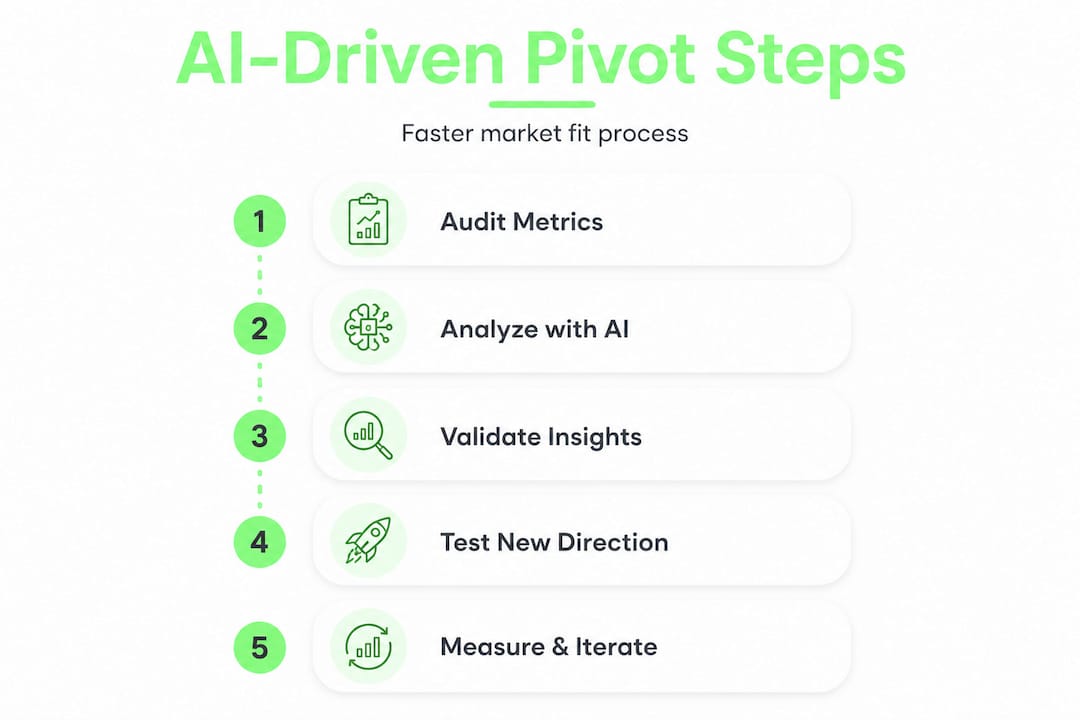
Start by auditing your core metrics. Lagging activation rates, declining net promoter scores, and stalled revenue growth are all objective signals. If those metrics are trending the wrong way despite solid execution, it’s time to investigate the underlying hypothesis, not just the tactics.

The Build-Measure-Learn loop is your operating framework here. Build a minimum viable product (MVP) to test a new hypothesis, measure the response with real users, and learn from what you observe before committing to a full pivot.
Here’s a practical validation sequence:
- Identify the assumption being challenged. Is it the customer segment, the core value proposition, or the distribution channel?
- Use AI tools for rapid market analysis. Platforms like best AI tools for startups can surface competitive gaps, sentiment trends, and demand signals in hours rather than weeks.
- Run structured customer interviews. Talk to 20 to 30 users with open-ended questions focused on their actual behavior, not their stated preferences.
- Automate surveys and A/B tests. AI-powered survey tools can segment responses and surface patterns you’d miss manually.
- Look for payment signals. Are users willing to pre-pay, upgrade, or refer others? Payment behavior is the most honest validation signal available.
The AI validation tools available today can dramatically compress research timelines. But there’s a critical caveat: AI accelerates evidence gathering, it doesn’t replace the human conversations that reveal emotional truth. A survey can tell you what customers say. A real conversation tells you what they actually feel.
Pro Tip: Use user interviews and surveys to validate AI-generated insights. If your AI analysis says demand exists in a new segment, confirm it with at least ten direct conversations before building anything new.
Execution: The step-by-step process to pivot successfully
Once evidence points clearly toward a pivot, execution becomes the priority. A pivot without a structured process often creates more confusion than it resolves, especially for your team and early customers.
“Successful pivots leverage prior learnings and align with mission. The goal is not to abandon what you’ve built but to redirect it toward a more promising path.”
Follow this execution sequence:
- Define the new hypothesis clearly. Write it down: “We believe [customer X] will pay for [solution Y] because [evidence Z].”
- Build a focused MVP for the new direction. Keep it lean. The goal is learning, not perfection. Explore MVP prototyping with AI to move faster without overbuilding.
- Reset your metrics dashboard. Old KPIs may no longer apply. Define what success looks like for the new direction before you start measuring.
- Communicate transparently with your team. Misaligned teams are the silent killer of well-planned pivots. Involve key people early, explain the evidence, and give everyone a role in the new direction.
- Communicate externally with care. Customers and investors need context, not confusion. Frame the pivot as an evolution, not a retreat.
- Use AI tools to accelerate feedback loops. Deploy automated feedback collection, sentiment analysis, and usage tracking from day one of the new direction. Strong AI business applications can cut your feedback cycle from weeks to days.
- Track product iteration and market fit signals continuously. Engagement depth, retention curves, and referral rates are your early indicators.
Pro Tip: Give each new direction at least three to six months for meaningful data to accumulate. Pivoting again after six weeks because results aren’t explosive is a common and costly mistake.
Troubleshooting: Common mistakes and how to avoid them
Execution isn’t the end of the story. Even well-planned pivots get derailed by predictable, avoidable errors. Knowing what to watch for is half the battle.
The most common mistakes include:
- Pivoting on instinct, not evidence. Gut instinct fails consistently as a pivot trigger, per HBR research. If you can’t point to specific data, you’re not ready to pivot.
- Letting passion override the numbers. Founders often fall in love with their original idea and rationalize weak signals as temporary setbacks. Pivoting too late after exhausting resources is just as dangerous as pivoting too early without sufficient data.
- Confusing market signals. A slow quarter isn’t a pivot signal. A consistent, multi-month pattern of declining engagement across multiple cohorts is.
- Team misalignment. If your co-founder or key team members don’t understand or believe in the new direction, execution will suffer regardless of how good the strategy looks on paper.
- Pivoting too many times. As First Round Review notes, serial pivoting dilutes team passion and erodes investor confidence. Each pivot should be informed and intentional.
- Ignoring customer targeting mistakes like assuming a new segment is similar enough to your old one without fresh research.
The counterintuitive truth? Sometimes the right call is to persevere. If your core metrics are improving, even slowly, that’s a signal to stay the course and optimize rather than abandon ship. Use AI tools for product market fit to distinguish between a strategy that needs time and one that needs a fundamental change.
Pro Tip: Create a simple decision matrix before any pivot conversation. List your top five metrics and whether each is trending up, flat, or down. If three or more are declining over 90 days, the evidence supports a pivot conversation. If most are flat or improving, persevere and iterate.
Verification: Measuring results and iterating after a pivot
A pivot is only as good as the feedback loop you build around it. Once you’ve launched the new direction, disciplined measurement becomes your most important habit.
Key actions for the post-pivot verification phase:
- Reset your baseline. Day one of the new direction is your new zero. Old benchmarks from the previous strategy are irrelevant comparisons now.
- Track leading indicators weekly. Activation rate, session depth, and early retention are faster signals than revenue in the first 60 days.
- Use AI for rapid feedback analysis. Automated sentiment tools and tracking growth and metrics platforms can surface patterns across hundreds of user interactions simultaneously.
- Conduct regular check-ins with early adopters. The Build-Measure-Learn loop only works if the “learn” phase includes real human input, not just dashboard data.
- Celebrate small wins publicly. Team morale after a pivot is fragile. Visible progress, even minor, builds momentum and belief.
| Signal | What it means | Action |
|---|---|---|
| Activation rate rising | New direction resonates early | Double down, expand outreach |
| Retention flat after 30 days | Value not yet proven | Deepen onboarding, gather feedback |
| Referral rate increasing | Strong product-market signal | Accelerate getting early customers |
| Churn accelerating | Misalignment with new segment | Return to customer interviews |
Give yourself permission to iterate within the new direction before considering another pivot. Micro-adjustments to messaging, onboarding, or pricing often resolve what looks like a strategic problem.
Why smart pivots build stronger startups: Lessons from real founders
Here’s the perspective most pivot guides skip entirely: a pivot isn’t a reset. It’s an upgrade.
Every founder who has navigated a successful pivot will tell you the same thing. The learnings from the first direction, the customer conversations, the failed experiments, the product instincts built through iteration, all of that carries forward. You’re not starting over. You’re starting smarter.
The data is clear: only about 10% of startups reach meaningful scale without any pivot. The other 90% refine, redirect, and sometimes completely reimagine their original idea. That’s not a failure statistic. That’s a resilience pattern.
What AI tools for entrepreneurs genuinely change is the speed and cost of validation. What used to take three months of manual research can now take three weeks. But here’s the uncomfortable truth we see repeatedly: founders who rely entirely on AI-generated insights, without talking to real customers or watching real payment behavior, often pivot in the wrong direction faster. Speed without signal is just expensive noise.
The best founders we’ve seen use AI to accelerate the evidence-gathering process, then let human conversations confirm or challenge what the data suggests. That combination, machine speed with human depth, is what separates a strategic pivot from a panic move.
Take your next step: AI-powered startup intelligence
If you’re sensing that a pivot might be on the horizon, or you’re already mid-pivot and need a clearer framework, you don’t have to figure it out alone. siift’s founder’s intelligence platform is built specifically for this moment in your journey. It guides you step-by-step through ideation, validation, and go-to-market strategy, using agentic AI to filter out bias, blind spots, and the noise that slows most founders down. Whether you’re validating a new customer segment, stress-testing a new business model, or building your first post-pivot MVP, siift gives you the structured intelligence to move with confidence, not guesswork.
Frequently asked questions
How do I know if my startup needs to pivot?
Look for consistent, multi-month declines in core metrics like activation, retention, or revenue, then use AI tools and customer interviews to validate the signal before acting. Pivoting too early without sufficient data is as risky as waiting too long.
What AI tools help with pivoting?
Market research platforms, survey automation tools, A/B testing software, and customer segmentation tools all help you validate pivot hypotheses quickly and with less manual effort.
Should I pivot or persevere if metrics are improving?
If your main metrics are trending upward, even gradually, persevere and optimize rather than pivot. A pivot should be triggered by sustained negative trends, not impatience.
How long should I test a new direction after pivoting?
Give each new direction three to six months for meaningful data to accumulate before evaluating whether another strategic shift is warranted.
Is pivoting considered failure?
Pivoting is adaptability, not failure. As Eric Ries and First Round both document, the vast majority of successful founders pivot multiple times on the path to product-market fit.
Recommended
- How to Get Early Customers for My Startup With AI Tools | siift
- Master Business Strategy to Launch Your AI Venture | siift
- AI-Driven Strategy for Business: Launch 3x Faster with 3.7x ROI | siift
- 7 Essential AI Tools for Product Market Fit Success | siift
- Small Startups (1-20 Employees) | Outsprinter
- Innovate and Optimize: Harnessing AI and Analytics for Strategic Advantage | Singleclic